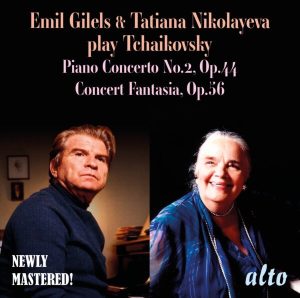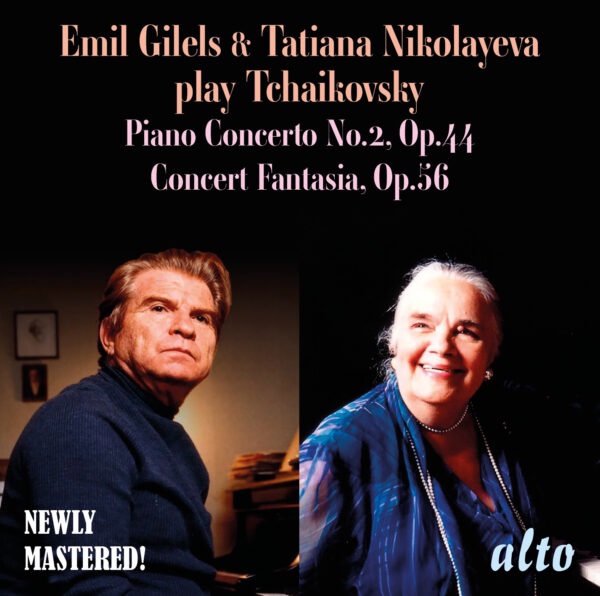
TCHAIKOVSKY: Piano Concerto No. 2; Concert Fantasy in G Minor – Emil Gilels,Tatiana Nikolayeva, piano/ USSR State Symphony Orchestra – Alto ALC 1711 (7/25) (64:35) [www.altocd.com] *****:
Taken from Soviet Melodiya LPs from 1952 (Concert Fantasy) and 1962 (Piano Concerto No. 2), these classic readings feature two eminent keyboard artists, Tatiana Nikoleyeva (1924-1993) and Emil Gilels (1916-1985) in the music of Tchaikovsky, both brilliantly assisted by veteran conductor Kyrill Kondrashin (1914-1981). While the concerto had an early apostle on records by way of Benno Moiseiwitsch and conductor George Weldon in 1944, a select few pianists have taken it up since Nikolayeva’s day, including Shura Cherkassky, Gary Graffman, and more recently Barry Douglas, Peter Donohoe, Mikhail Pletrnev, and Yuja Wang. The Concert Fantasy, on the contrary, has had fewer acolytes, among them Peter Donohoe, Barry Douglas, Dmitris Sgouros, and Konstantin Scherbakov.
As originally conceived, the glory of the Second Piano Concerto of 1881 lies in its second movement, Andante non troppo in D Major, whose broadly melodic texture had the violin and cello engaged enough to warrant calling the work a “triple concerto.” Objecting to the first two movements for their breadth and scoring, Editor Alexander Siloti (1863-1945) excised large portions of the second movement, creating the abridged edition favored in most performances, including this one by Gilels. The opening movement, Allegro brillante e molto vivace, proves a stentorian affair, rather martial in tone, with the piano and orchestra’s trading percussive sonorities that the flute interrupts with a consoling, secondary tune. The dramatic contour relies on Tchaikovsky’s operatic intuitions, juxtaposing mighty orchestral tuttis against lyrical meditations from the keyboard (and principal flute) that well remind us of coloratura arias. Gilels executes the huge roulades, runs, and extravagant filigree with polished aplomb, often projecting a potent sonority that rivals the thunder we hear from his contemporary, Sviatoslav Richter.
The designation molto espressivo permeates the realization of movement two, whose melodic tissue rises from an intimate musing to a passionate outcry. The introduction of violin and cello into the texture infuses the arioso quality with the decisive fervor we will experience again in Tchaikovsky’s Piano Trio in A Minor, Op. 50. An ominous transition marks the segue into the fervent Allegro con fuoco last movement, a volatile Russian dance sequence in 2/4. Gilels alters his sonority at times to achieve a music-box effect, while the Slavic rhythms suggest a hearty ballet interlude in the manner of a Cossack song and dance. Deftly controlling their cumulative momentum, Gilels and Kondrashin infuse a boisterous energy into the shifting, swaying moods of the occasion, as explosive as it is impulsively joyful. Only with the last notes of the coda do we realize the performance had been taped live.
While Tchaikovsky worked on his 1884 Third Orchestral Suite in G Major, Op. 55, his dissatisfaction with a movement meant to be called “Contrastes” led to his conception of the Concert Fantasia, Op. 56. The audacious piano part found its own inspiration from the playing of young Eugen d’Albert (1864-1932), whom Tchaikovsky heard in a Moscow concert. In two movements, Quasi rondo: Andante mosso and the aforementioned Contrastes. Tchaikovsky’s approach to the opening section, Quasi rondo, seems rather loose, since he gives the dancing, rondo theme but once, returning at the end as a (militant-sounding) concession to his format. Nikolayeva assaults the ferocious piano part with élan and alacrity, a startling combination of bombast, bravura, and silken poetry.
Tchaikovsky absorbs what would have served as a slow movement in a concerto by means of a piano solo cadenza, Andante cantabile, that asks a cello to provide balletic counterpoint for an extended, romantic ‘scena.’ The notion of “contrasts” operates effectively, with a rapid series of tempo fluctuations: Andante Cantabile – Molto Vivace – Vivacissimo – Allegro Moderato – Vivacissimo – Molto Piu Tranquillo – Vivace. A hearty dance emerges from the mix at 4:30, punctuated by winds, strings and brass as Nikoleyeva skittishly moves across the keyboard registers. Kondrashin invokes a kind of augmented “fate” motif that soon yields to a horn and wind adagio, that, too, succumbs to the dazzling gymnastics of the dance theme. A degree of repetition – which we have leaned to expect from Tchaikovsky – somewhat enervates the momentum; in fact, the music breaks off into a nostalgia Molto Piu Tranquillo that erupts precipitously into the final, mad dance rife with drunken Cossacks.
An energetic presentation of Russian classical piano artistry at its finest.
—Gary Lemco
Gilels and Nikolayeva play Tchaikovsky
Piano Concerto No. 2 in G Major, Op. 44
Emil Gilels, piano
Concert Fantasy in G Minor, Op. 56
Tatiana Nikolayeva, piano
USSR State Symphony Orchestra/ Kyrill Kondrashin