RAVEL: String Quartet in F Major; Menuet sur la nom d’Haydn (trans. Snyder); Menuet antique (trans. Snyder); Menuet in C-sharp minor (trans. Snyder); HAYDN: String Quartet in C Major, Op. 54, No. 2; STRAVINSKY: Concertino for String Quartet – Tesla Quartet – Orchid Classics ORC100085, 63:02 (9/7/18) [Distr. by Naxos] ****:
The Tesla String Quartet likes to conceive itself as innovative, given its namesake, Nicola Tesla (1856-1943), the Serbian-American inventor of extraordinary vitality and eccentric insight. Celebrating their ten-year milestone as an ensemble, the Tesla makes its debut album with pieces that resonate with favorite pieces and arrangements that convey deep association. To quote Tesla, “Though free to think and act, we are held together, like the stars in the firmament, with ties inseparable. These ties cannot be seen, but we can feel them.”
The Tesla Quartet recently took Second Prize as well as the Haydn Prize and Canadian Commission Prize at the 12th Banff International String Quartet Competition. In the accompanying booklet, first violin Ross Snyder claims that the Haydn C Major Quartet “has been my favorite quartet since the first time I heard it at a summer music camp as a young teenager, and it’s the piece that motivated me to dedicate my life to string quartets.”
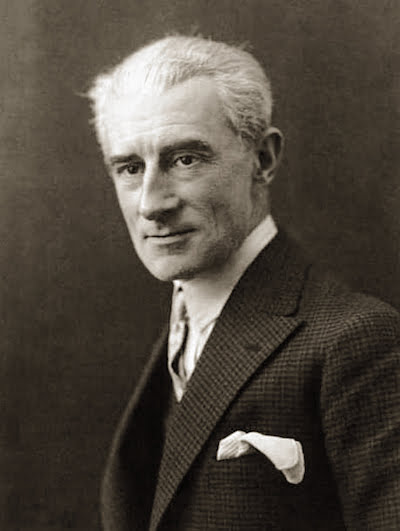
Maurice Ravel, 1925
As performed in the Concert Hall, Wyastone Leys, Monmouth, UK on 29-30 April and 1 May 2017, the recording enjoys the same vibrant presence that those old Nimbus recordings had, courtesy of Producer Andrew Keener and Engineer Simon Eadon. The opening 1903 Ravel Quartet in F resonates with interior details that emanate from its falling-fourth motif, especially vibrant when Ravel exploits his sonorities in paired instruments. In the presentation of the main theme of the Allegro moderato, we hear the second violin (Michelle Lie) and viola (Edwin Kaplan) in murmured colloquy against Snyder’s main theme. The secondary theme in octaves has a luscious effect between Snyder and Kaplan. The` whiplash and aurally exotic Assez vif scherzo delights in pizzicato gestures that retain something of the percussive gamelan effects of the Javanese orchestra. Even as the four instruments move lyrically, they often assume conflicting rhythms, in 6/8 and 3/4 meters, rather dazzling the ear. Already in movement two we hear the influence of Cesar Franck and his penchant for cyclical treatment of materials, and the Tres lent slow movement proceeds as a nocturne based on first movement motifs, with eerie effects made by fingerboard tremolo and bridge mutes. The Tesla captures the tension and bluster of the last movement Vif et agite with virile force. The drama evolves out of the sudden shots in metrics: 5/8, 5/4, 3/4. The movement plays like a competition piece, rife with ostinato drive colored by rapid tremolandi, short bits of melody, arched arpeggio phrases, and sostenuto passages. The total effect becomes wild, belying the innate Classicism that underlies this composer whose work Stravinsky compares to a meticulous “watchmaker.”
Violinist Snyder “orchestrates” the piano piece of 1909 by Ravel, his elegiac homage on the death of Haydn a century before. Some of the harmonies become quite adventurous, just as Papa Haydn might have injected little shocks to his otherwise complacent Esterhazy auditors. The 1895 piano solo Menuet antique Ravel called “a retrograde work,” but its sunny disposition allows the individual instruments their lyrical flourishes in this transcription, not the least of which come from the low tones of cellist Serafim Smigelskiy. The little 1902 Menuet in C-sharp minor casts a melancholy shadow, a yearning character. It ends almost as quickly as it began, leaving us slightly uneasy, perhaps seeking more tones from this ensemble.

Franz Joseph Haydn
Two five-bar phrases announce the aggressive virtuosity, Vivace, of the C Major Quartet, Op. 54, No. 2 of Haydn (1788), which exploits the concertante capabilities of his first violin. Even harmonically, Haydn seeks bold paths, opting for A-flat Major for a thematic tour de force. After a relatively brief development, Haydn saves his ingenuity for the recapitulation, with expansive treatment of the opening materials, building to a potent fortissimo climax, what one commentator has called the “prophetic innovations” of this most audacious Haydn quartet. Harsh passing dissonances mark the Adagio, some of which sound like gypsy salon music for a slow Hungarian procession. Violinist Snyder has a field day in this work, with its throaty chorale tune in C minor. When intoned by the four instruments, the music has an air of a Brahms passacaglia. The Menuetto emotionally balances out the slow movement, in C Major; but its trio section reverts to the darkness of C minor, here as a kind of askew parody of the opening tune. A completely unusual Adagio announces the final movement, moving once more from C Major to its minor mode, recalling the slow movement. The music evolves into a melancholy contredanse. In the course of these wayward tones, the cello line soars above the violin part. The music might be construed as an empfindsamkeit tribute to K.P.E. Bach. Suddenly, the music rips forward—Presto—but before we can grow accustomed to its energy, the piece reverts to the Adagio, touching us in ways that continue to shake our complacency, musical and psychological.

Igor Stravinsky,
by Pablo Picasso
The “bad boy” of this collection, Igor Stravinsky’s 1920 Concertino, which basks in angular rhythms, crisp attacks and szforzati, jazzy allusions to melody, unison blocks or clusters of sound, and the wild concertante violin part we recall from L’Histoire du Soldat. Vital and rife with red pepper, this rendition will have feet pounding and heart pumping long after the recorded sound dies away.
—Gary Lemco