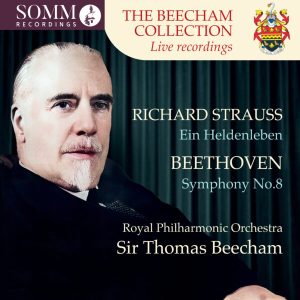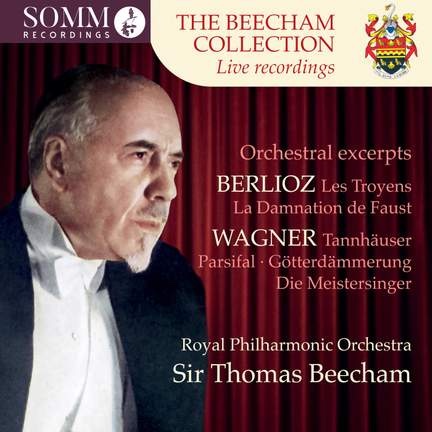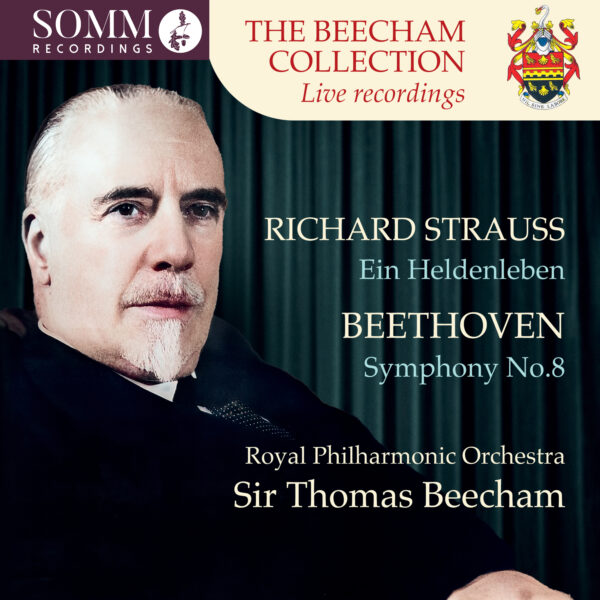
BEETHOVEN: Symphony No. 8 in F Major, Op. 93; R. STRAUSS: Ein Heldenleben, Op. 40 – Arthur Leavins, violin/ Royal Philharmonic Orchestra/ Sir Thomas Beecham – SOMM-Beecham 33 (67:56) [Distr. by Naxos] *****:
SOMM and audio restoration producer and engineer Lani Spahr restore a vivacious, even thrilling, pair of 1956 performances from the “inimitable” Sir Thomas Beeecham (1879-1961) at the helm of his Royal Philharmonic Orchestra, from respectively 17 October (Beethoven) and 12 December (Strauss). Both works, the Beethoven Eighth and the Strauss symphonic poem Ein Heldenleben, remained among Beecham’s favorite scores, through which his unbuttoned enthusiasm became a palpable Force of Nature.
From the outset of Beethoven’s first movement, Allegro vivace e con brio, Beecham sets a whirlwind tempo that sallies forth without a misstep. More than one commentator has christened the Beecham sound “torrential,” and this assault into Beethoven’s fecund and boisterous Symphony No. 8 (1814) proves true to form. The composer held this delightfully eccentric score in especial affection, and its means, forever Classical in design and architecture, reveal a saucy and mischievous turn where Haydn and Mozart remain conventional. Beecham has the second movement Allegretto scherzando chug along in 16th note parodies of the at-the-time-new metronome, his woodwinds, especially the bassoon, in fine fettle.
Eventually, the mechanism overwinds itself and flies off into space. A rural roughness guides the Tempo di menuetto, too sturdy to qualify as courtly music. Though the Trio, marked by horn and clarinet solos, bears aspects of a cassation, the impulse urges to grow larger, beyond a mere soothing interlude. The finale, a rough-house Allegro vivace, allows Beecham to invest his patented bombast in full Technicolor, mischievous and dynamically explosive. The spaces between notes drip vital energy, and the (sometimes contrapuntal) evolution of the movement, with our good friend the bassoon, rollicks forward to its exorbitant coda with splendid resolve, a definitive Eighth!
Richard Strauss conceived his 1899 symphonic poem Ein Heldenleben as a musical glorification of his own ego; but beyond that, the score celebrates his esteemed, horn-player father Franz, his wife Pauline, and even Beethoven’s Eroica, sharing the same key of E-flat major and identifiable scalar passages. The score demands huge forces well disciplined to the virtuoso requirements in technique and temperament.
Beecham launches the six-movement colossus with an epic sense of scale, given the central theme’s occupying three-and-one-half octaves. After an appropriately raucous attack by the hero’s critics, The Hero’s Helpmate appears, rather in an understated solo volley by Arthus Leavins. Despite some emotional, moody contortions in this section, wife Pauline evokes the passionate ardor worthy of a lifetime partner. If a sense of marital contention lies within the love-scene, the real conflict reveals itself in the polyphonic assaults of section IV: The Hero’s Battlefield.
Husband and wife take up their “sea of troubles” in dramatic fanfare, given Beecham’s brass and battery forces that shine forth. As an exercise in orchestral, contrapuntal discipline, the craft and its realization have few peers. The RPO cymbals generate a life force of their own, along with thunderous emanations from brass and timpani. The ardent reprise of the Hero theme segues into triumphant victory, so that he may now indulge the fruits of his various labors: The Hero’s Works for Peace.
A virtual litany of the Strauss oeuvre, we hear allusions to Guntram, Don Juan, Also Sprach Zarathustra, Tod und Verklärung, Don Quixote, and Till Eulenspiegel. Beecham sets aa leisurely pace for basking reflection, especially poignant in the RPO woodwinds and strings. Each musical allusion floats within its own, warm halo. The Hero may now ascend to Valhalla, the string motif almost reminiscent of Wagner’s Rienzi, now intertwined with the last movement from the Eroica. Twitters from the Adversaries still endure, since history will persist in controversy. But the consolations of love and companionship, along with well-wrought celebrity find resolution in The Hero’s Retirement from this World, a more optimistic reading of Tod und Verklärung. The applause erupting from Royal Festival Hall suggests that Sir Thomas Beecham shares the laurels with the composer.
—Gary Lemco