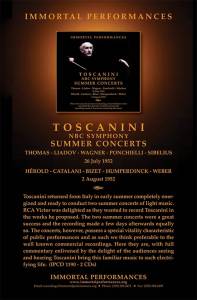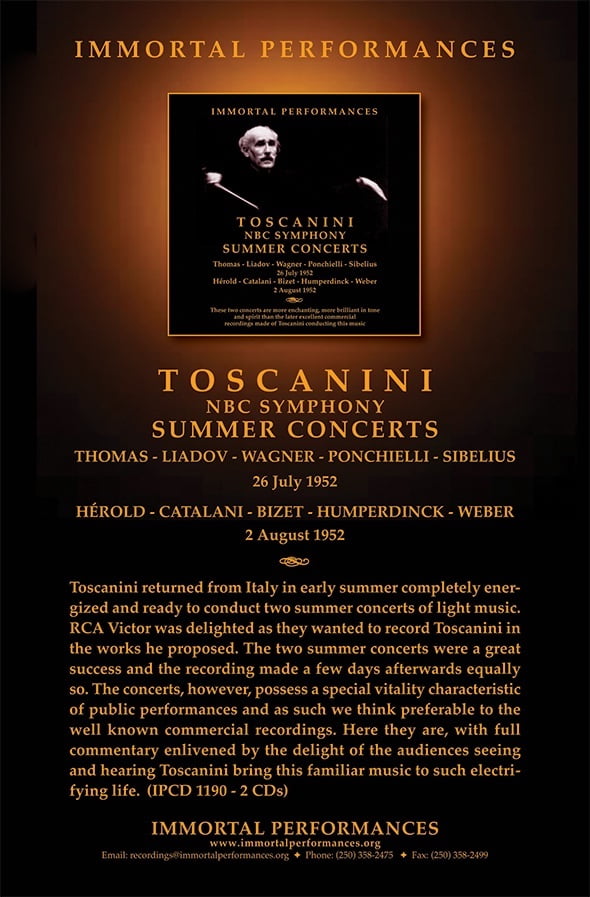
Toscanini NBC Symphony Summer Concerts 1952 – July 26, August 2 (complete listing below) – NBC Symphony Orchestra/ Arturo Toscanini – Immortal Performances IPCD 1190-2 (2 CDs: 1:49:02 [www.immortalperformances.org] *****:
Immortal Performances restores Maestro Arturo Toscanini with what commentator Ben Grauer calls “The NBC Summer Orchestra,” a gentle misnomer for a pair of unscheduled concerts given in late July and early August 1952. after the Maestro had suffered several physical and emotional setbacks: an injured knee after an NBC radio broadcast 17 February 1951 had terminated the remainder of the season; the exertions of compensatory over-exercising had led to a small stroke; and the conductor’s wife, Carla, suffered a heart attack that April, dying in late June. Despite a palpable depression, Toscanini rebounded for the 1951-52 season, determined to make his music compensate for life’s trials. In early July, curtailing his usual vacation to Italy, Toscanini returned to New York on July 8, and he immediately programmed two additional concerts, 26 July 1952 and 2 August 1952, of lighter concert music in a popular taste. Though RCA recorded the programs commercially a few days after each concert, the tapes of the actual performances invoke a resonant, thrilling energy which studio incarnations lack. The eternal dictum about Toscanini, that his commitment to any score before him, however serious or light-hearted, elicited the utmost care and demanding discipline from all participants. The scintillating brio that pervades these two hour-long programs testifies to the success of the Maestro’s working aesthetic.
The Immortal Performances production in itself offers marvelous, eyewitness accounts, first from restoration engineer Richard Caniell, who was in attendance at Carnegie Hall. He had the rare privilege of hearing Toscanini in three works new to his ears and eyes: Kikimora, Dance of the Hours, and Finlandia. Caniell testifies to “the jubilant spirit that seemed to pervade the entire experience.” Robert Matthew-Walker in the 15-page booklet provides historical commentary, noting that Toscanini raised the level of expectation for the realization of popular-concert programs, with his “empathy and interpretative skill.” Caniell adds that significant cuts were made to Ben Grauer’s loquacious commentaries, and sonic adjustments were selectively instituted to bring out orchestral voicings and definition to augment effects bequeathed by the original broadcast engineers.
Toscanini opens with the lively 1868 Overture to Mignon, by French composer Ambroise Thomas’ adaptation of a work by Goethe. The clarity and instrumental dexterity of the NBC string choir imparts a buoyancy of spirit that permeates both of the summer concerts. Anatole Liadov’s 1909 tone-poem Kikimora, Op. 63, from a Russian legend of a young maiden held in thrall by a magician and a talking cat, the piece rife with moody, chromatic effects that burst into a thrilling presto section. Toscanini holds the initial tension in check until various interjections and jabbing motifs propel the music forward irresistibly. Caniell gratefully preserves the appreciative audience response throughout these selections.
The 1870 Siegfred Idyll of Richard Wagner dispels the patented myth of Toscanini’s relentless need for fast tempos, since here Toscanini lavishes a warm, affectionate aura of string and wind sound around the unfolding melody. The NBC Symphony makes a virtual chamber music serenade of this celebratory piece for Wagner’s infant son. Those moments that arise in passionate declamation might pass for a reading from Bruno Walter, given the lingering repose of the occasion. In immediate contrast, Toscanini mounts a rousing delivery of Amilcare Ponchielli’s “Dance of the Hours” from Act III of the 1876 melodrama La Gioconda, a deft, virtuoso tour de force that has warranted even parody in such instances as Disney’s Fantasia. Virile strings and harp soon segue into tiny, vibrant kernels of cloying, woodwind melody, only to explode into a rich tapestry of kinetic, dramatic energy, the fleet transparency of which carries us away.
The last item of the 26 July concert, Sibelius’ nationalistic ode Finlandia, often appeared in Toscanini’s concerts dedicated exclusively to the composer. The dire opening declamations, pesant e marcato, project a biting, ardent sense of the occasion in a plea for independence and humanity. Toscanini maintains a fine sense of decorum as the procession extends, embracing the brass and timpani. A convulsive, jarring power emerges that will resolve into the familiar hymn that identifies this work as a tacit national anthem. Lyrical and vocally ceremonial, the fine melody does not dissolve into anything like bathos or turbid sentimentality. To call the audience response “vehement” hardly does it justice.
The 2 August concert of Toscanini favorites begins with Louis Hérold’s Overture to Zampa! of 1831. A virtuoso ensemble piece in the Italian style – here, for an Opéra-comique – it allows Toscanini to exert marvelous dynamic control as he molds the rhythmic impulses into a driven flow of scintillating energy, ending in moments of exuberant bombast. Toscanini consistently programmed two intermezzos by Italian composer Alfredo Catalani (1854-1893), of which La Wally (1892) is among his last works, while his Lorelei precedes it by two years. Catalani’s name gained prominence when his haunting aria from La Wally, “Ebben? Ne andro lontana,” appeared in the film Philadelphia. The Prelude to Act IV resonates with transparent, passionate mystery and darkly exotic lyricism. “Dance of the Water Nymphs” enjoys a plastically rhythmic incarnation rife with string, harp, and woodwind colors, underlined by percussive thumps. The texture swells into a kind of bacchanale, replete with snare and tambourine effects. The music transforms into an extended gavotte with distant brass fanfare.
What follows are five excerpts from Bizet’s Carmen, the suite arranged for concert use by Arturo Toscanini. That the throbbing passions of this most universal of live stories emanate from an 85-year-old conductor begs the proof of repeated auditions. The harp part, realized by Edward Vito, warrants recognition. After the introductory music from Aragon, the Fate Motif makes itself heard, the NBC brass and timpani especially ominous. The Intermezzo of Act III, for flute and harp, touches by virtue of its interior detail, its purity of line. The martial Prelude to Act II injects a degree of comic relief, however short lived, frothy in its trills and subdued pomp. Finally, the Entry of the Toreador and chorus from Act IV, a fertile mix of heroism and fatal passion. The NBC battery and brass resound in full throttle, the strings having substituted for the chorus. We can easily visualize the attending audience’s mouthing the word “Toreador!” in perfect rhythm.
The tale of the two lost children and the wicked witch, Hansel und Gretel, has its most refined statement in the 1893 music of Humperdinck, here presented in the Overture. Toscanini maintains its childlike sensibility, even as the harmonic language asserts its debts to Richard Wagner. The cumulative momentum achieved is pure Toscanini, illumined by striking choir entries and vivacious, resonant, blended collaboration.
For his final coup, proceeding after tumultuous applause, Toscanini turns to the fairy world of Weber’s Oberon Overture, where restrained clarity and taut control suddenly yield to the Toscanini impulse for the demonic. Composer Weber’s indication Allegro con fuoco suddenly has given Toscanini license to “cut the rope,” as Zorba, might have expressed it. An infectious bravura sweeps all before it, as if Toscanini had finally ceded an urge from former colleague at the New York Philharmonic, Willem Mengelberg. The result has the last two minutes of the Overture hurtling like an inspired cannon ball, aimed directly at our musical imagination. Oh, Happy Day!
—Gary Lemco
Toscanini NBC Symphony Summer Concerts 1952 =
July 26, 1952:
THOMAS: Mignon Overture;
LIADOV: Kikimora;
WAGNER: Siegfried Idyll;
PONCHIELLI: Dance of the Hours;
SIBELIUS: Finlandia;
August 2, 1952:
HÉROLD: Zampa! Overture;
CATALANI: La Wally: Prelude to Act IV;
CATALANI: Lorelei: Dance of the Water Nymphs;
BIZET: Carmen Suite: Prelude to Act IV; Prelude to Act I; Prelude to Act III; Prelude to Act II; Entry of the Toreadors and chorus Act IV;
HUMPERDINCK: Hansel und Gretel Overture;
WEBER: Oberon Overture