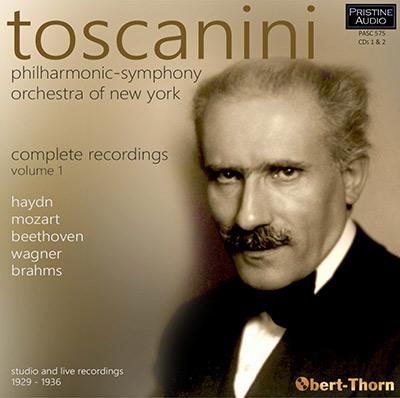
Toscanini: Philharmonic Symphony of New York: Complete Recordings, Vol. I = Works of HAYDN; MOZART; BEETHOVEN; WAGNER; BRAHMS [Composition list below] – Pristine Audio PASC 575 (3 CDs) TT: 3hr 33:12 [pristineclassical.com] *****:
Toscanini set down a series of 20 sides for RCA in 1929, but he felt compromised by the entire recording process and swore to eschew further attempts to preserve his art. He did allow RCA in 1933 and 1936 to record him in live and studio sessions at Carnegie Hall, adjusting through brief hesitations that permitted engineers to coordinate the cutting tables, working in tandem. Mark Obert-Thorn has studiously transferred the documents, lending a new luster to the already fluid and homogeneous quality of the Toscanini sound. The style, a combination of fiercely driven, linear direction and sometimes clipped phrase-endings, still displays moments of portamento and rubato that hearken to an older tradition of musicianship. The power and muscular authority of the readings never wanes, the sensitivity both to rhythm and structure everywhere in evidence.
The opening of the Haydn “Clock” Symphony (29-30 March 1929) proves instructive, given the breadth of tempo for the Adagio and richness of the texture. Like Sir Thomas Beecham, Toscanini utilized inaccurate scores—the Vivace of which “corrected” unconventional dissonances. The sway and virile confidence of the succeeding Presto, which relishes Haydn’s turns of phrase and passing counterpoints, conveys dramatic lyricism. The reduced ensemble of fifty-five players seems a forecast of the movement that claimed “authenticity.” Obert-Thorn informs us of the various takes of individual movements, and the first few minutes of the eponymous Andante derive from Toscanini’s third session with this persuasive reading, buttressed by the lingering influence of Willem Mengelberg’s approach to string slides and rubato. The expansive phrasing of the Minuetto adds a hearty girth to the music’s immediacy and drive. We have two alternative takes for the Finale: Vivace, which differ by a mere two seconds. The music flows in brilliant, “Italianate” style: the attacks crisp, the melodic line a pure arioso, the counterpoint a sterling example of ensemble clarity.
The Mozart Haffner Symphony (5 April 1929) delivers a fascinating first page, one that reminds us of the debts Mozart owes to C.P.E. Bach and the empfindsamkeit sensibility. A mix of emotional thrusts and Mannheim rockets, the Allegro con spirito moves in bravura fashion. The slower sections, often in polyphony, again reveal tendencies from the older, Mengelberg style. The Andante benefits from Toscanini’s balance of considered tempos and attention to the intimate colors Mozart invests into the text. A mock pomposity informs the Menuetto, though the richness of the string tone assures the music of its essential dignity. Toscanini slows the tempo for the Trio, almost to a point of stasis, the music’s reminding me of a piece by Lully. The Presto, however, restores the virtuoso character of Mozart’s fertile imagination, often in whirlwind realization.
The Beethoven Fifth Symphony (live, 9 April 1933) delivers a ripe, intensely forward-moving Allegro con brio – sans repeat – that appreciates the composer’s sudden and ferocious dynamics as well as his love of individual color elements. While the wind section projects luster, the horns seem somewhat subdued. The warmth of the reading emerges in the splendid Andante con moto, in which Toscanini adjusts each of the variations for its color merits while preserving the elastic continuity of the whole. The Allegro third movement proffers mystery as well dynamism, building a towering statement of the core rhythm, in which the brass and tympani enjoy a sterner impact. The orchestral image in the strings builds the tension from the bottom up, a fierce yet expressive stretto. The Philharmonic flute and pizzicato strings carry us to the fortuitous, tympanic pedal point that will announce a shattering final Allegro, whose rhythmic cell already contains the germ of the Seventh Symphony. The suave elasticity of the upward string line, interrupted by the force of the “Fate” motif, assumes a compelling, “definitive” momentum that virtually defines the Toscanini approach in Beethoven. The coda takes on a theatrical dynamism of its own, a nervous tension and playfully mercurial character with a colossal will of its own.
The piece-de-resistance, the Beethoven Seventh (10 April 1936) manifests its eternal virtues, not the least of which derives from a thoroughly homogeneous ensemble, tonally acute and resonant, as well deliciously transparent in the colors. The massive girth of the fortes and their graduated nuances into espressivo gestures marks a true demon of the podium at the helm. Even in its early LP incarnation on RCA’s Camden label, the performance enjoyed a special luster. We may still detect the portamentos in the first movement strings, but the forward drive aligns Toscanini more with Weingartner than Mengelberg. Obert-Thorn offers us two alternate takes of the first movement Poco sostenuto; Vivace, with second take’s cutting almost a half-minute in the realization. Virgil Thomson once called the A minor Allegretto “the most tragic music Beethoven ever wrote.” Toscanini creates an ineffably dignified chorale movement, tenderly and sensitively layered. It is dance music, after all, but by the shadows of all whom we have loved. The delicate, contrapuntal development achieves the intimacy of chamber music until the manic passion surges forth once again. An electric blend of nervous tension and unabashed brio, the two latter movements vibrate with fertile energy. The joie de vivre, the kinetic energy, and the controlled “dervishness” more than warrant the exploration of the entire project.
Disc 3 restores the April 8-10, 1936 sessions that Toscanini dedicated to Wagner and Brahms. That Toscanini became a world authority in the music of Wagner has testimonials from those mavens at Bayreuth who allowed him to investigate the sacred urtexts when he challenged specific tempo and textual indications in selected operas. The incandescence of the Act I Prelude of Lohengrin and its “Grail” motif has its exact foil in the hurtling fanfares and heroic tension of Act III’s Prelude. The fateful dawn that opens Goetterdaemmerung (8 February 1936) quickly rises through “Zu neuen Thaten” to embrace the last, heroic visions of the Ring tetralogy. Exuberant optimism illustrates Siegfried on his quest among recollections of the Rhine’s swirling waters, the gold, Brunnhilde, and the thwarted chorale of the Rhinemaidens. The fateful horn call itself transmogrifies into an orison of love and valiant death. A moment of spiritual refreshment, A Siegfried Idyll (8 February 1936) captures Toscanini’s powers of intimate persuasion in colors subtle and intricate. The music of Johannes Brahms – bequeathed to Toscanini from such authoritative luminaries as Fritz Steinbach — has a noble representative in the Haydn Variations (10 April 1936), here a display piece for the Philharmonic’s various choirs, but more specifically its winds and brass. The Tristan excerpts from 1941-42 (these from NBC Symphony, bonus tracks) testify to the dualism in Toscanini’s style: the rhythmic and agogic links to a Romantic approach (in the 17 March 1941 Prelude) he constantly sought to shed, and the newer, crisp, clipped directness of expression (in the 19 March 1942 Liebestod) that found his earlier perspective unacceptable.
Recording Contents:
HAYDN: Symphony No. 101 in D Major “Clock”
MOZART: Symphony No. 35 in D Major, K. 385 “Haffner”
BEETHOVEN: Symphony No. 5 in C minor, Op. 67; Symphony No. 7 in A Major, Op. 92
WAGNER: Lohengrin: Preludes, Acts I and III; Goetterdaemmerung: Dawn and Siegfried’s Rhine Journey; A Siegfried Idyll; Tristan und Isolde: Prelude and Liebestod
BRAHMS: Variations on a Theme of Haydn, Op. 56a
—Gary Lemco