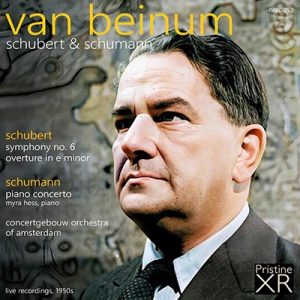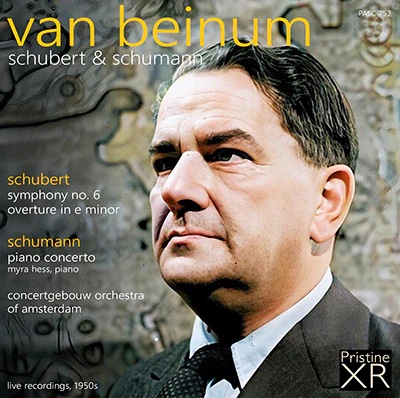
Van Beinum = SCHUBERT: Overture in E Minor, D. 648; Symphony No. 6 in C Major, D. 589; SCHUMANN: Piano Concerto in A Minor, Op. 54 – Myra Hess, piano/ Concertgebouw Orchestra of Amsterdam/ Eduard van Beinum – Pristine Audio PASC 752 (66:39) [www.pristineclassical.com] *****:
Pristine Audio, courtesy of the private collection of recorded performances of Francsico A.M. Joffily B. Mello, restores in solid sound music by Schubert and Schumann as led by Eduard van Beinum (1900-1959), who succeeded Willem Mengelberg at the helm of the Concertgebouw Orchestra without the imposition of any dictatorial ethic. The centerpiece of his album lies in the Schumann Piano Concerto from15 November 1956, featuring legendary British pianist Myra Hess (1890-1965) in the solo role. While the dates of performance of the two Schubert entries remain unknown, their aural impact has fine resolution and instrumental detail, immediately attested to by woodwinds of the Concertgebouw in the Schubert overture.
Beinum opens with an energetic rendition of Schubert’s 1819 Overture in E Minor, composed for Vienna but withdrawn from the general music population until 1886, for his collected works. The dramatic poise of the seven-minute piece bears the influence of Beethoven, with some sensitive articulation from the Concertgebouw winds and strings, and a sweet shaping of the brief but touching main melody. The accompanying note from Andrew Rose testifies to “a sparkle and delicacy that van Beinum clearly relishes.”
While some may quibble at the digital inaccuracies incurred by Dame Myra Hess, here late in a brilliant career, she and van Beinum deliver a poetic, nuanced account of Schumann’s one contribution (1845) to the piano concerto medium. Throughout the performance sonic treasures emerge from her colored arpeggios and careful runs, while the Concertgebouw oboe alerts us to a real talent at work. The Intermezzo has a particularly romantic and misty seduction, while the entry, attacca subito, into the Allegro vivace has a real schwung. Rather than reaching for the epic moment, the collaboration retains a loving, intimate affection. At times, Beinum injects a passion into the orchestral tissue that has us once more appreciating his flair in the repertory he savored. The athletic Allegro vivace last movement, marches, dances, and sings in a wondrous simultaneity of effect, all to the sheer delight of a most responsive audience.
Beinum concludes with Schubert’s 1818 Symphony No. 6 in C Major, which despite it occasional nods to Beethoven’s sense of drama, retains a lyric charm and boisterous energy entirely the composer’s own. Rossini and the lighter side of Haydn seem the more immediate models for Schubert’s elevated spirits, which can themselves become quite intense. The transparency of texture Beinum elicits supports an elastic flow of melody in the first movement Allegro, after an ominous Adagio.
Schubert sets the second movement Andante in two contrasted impulses, a gavotte-like melody that Haydn would admire, and a second that follows a triplet-laden interruption. Brinum gives the Scherzo: Presto a lithe, athletic buoyancy, his string section alerted to the nuances of the tip of the bow. The momentum sustained, it enjoys a robustly pert definition, and the sense of the strings and (high) winds’ delighting in their imitative (mechanical-clock) antics that permeate the reading. The finale, Allegro moderato, inhabits the self-same space as masterful Haydn, with tenderly deft Mannhein rockets, except for a sudden explosion or two that adumbrate the later “Great” Symphony also in C major. Beinum’s dynamic control adjusts so surely, that if I had to guess at the conductor, I might render Bohm or Karajan as my choices. The grandly exhilarated coda completes a most successful discovery from a valued, personal archive.
Thanks to Pristine Audio for this one.
—Gary Lemco