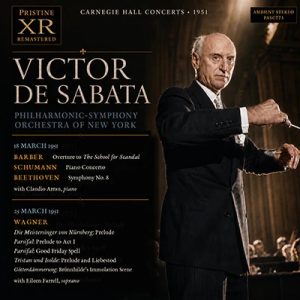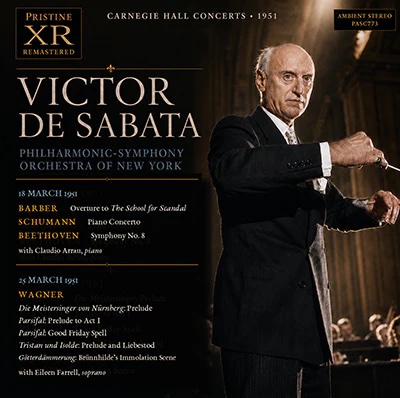
Victor de Sabata = BARBER: Overture to the School for Scandal; SCHUMANN: Piano Concerto; BEETHOVEN: Symphony No. 8; WAGNER: Excerpts from Die Meistersinger; Parsifal; Tristan und Isolde; Götterdammerung – New York Philharmonic – Pristine Audio PASC 773 (2 CDs = 2:26:35, contents detailed below) [www.pristineclassical.com] ***** :
I came to know the art of famed opera conductor Victor de Sabata (1891-1967) originally through recordings from Nuovo Era, Angel Records, Music&Arts, and various pirate companies based in Italy. The performances of the Schumann Piano Concerto with Arrau and the Brahms Violin Concerto with Milstein, both from New York City, stood out dramatically. A more personal, though once-removed, experience occurred in Atlanta, Georgia, when guest conductor Aldo Ceccato visited the Atlanta Symphony. Aware that Ceccato had married de Sabata’s daughter Eliana in 1966, I brought with me a copy of RCA Victor LP LM 1057, the transfers of Respighi’s The Fountains of Rome and Debussy’s Jeux. When Mme. Ceccato saw my offering for her autograph, she exclaimed, “That was my father’s favorite recoding! How did you know?”
Pristine Audio offers two concerts of the New York Philharmonic as led by de Sabata 18 and 25 March 1951, a time when the orchestra, led by the extraordinary Dimitri Mitropoulos, could no less boast of eminent musicians who regularly appeared at the helm: Bruno Walter, Guido Cantelli, and Leopold Stokowski. Sabata opens with Samuel Barber’s 1933 Overture, The School for Scandal, a conservative, sonata-form responsive to the spirit of Sheridan’s 1777 comedy of manners. The woodwind, two-note chirps soon erupts into a pandemonium assuaged by a tender oboe melody of marvelous appeal soon expanded by the strings. De Sabata keeps the motion active and pointed, the shifting colors and rhythmic thrusts acerbically intoned. Happily, the persuasive second melody reappears before the intense, fanfare coda, a kind of musical swashbuckler assertively sounding out the two-note motif.
Chilean piano virtuoso Claudio Arrau (1903-1991) joins de Sabata for the Schumann 1841-45 Piano Concerto: when I mentioned this amazing performance to Arrau in conversation, Arrau’s peremptory response was, “It was a long time ago.” The romantic Schumann work manages to “conform” to a “classical” model by simply repeating each melodic or scalar phrase in movement one twice. Arrau and Philharmonic oboe execute some fine duet sequences as the melodies gain fervor and monumentality. Sabata manages to make the repeat of any arched phrase more intense than its initial statement, a quality that makes the last movement Allegro vivace a thrilling revelation. Arrau’s potent (German) technique possesses a fine capacity for poetic expression, and the first movement balances bravura with nostalgic sentiment. The first movement cadenza, which de Sabata ushers in with some force, exudes charismatic contemplation, a potent trill, and contrapuntal finesse.
The second movement, Andantino grazioso in F major, offers a sustained, erotic intimacy, especially after movement one, derived from notes an agrammatical arranged from “Chiarina” (Clara Schumann) from the piano suite Carnaval. With requisite schwung, the attacca last movement launches into the A major Allegro vivace with resolve tempered by Schumann’s penchant for syncopated polyphony. The march tune parades through 6/4 and 3/2 with no discernible loss of transition; in fact, the momentum ever increases like some magnificent, singing pendulum. The swelling pulse and emotional ardor of the interpretation quite engulfs the New York audience – who having subdued their enthusiasm at the coda of movement one – now have become liberated to express their aroused appreciation.
After intermission, Jim Fassett then announces de Sabata once more as the visiting director from La Scala in Milan, now to lead Beethoven’s 1812 Eighth Symphony. De Sabata reminds us of the inventive charms of this work, which remained the composer’s favorite. The playful wisdom, here compressed into classical structure, allows De Sabata to indulge in the frantic collision of rhythmic and harmonic forces that glide by so glibly. The colossal, joyful brio of the piece consistently assaults our “classical” complacencies of structure and dramatic expectation. Sabata no less communicates in movement one a sense of divine mystery, as the sonata-form process must succumb to Beethoven’s atomic energy. The second movement’s parody of the metronome enjoys an athletically robust realization that well transcends any “courtly” function, as will the ensuing Tempo di menuetto. The music here assumes a ceremonial dignity and pomp that rather reminds us of Handel, whose music would soon influence the Overture to the Consecration of the House. The last movement, Allegro vivace, certainly frolics, but it also explodes with a passion worthy of its symphonic predecessor, the Seventh, Op 92.
Nothing “polite” in this reading; rather, a galloping, vehement reminder of the power potential in each, often “quirky,” kernel of musical tissue in Beethoven’s inventive imagination. The audience gets the point.
De Sabata’s concert of 25 March (Easter Sunday) involves all-Wagner, in which soprano Eileen Farrell (1920-2002) joins De Sabata for the “Immolation Scene” from the last of The Ring operas. De Sabata begins with the well-familiar Prelude to Act I of Die Meistersinger, Wagner’s most “German” opera, concerning the various guilds that laid claim to cultural pre-eminence. A swift, linear, driven tempo marks the occasion, processional and invested with ceremonial, contrapuntal splendor. The Philharmonic’s brass sings out with especial urgency and brilliance.
I venture that De Sabata’s measured reading of the Parsifal excerpts competes, interpretationally, with those of Wilhelm Furtwaengler. The sense of metaphysical significance permeates the occasion, in which the silences prove as stirring as the periods of elevated cadences. The famed “Dresden Amen” floats in a suspended sea of devotion, followed by the trumpet annunciation of The Grail motif. The quality of brass sound resembles a Gabrieli motet from the Renaissance. The ensuing hush of the strings tugs at the heart, the music all gradations of tonal color. De Sabata maintains a taut melodic line, singularly flexible even as the arch broadens into ardent rapture. If the idea of “epiphany” applies, a la James Joyce, to this music, De Sabata realizes it.
The orchestral compression of the opera’s Act III, the “Good Friday Spell,” comes to us from the composer himself. Though the musical context implies a spiritual stasis, De Sabata invests a lyrical drama into the extended meditation, drawing impressive, nuanced, harmonic color from the modulations in the string line and the transition to the woodwinds. The silences once more reveal as much mystery as they delay. The overcoming of Amfortas’ reticence to reveal the Grail invokes a new and permanent state of grace, irradiated by De Sabata’s responsive players.
Eileen Farrell built a reputation for an extraordinary vocal volume, great range, a short temper, and a foul mouth. Certain conductors – Mitropoulos for one – could restrain the unmusical elements in her nature. As for great performances of Wagner’s Liebestod from Tristan, I had the good fortune to audition, first, the Birgit Nilsson recording on Decca with Hans Knappertsbusch and the Vienna Philharmonic, a realization as voluptuous as it was absolutely convincing. For the Prelude, Act I, Knappertsbusch elicited the most compelling cello I had heard in Wagner. The Prelude, naturally, generates its own ineluctable, often sweeping, tension, avoiding its C major tonality through unresolved cadences until the last act coda. De Sabata’s judicious silences imbue the musical line with a dire sense of lingering tragedy, at once melancholy and heroic. This reading convinces us of Nietzsche’s claim that, upon discovering Tristan, he became a Wagnerian. Farrell’s voice conveys a total intoxication of amor, insisting that Isolde’s dead lover yet lives, his eyes a shining halo of light. De Sabata’s grip on the unfolding, erotic musical line refuses to relent until the ecstasies of death-in-life culminate spectacularly.
The “Immolation Scene” concludes The Ring cycle, with Brunnhilde’s elongated farewell to the dead Siegfried, a victim of Wotan and the gods’ treachery, who having stolen the Rheingold from Alberich then assign a mortal to atone and redeem the gods, a reversal of the Christian spiritual logic. Brunnhilde’s own ashes from her funeral pyre will cleanse the taint of betrayal and permit her to reunite with Siegfried in death. The martial sensibility that permeates the scene has its foil in the great longing of the yearning fr a clean death. Farrell communicates tenderness as well as righteousness in her address, telling Wotan’s ravens to convey the message that Valhalla can no longer justify its existence. The Magic Fire recalls Siegfried’s quest along the Rhine, and the collision of elements arouses a metaphysical tenderness for fallen ideals. De Sabata, once described as part Julius Caesar, part Satan, revels in the tumultuous ecstasy of catastrophe-become-redemption. The sense of existential resolve saturates every measure, and we witness the lamentable Fate that leaves none exempt.
Kudos to Pristine and their XR restoration process for having returned to us two colossal musical events. We await more of the same from the De Sabata sessions in New York City.
–Gary Lemco
Victor de Sabata Conducts:
BARBER:
Overture to the School for Scandal, Op. 5;
SCHUMANN:
1Piano Concerto in A Minor, Op. 54;
BEETHOVEN:
Symphony No. 8 in F Major, Op. 93;
WAGNER:
Die Meistersinger: Prelude, Act I;
Parsifal: Prelude Act I;
Good Friday Spell;
Tristan und Isolde: Prelude and Liebestod;
2Götterdammerung: Brunnhilde’s Immolation –
New York Philharmonic
1Claudio Arrau, piano/
2Eileen Farrell, soprano/