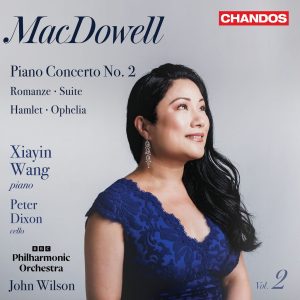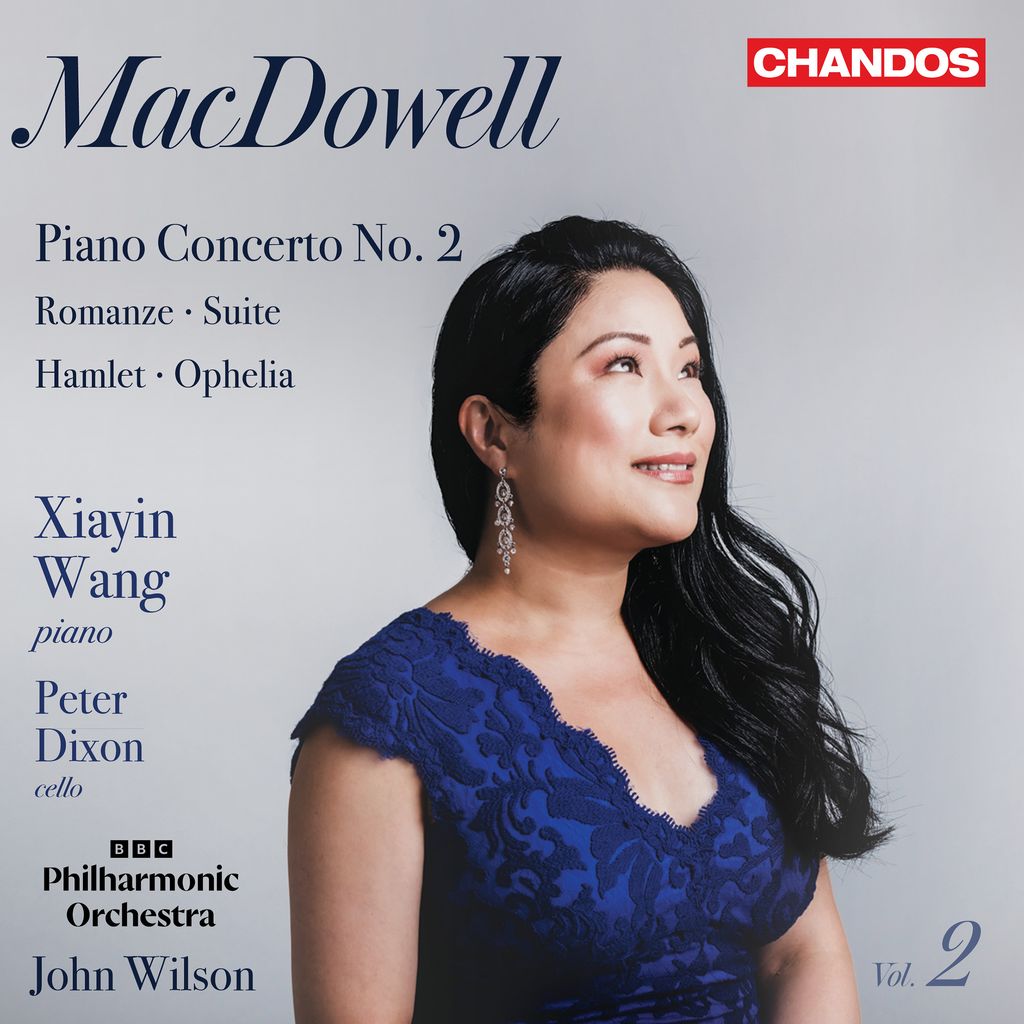
MacDowell: Hamlet/Ophelia, Op. 22; Piano Concerto No. 2 in D Minor, Op. 23; Romanze in E Minor for Cello and Orchestra, Op. 35; Suite No. 1 in A Minor, Op. 42 – Xiayin Wang, piano/ Peter Dixon, cello/ BBC Philharmonic Orchestra/ John Wilson – CHANDOS CHAN 20332 (61:08) (10/29/25) [Distr. by Naxos] ****:
The music of American composer Edward MacDowell (1860-1908) remains firmly, albeit occasionally, entrenched in our concert life, mainly due to the attractive power of his Second Piano Concerto of 1886, and the performances of various symphonic poems that testify to the influence of Franz Liszt. This Volume 2 from conductor John Wilson embraces compositions 1884-1893, with an emphasis on those works created during and subsequent to MacDowell’s honeymoon excursion to England with his wife, Marian Giswold Nevins. Collectors continue to cherish recorded performances of the Piano Concerto by Earl Wild and Van Cliburn, while I recall a particularly successful rendition in Atlanta by Leon Bates.
The program opens with Two Poems for Large Orchestra: Hamlet/Ophelia, conceived in response to a series of Shakespeare productions mounted at the Lyceum Theatre in London, supervised by the acting duo Henry Irving and Ellen Terry. Highly chromatic n texture and favored by some good melodic content, the diptych – in D minor and F major – might owe debts to Liszt’s 1854 Mazeppa for structure and dramatic impulse. The music captures the mood shifts of the two protagonists in Hamlet, their vacillations of manic confidence and deep insecurity, rendered in occasionally tumultuous fashion by MacDowell, who enjoys the effects of terraced dynamics.
Composed in Wiesbaden, Germany between 1884 and 1886, the D Minor Concerto conforms to the virtuoso concerto style established by Liszt and Saint-Saens, MacDowell’s having incorporated some incidental music for Shakespeare’s Much Ado About Nothing and the character of Benedick into his second movement scherzo, Presto giocoso. Quick tempos had been a calling card for MacDowell’s own keyboard prowess, and Xiayin Wang does not balk at the digital challenges – the crisp, fluent articulations – demanded by the composer and characterized by his wife as “gossamer demons.” Both hectic and impelled by sheer velocity, the music manages to project a distinct color wrought of fierce concentration, occasionally reminding us of the famous Scherzo by Henri Litolff.
The first movement, scored in eight distinct tempo periods, opens with a misty Larghetto calmato in violins and horns, followed by a potent cadenza from Wang, attesting to her natural ability to perform the Grieg Concerto. Amplification of the opening materials – with violin, flute, horns, cello pizzicatos – involve more dreamlike figurations and sudden bursts of passion, while the main theme gathers an irrevocable momentum and glistening filigree. Intimacy and spectacle compete for dominance, and both impulses win our approval. The texture becomes increasingly massive, a la Liszt or even Wagner, while the keyboard motion insists on brilliant velocities. A sudden hiatus leads to another solo cadenza, more in the manner of a passionate improvisation with added orchestral, aerial and throbbing colors. The lure of intimacy prevails in the last pages, though the sensibility swells in volume and luster momentarily, only to bask in a hard-won resolution.
A degree of cyclic unity marks the last movement, opening as it does quietly, meditatively Largo before the piano explodes Molto allegro, trills aplenty, and then allowing the original, first movement tune a re-entry before three, new ideas supplant it. Rather martial in tone, the movement enjoys a pompous, semi-gypsy swagger of technical confidence and deft coloration. A mid-point serenity descends upon the procession, rife with romantic overtones, the main melody in sweet strings and winds. But this has been the lull before the final storm, gradually becoming more animated and delicately inflamed, until another zealous crash impels us, Presto and then Prestissimo, to a convulsive, resonant coda.
In immediate contrast, we have MacDowell’s homage to Bohemian cello virtuoso David Popper (1843-1913), the Romanze in E Minor of 1887, also written in Wiesbaden. Melancholy in tone, the piece seems to embrace Massenet and later Elgar at once, repetitious in melodic character but nonetheless intimately expressive. The coda, ethereal, melts into a sweet space.
Wilson concludes with a large orchestral work from 1893, the five-movement Suite in A Minor. Notably German influences pervade the work, since we hear (and feel) allusions from Schumann, Weber, Mendelssohn, and Wagner. Wife Marian intimated that MacDowell’s Celtic heritage accounts for the pantheistic, bucolic elements throughout the work. We open “In a Haunted Forest,” in which the texture enjoys a menace (Maestoso) close to Der Freischuetz, with some impressive woodwind scoring. The ensuing, brief “Summer Idyll” marked as Allegretto grazioso, an indication and waltz feeling shared by Dvorak and Glazunov. “Im Oktober” (1893) serves as the inserted movement to fill out the original four-movement version of the suite. The music alternates between a militant affect and a lyrical sense of repose in sympathy with much of Grieg.
The “Song of the Shepherdess,” marked Andantino semplice, achieves a sense of grandeur and transparent intimacy, at once. The last movement, “Forest Spirits,” combines elements of Weber, Mendelssohn, and Grieg, moving with hurtling energy and a dancing flightiness. Misterioso serves as the dominant impulse, set as a series of scalar motifs that end with a rhythm close to the second movement of Beethoven’s Seventh Symphony. The balletic chirps of the woodwinds might invoke Tchaikovsky to respond. A military fanfare suddenly rushes in to conclude the suite with a precipitous crash. Recorded in Manchester, England, the sonic production from Brian Pidgeon and Mike George proves immediate and clear.
—Gary Lemco