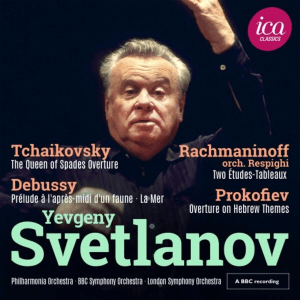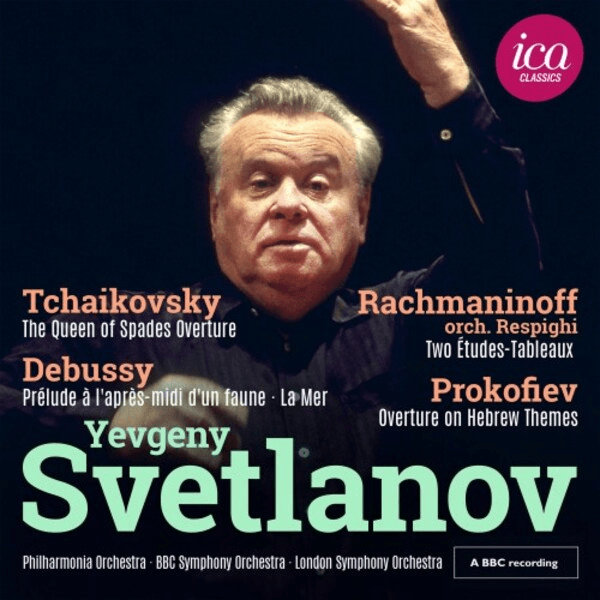
TCHAIKOVSKY: 1The Queen of Spades, Op. 68 – Overture; DEBUSSY: Prelude to the Afternoon of a Faun; La Mer; 2RACHMANINOFF (Orch. Respighi): Two Études-Tableaux; 3PROKOFIEV: Overture on Hebrew Themes, Op. 34 – 1Philharmonia Orchestra/ 2BBC Symphony Orchestra/ 3London Symphony Orchestra/ Yevgeny Svetlanov – ICA Classics ICAC 5181 (66:00) [Distr. by Naxos] ****:
The late Evgeny Svetlanov (1928-2002) inherited the mantle of his own great predecessor Nicolai Golovanov; and, among his several achievements, Svetlanov embarked on a major restoration of his Russian national musical heritage with several series’ worth of anthologies of Russian music. Estimates of Svetlanov’s recorded legacy run as high as 2,000 documents! Describing himself as a blatant neo-Romantic, Svetlanov proclaimed that “my head alone is not enough for my music; I demand my soul to be involved in music.” And while certain contemporary Russian musicians held Svetlanov’s catholic interests, he remained indifferent to atonality and serialism. His performances – led after 1980 without baton – consistently evidence a high gloss, glamorously tremendous energy, and a loving emphasis on inner details. With examples like Mravinsky, Kondrashin, and Sanderling as ideal contemporaries, Svetlanov made visceral attacks and resonant sonority his major selling points.
These performances with British ensembles open with the concert from Royal Festival Hall, 15 March 2001, the music by Tchaikovsky: his 1889 opera The Queen of Spades, after Pushkin’s tragic story, composed in a hectic 44 days and embracing the surreal monomania of a grotesque addiction to gambling and obsessive romance. The Overture seems to gravitate between sighing figures and dramatized, emotional collapse. Trumpet figures announce a balletic panorama, soon galloping towards Doomsday. A tender aria filled with longing emerges, harmonized in counterpoint, underlined by pedal timpani. The sad orison drifts away into the aether and audience applause.
Debussy’s eternal faun of 1888 is realized by the flute of Kenneth Smith, floating amidst magical harmonies from strings, horn, and harp. This dream-scape account literally lingers, stretched to maximum expanse by Svetlanov, as if Mallarmé’s Symbolist poem were scripted to the aural experience. The only conductors for one to make inevitable comparisons for such a spatial concept would be Leopold Stokwski and Sergiu Celibidache. That the Philharmonia players could accommodate such a willful tempo testifies to the transcendent discipline of all parties.
Debussy’s 1905 sea triptych La Mer seems to have elicited more passion than severe discipline from the Philharmonia Orchestra, and observable slips in articulation occur – but do not detract from Svetlanov’s fevered momentum. The volatile mystery of The Sea remains utmost in the exposition – “From Dawn to Noon at Sea” – of Svetlanov’s unfolding of Debussy’s palette, set ostensibly in D-flat major but insistent on elusive ninth chords and modifications of the sequence C#-F# and G# as whole tone scales and fluttering, varied 6/8 rhythmic motifs suggest flowing undercurrents and the flights of airborne fowl. The blend of the Philharmonia brass and strings offers a warm, tangibly sensuous palette, and we envision painted seascapes by J.W.N. Turner. From a voluptuous mist of color, the melodic curve in woodwinds, cymbals, and harp rises to a potent climax, stirring in a cinematic outburst of dazzling intensity.
Even more color nuances invest the second movement, “Play of the Waves,” rife with dazzled glissandos and harp arpeggios, tinkling brass and cymbal, and a shimmering patina in which we experience the effects of so many of the conductor’s demands for vibrato. Kernels of rhythm and melodic fragments compete for dominance, and a sole flute makes a brief outcry before the impelled rhythmic forces seize power. We hear perhaps touches from Dukas’ Sorcerer’s Apprentice, no less besieged by water, as these waves, contrapuntal and modal, perform their own magic on our assaulted senses.
Could Mussorgsky be the inspirator of the opening measures of “Dialogue of the Wind and the Sea”? Vertical harmony rules while the brass assert a hymn to guide lost souls, and a polyrhythmic hostility seems to emerge from the very depths of the world. Triton appears with his wreathed horn, announcing his supremacy. The sheer allure of the pantheistic impulse has us in thrall, and the motions temporarily slow down to mesmerize us. Inverted pedal tone establish an other-worldly source for these revealed powers, and the Philharmonia oboe and gentle battery lead us to the Enchanted Isles. Svetlanov now revels, somewhat disorderly, in the rush to the final pages, which vibrate with erotic energy, informed by the ad libitum brass punctuations that Mitropoulos favored. Nature can be messy, as the raucous conclusion exhibits, but does the audience care? – I think not.
Svetlanov turns with the BBC Symphony to the Respighi orchestrations of two Études-Tableaux by Rachmaninoff, the suggestion for the programmatic response made by conductor Serge Koussevitzky. The E-flat Étude. Op. 33, No. 6 is now subtitled “A Scene at a Fair,” and the Étude in A Minor, Op. 39, No. 2 is referred to as “The Sea and the Seagulls.” The A minor, rather lengthy, opens with motives reminiscent of the symphonic poem Isle of the Dead, the suggestion of the Dies Irae sequence blended in with oriental strains we hear in Balakirev and Borodin. The Philharmonia bass harmonies prove voluptuous, which the strings insist on as luring us, siren-like, to a gallant, blessed demise at sea. The E-flat major, Allegro con fuoco, could not contrast more: startling fanfares open the brief piece, rampant with dispersed color elements in strings, winds, brass, and battery. For pure execution of brash colors, the concentrated piece rivals Stravinsky’s Petrushka.
Serge Prokofiev originally conceived his 1919 Overture on Hebrew Themes as a sextet for piano, clarinet, and string quartet, but the popularity of the piece exploded after its 1920 premiere. Prokofiev had already fled his homeland to escape the repercussions of the Russian Revolution. After the 1920 performance, Prokofiev decided to expand its color horizons. He had not previously worked with folk materials, especially Jewish klezmer impulses, but the chamber group Zimro provided him a notebook of thematic motives which suited his purpose. The idea of “klezmer” means an itinerant, wandering musician, often a clarinetist or a violinist. In two parts, the music opens with a jerky, grotesque tune that possesses a certain flair. A second melody, more plaintive, emerges, soon to join the first in contrapuntal development. From 30 October 1979, Svetlanov and the LSO deliver a hefty, jazzy version, often rife with the composer’s idiosyncratic romanticism. The klezmer tune returns, the melody inverted, fragmented, and now contrapuntally active. Svetlanov keeps the interior lines fluent and expressive. One last time, the main tune returns, and then the whole thumps to a resounding finale.
–Gary Lemco