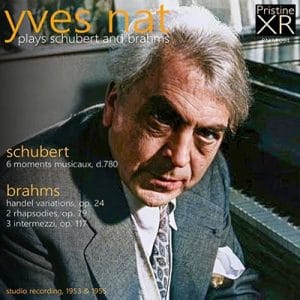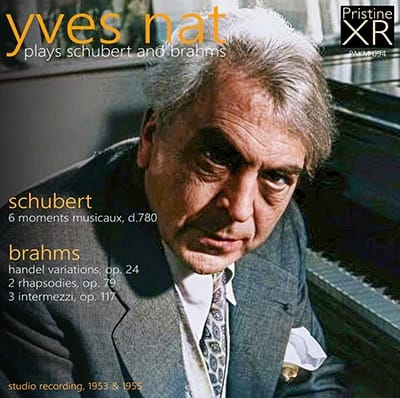
SCHUBERT: Moments musicaux, D. 780; BRAHMS: Variations and Fugue on a Theme of Handel, Op. 24; Two Rhapsodies, Op. 79; Three Intermezzi, Op. 117 – Yves Nat, piano – Pristine Audio PAKM 094 (73:59) [www.pristineclassical.com] *****:
French pianist Yves Nat (1890-1956) has perennially remained a cult figure among keyboard literati, a musician who eschewed both publicity and, so far as recordings apply, his native repertory, generally preferring German music. This Pristine revival of his undated 1953 Schubert and October 1955 recital of Brahms complements the issue on Forgotten Records (FR 1513) of his notable 17 March1953 concert also in Paris, which reveals an artist, though already ailing, who still maintains a potent technique and a fertile, musical imagination. Yves Nat was born in Béziers, France, and he studied at the Paris Conservatoire with Louis Diémer – likewise the teacher of Robert Casadesus – receiving in 1907 first prize in keyboard performance. Though he embarked on chamber music concerts between 1911-1916, after WW I, and then in 1937, Nat seems to have embraced a long period of seclusion, eventually re-emerging in 1953 to reclaim some degree of international fame, especially through his association with the record label Les Discophiles Français, for which he documented the complete cycle of Beethoven sonatas, and music by Brahms, Schubert, Schumann, and Chopin.
What emerges immediately from the set of Schubert Moments is the utter comfort Nat feels for the style: although he favors quick tempos – especially in the C# minor – his sonority and dramatic articulation resonate with his singular authority. His playing in the Moderato and Allegretto sections, moreover, proves meditative, well-considered, and plastically affectionate. To make comparisons to more familiar names in such repertory, one might mention those in the Artur Schnabel tradition, like Leonard Shure and Leon Fleisher. Nat projects a warm grace and sensitivity to Schubert’s refined, colored blend of impassioned but restrained melancholy, and the group of six pieces stands as an independent vision of the set as a whole.
Follows on this disc the massive 1861 Handel Variations of Johannes Brahms, itself a compendium of the range of music the composer had imbibed in his effort to transform a Baroque art form into a potent expression of Romantic poetic ardor that seeks to transcend its origins. The set of twenty-five variations on the theme – from Handel’s Aria from the Harpsichord Suite No. 1 in B-flat Major, HWV 434 – exploit the simplicity of both Handel’s melodic line on the B-flat scale and its bass, the key element in maintaining the evolving work’s sense of structure. A series of diverse character pieces, national styles, and dance forms emerges, all the while seeking to culminate in a fugue worthy of the Brahms predecessors, Beethoven and Bach.
Clean, transparent articulation and silken rhythmic flexibility mark the Nat approach, which soon rivals my own preferred accounts by Moiseiwitsch, Solomon, and Fleisher. As early as Variation 1 Nat injects a skilled sense of playful humor, the trill and the turn already serving as ornaments and organic components of the journey. The colors soon change, often quickly, with Nat’s varying the timbre and restrained percussion of his sonority, allowing shades of personality into the Hungarian and fleetly bravura episodes, such as those in brilliant staccato that play like études. When Nat applies force to his projected sound, the effect rings in the manner of Beethoven and the oft-cited “symphonic” concept attached to the Brahms keyboard legacy. The capacity for color, however, strikes me as singular, with Nat’s attending to bass harmonies and motions that well adumbrate evolutions in Debussy. Staccato and legato periods create their own logic, and the chiaroscuro extends into the variations’ dynamic intensities, which unfold in pairs or asymmetries soon resolved by virtue of the juxtaposition of dance pieces in alternations of major and minor. The siciliano and musette variations stand out for delicate, suave clarity. The ineluctable progress to the fugue occurs through steady, luxuriant strides, at last culminating in the Brahms contrapuntal fulfillment that can safely assume a place next to venerated Beethoven and Bach, a resounding, spectacular finale.
The later Brahms pieces exhibit what has become the patented blend in Nat of gravitas and sensitivity, of sonorous declamation and inward meditation. The B Minor Rhapsody, marked Agitato, opens perhaps too aggressively in storm and stress, but the tone relaxes for the second subject and assumes the innigkeit we associate with the music of Schumann. Indeed, there appear dark, fateful undercurrents and dissonances which Nat refuses to conceal. The G Minor Rhapsody does not succumb to excessive speed, but its essentially tragic demeanor becomes plain, almost a grievance from Beethoven.
At last, the 1892 Op. 117 “lullabies to loneliness” that Brahms created, much in a spirit that laments the passing of his relationship with the Robert Schumanns and the decline of an age of enhanced German creativity. The lovely song taken from the Scottish ballad emerges simply, clearly, without strained sentimentality. The glorious middle Intermezzo in B-flat Minor rings with impassioned, autumn rain, pre-Debussy anguish, offset by a love of tender recollections. The final selection, the C# Minor Intermezzo, haunts with its anticipation of all the desolations awaiting the 20th Century. Nat plays this piece with stentorian deliberation, relenting only for the middle section, a series of clarion bell-tones that may provide a qualified solace.
In all, a potent and impressive undertaking by Andrew Rose to re-acquaint us with a French piano master well worth our collective rediscovery.
—Gary Lemco