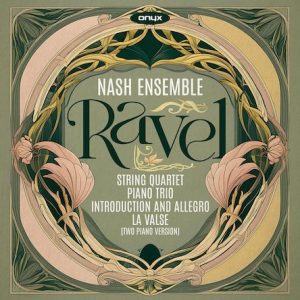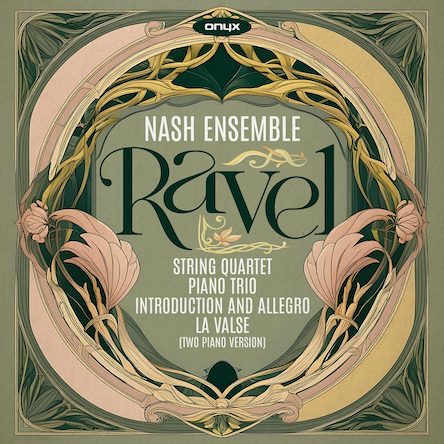
NASH ENSEMBLE plays RAVEL = Introduction and Allegro; Piano Trio in A minor; La Valse (two-piano version; String Quartet in F major – The Nash Ensemble – ONYX4270 ((75:55) (10/02/25) [Distr. by PIAS] *****:
The chamber music of composer Maurice Ravel (1875-1937) justifies Stravinsky’s epithet, “the most perfect of Swiss watchmakers,” analogy that characterizes Ravel’s sense of clarity, precision, and exotic coloring. The Nash Ensemble addresses some of the major compositions, 1902-1920, recorded 14-17 April at Yehudi Menuhin School in Surrey, under the supervision of Producer Andrew Keener. The Ravel album is dedicated to the memory of Amelia Freeman (1940-2025), sixty years the Artistic Director of the Nash Ensemble.
Despite Ravel’s stricture that “music must be emotional first a intellectual second,” the tension between Ratio and Eros colors his entire oeuvre, and the 1905 Introduction and Allegro for harp and ensemble, commissioned by Erard to highlight the virtues of its double-action, pedal harp, conforms to the demands of a concertino in the manner of a septet in G-flat major. Harp solo Lucy Wakeford establishes the dominance of her instrument in the measure 4 arpeggio, weaving a sensuous 4/4 theme, one of three, that the flute (Philippa Davies) and clarinet (Richard Hosford), and the cello (Adrian Brendel) have initiated, respectively. The shift to ¾ and moins lent (less slowly) graduates to a crescendo, only to dissipate in preparation for the sonata-form Allegro. While the harp will sang and dance the main theme in variants, color effects from viola (Lars Anders Tomter) and brilliant pizzicato strings will urge the music to the final, glistening harp cadenza, whereby trills from winds and strings lead us to a brief solo interlude by Wakeford, just prior to a dazzling, whirlwind coda.
Conceived on the cusp of World War I, March-August, 114, Ravel’s Piano Trio vibrates with aspects of his Basque heritage and his fertile, exotic imagination. Ravel often decried the incompatibility of the percussive piano and the soft string tones, but he manages to discover a marvelous, if eccentric, blend of color that results in musical magic. The opening movement, Modéré, relies on the repetitive 8/8 rhythms from the Basque zortzico, unusual in refusing to modulate for the second theme away from the tonic minor. The theme moves in small, scalar increments until it jumps a fourth as it concludes.
The second movement, perhaps, proves the most original: a pantoum, a Malaysian verse form in which two themes interlock through lines 2 and 4 of each four-line stanza, to become the first and third of the next stanza. In essence this movement embodies a scherzo and trio, juxtaposing ¾ injections by the string payers against the long 4/2 notes of the keyboard. Benjamin Nabarro, violin and Adrian Brendel, cello execute fiercely quick repeated, even in left-hand pizzicato, while pianist Simon Crawford-Phillips seduces us with melody. The slow Passacaglia movement testifies to Ravel’s penchant for Baroque taste. Marked Très Large ¾, the polyphonic technique taught Ravel by André Gadalge manifests itself in an 8-bar, processional theme – appearing first in the piano’s lowest register – reiterated eleven times, a concession to the Great War a step away from his Tombeau de Couperin suite. The pungent last movement Final: Animé, relies on two antagonistic rhythms, 5/4 and 7/4, a Basque construction that has violinist Nabarro’s having to negotiate, with precision, arpeggios and trills in harmonics. The Nash Trio performs this demanding but acerbically satisfying music with seamless aplomb.
I have noted elsewhere Ravel’s tendency to explode several of his dance forms, especially the Bolero and his 1920 homage to Johann Strauss and the Vienna Waltz, La Valse. Alistair Beatson and Simon Crawford-Phillips collaborate in the 2-piano version, a swirling mass of dance music that culminates in a self-destructive bacchanal. “Voluptuousness to the point of paroxysm” state Ravel’s own characterization of this virtuoso, tragic and demonic piece that sways and convulses in the style of Liszt but remains cross-fertilized by French savoir-faire.

Maurice Ravel, 1925
Finally, the cyclical Ravel F Major Quartet of 1902, which, while resonating the influence of Debussy’s 1893 Quartet in G Minor, maintains a striking individuality. Among the other sonic glories of the first movement Allegro moderato, “very gentle,” the dialogue between first violin Benjamin Nabarro and viola Lars Anders Tomter for the expressive, two-octaves-apart, secondary theme stands out for sheer, suave execution. The second movement, Assez vif, palpitates with cross rhythm typical of Iberia, pizzicato ¾ against 6/8, a concession no less to the gamelan sound of Java, but sonically open in a manner reminiscent of what Beethoven achieves in his middle quartets, Op. 59/1 and the “Harp,” Op. 74. By the end of the movement, he music’s “symphonic” dimensions burst forth in multiple-stop demands on the two violins, here executed fortissimo.
Much of movement one’s thematic tissue finds recycling in the third movement, Très lent, in which Tomter’s viola makes expressive points with stylistic glamour. The other players’ tremolo figures support a mysterious, muted atmosphere, rife with the feeling of a rhapsodic nocturne that Bartok might have envied. The last movement, vif et agité, thrusts stormy eighth notes in variable rhythms of 5/8, ¾, and 5/4, indulgent of emotional flourishes and demonstrative rhetoric. Recollections of movement one abound, but here these allusions have been blended in a storm both consoling and anxious, a musical enigma of which Fauré disapproved.
–Gary Lemco