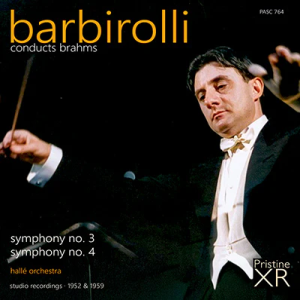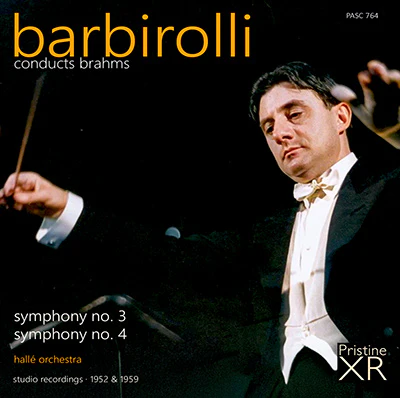
BRAHMS: Symphony No. 3 in F Major, Op. 90; Symphony No. 4 in E Minor, Op. 98 – Hallé Orchestra/ Sir John Barbirolli – Pristine Audio PASC 764 (71:59) [www.pristineclassical.com] ****:
Andrew Rose and Pristine restore two persuasive readings of the Brahms symphonies three and four led by Sir John Barbirolli (1899-1970), recorded 7-10 May 1952 (Op. 90) and 18-19 September 1959 (Op. 98) at the Free Trade Hall, Manchester. Andrew Rose does not refer to the Bluebird Classics (LBC 1042) incarnation of the F Major Symphony which had its UK release in 1953, so I suppose this performance, notable for its lyrically intense energy, differs from that American issue. The E Minor Symphony, recorded in stereo sound, receives a full, even lush, response in terms of weight and instrumental texture.
Barbirolli’s approach to the first movement Allegro con brio of the 1883 Symphony No. 3 in F Major seems to combine the linear, literal drive of Toscanini with the natural warmth of Bruno Walter, a fierce rhythmic alertness and a grand, singing line. The essential waltz pulse finds a nostalgia, though esoteric, in the (Schumann-influenced) F-A-flat-F motif that persists in an uneasy balance of major and minor. The Hallé woodwinds carry the burden of interior syncopation with warm clarity, while the string line neither sags nor yields to maudlin phraseology. We recall that the Brahms conception of classical architecture, its “unity of effect” (to cite Poe), made this symphony the very model of such writing for Edward Elgar.
The second movement, Andante in C major, endures as among the composer’s most beautiful, nostalgically bucolic, movements, opening as a 4/4 cassation or wind serenade. The beguiling warmth of the Hallé strings soon blends in and evolves a throbbing, heartfelt melody capable of sweet passion. That the rocking music lies in modified sonata form never occurs to us, since the seamless evolution of melody and transparent textures proceeds in a meditative, persuasive course that constantly hints at the motifs from the symphony’s outset. The third movement, Poco allegretto in C minor, projects a wistfully modified waltz in 3/8, which first made its impact on this listener in the movie Undercurrent, with Taylor, Hepburn, and Mitchum. Again, Barbirolli savors the long lines that flow over a pulsing and flowery bass and woodwind texture. The middle section has its moment of lyrical mystery before returning, on a diminuendo pedal point and horn entry, to the opening waltz.
The last movement Allegro – Un poco sostenuto (2/2) resolves issues among Brahms, Schumann, and Beethoven, tying all the intimations of his opening subject together in a “fateful” mix that includes Beethoven’s “fate“ motif and Schumann’s Rhenish Symphony. At the last, the Hallé’s muted violas will bring the mighty course of this movement to a close, entirely cyclical, as the opening motif rears up once more, softly but eloquently. Barbirolli’s is a generous performance, rich in texture and sympathy, though not an “epic” account on the level of Furtwangler, Klemperer, and Toscanini, but singularly warm in it embrace of a great composer.
The 1959 reading of the E Minor Symphony has broad tempos and an elastic, dramatic approach in the opening Allegro non troppo that renders the many “thirds” intervals into a seamless, tragic evocation in crepuscular colors. The Hallé woodwinds virtually whistle their transparent lines against the falling motif of the strings, a touch of wistful nostalgia in the course of a mighty, unbending line to the counterpoints that signal the composer’s epic resolutions. The transition to the recapitulation enjoys a tearful nostalgia, informed by the alert, syncopated counterpoints. The wind and brass regimen utter martial, if resigned, declamations, moving inexorably to a sterling memory of bucolic rapture. The dark undercurrents soon emerge to claim their due, the Hallé timpani in full throttle, and the coda unleashed by Barbirolli releases a gravitas worthy of the finer Brahms interpreters.
The Andante moderato in E major, 6/8, imparts its nostalgia early, in the opening horn solo set in the Phrygian mode of E, that likes to modulate (via clarinet and pizzicato strings) into B major for a series of yearning variations. The sonic ambiance here projects a particularly rich tone. Nobly intimate, the procession will acquire a spiritual largesse from the upper strings and cello line, molded by Barbirolli in warm, plastic, colors. At moments, the aura becomes devotional, a bucolic hymn in the form of a serenade. Some moments of dazzling polyphony, and the music asserts itself with epic vigor in martial terms. Then, the broad theme of ardent reconciliation, a huge breath from Barbirolli. The procession, in hushed tones, returns, this time with added, tremolo filigree, arpeggiated, a coda of intense, valedictory pathos.
The third movement Allegro giocoso, 2/4 in C, remains the unique scherzo in the Brahms symphonic oeuvre. But who else writes scherzos in sonata form? The music buoyantly moves into a hurtled G major, alert and rhythmically articulate from Barbirolli.
What passes for a Trio section, so abruptly, eases the tension a mite, only to tumble once more into the dervish antics of the da capo, rife with colors from triangle and bass drum. A whiplash coda, still wanting to demonstrate its “learned” propensities, gallops to a decisive, final note, a blazing three thumps.
The famous final movement, Allegro energico e passionato, offers a contradiction in terms endemic to the Brahms character: an extended treatment of an 8-messure theme from Bach’s Cantata 150, it plays as an antique Chaconne or Passacaglia in thirty-two, diverse color variants. The romantic impulse somehow endures through the scholastic procedure, often assuming an intimate or ecstatic energy. The tension between E minor and C major increases with mounting potency, suddenly bursting forth with a resolve that reminded me of my first audition of this mighty work, under Serge Koussevitzky. The alter playing of the Hallé flute finds equal pungency in the brass and strings. The final C major interlude once more sounds like a transparent serenade, until the heavy strings urge us to the peroration, the brass chaconne against the huge impulses from the exuberant strings, brass syncopes. Finally, the urgent rush to judgment of the coda, the composer’s swan-song to the symphonic genre which only slowly gestated in his erudite consciousness to achieve grand expression
—Gary Lemco