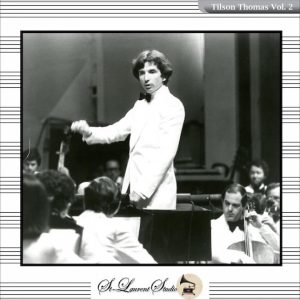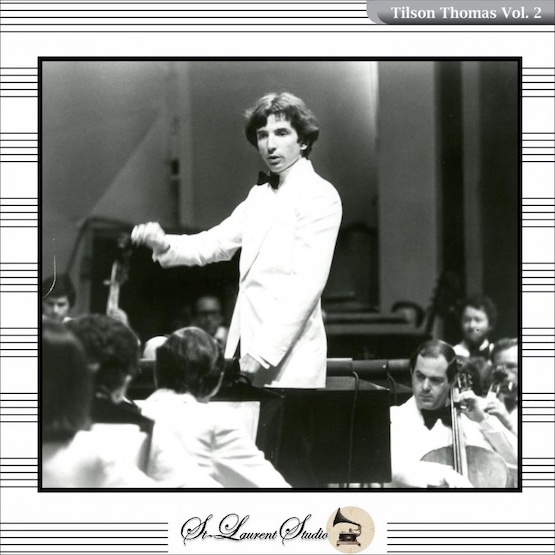
BACH: Suite No. 3 in D Major, BWV 1068; R. STRAUSS: Also sprach Zarathustra, Op. 30; BRAHMS: Piano Concerto No. 2 in B-flat Major, Op. 83 – Malcolm Frager, piano/ Boston Symphony Orchestra. Michael Tilson-Thomas – Yves St-Laurent YSL T-1815 (2 CDs = TT: 106:46) [www.78experience.com] ****:
The recent death of conductor Michael Tilson-Thomas (1944-2026) stirs a host of musical and artistic memories, especially given my own residence as a reviewer and broadcaster in the Bay Area, 2000-2025. Tilson-Thomas had assumed the mantle of both Dimitri Mitropoulos and Leonard Bernstein, tirelessly championing American musical composition and music education, while continuing to deliver a wide-ranging repertory from the Classics. One particularly glowing occasion involved Sibelius’ symphonies six and seven, in incandescent realization, these with the San Francisco Symphony. Another striking moment occurred after a piano recital in Atlanta by Tilson-Thomas that included Mussorgsky’s Pictures at an Exhibition, where while waiting on the line of congratulatory admirers, I spotted actor Jeff Corey – a friend of the conductor’s family, as it turned out – who invited me to join his acting class.
The Boston Symphony concert of 8 December 1973 opens with J.S. Bach’s ever-popular Suite No. 3 in D Major, (c. 1717-1723), whose revered “Air” receives a brisk andante realization, devoid of romantic sentimentality. The opening “Ouverture” enjoys a ceremonial pomp and resonance that maintains an elastic, dignified lyricism hose contrapuntal grandeur shines through. The playing by concertmaster Joseph Silverstein (1932-2015) illuminates Bach as well as Richard Strauss for his tonal richness and technical security. At the time of this concert, first trumpet Roger Boisin had retired, but his successor plays most admirably. The inflections for the two “Gavotte” movements, bouncily animated, remind me of Hermann Scherchen’s approach. The last two movements proceed with the same luster and graceful momentum, with the concluding “Gigue’s” igniting a grateful audience response.
Tilson-Thomas’ gift for leading large forces finds a happy vehicle in the Richard Strauss 1896 symphonic poem Thus spake Zarathustra, after the philosophical meditation by Friedrich Nietzsche. Recall that Nietzsche himself embraced contradiction as a viable element of human nature, so it comes as little surprise that the various appearances of Strauss’s “world riddle” motif will remain unresolved and even blatantly dissonant. The famous C-G-C opening has girth and immediacy, which Koussevitzky no less relished in his 1930 recording. The second section, Von den Hinterweltern, enjoys lyrical breadth but not the sustained intensity Fritz Reiner provided in Chicago.
“The Grave-Song,” juxtaposed with the succeeding “Of Science and Learning” pits the two dramatic forces in human finitude at odds, with the intricate figure of the latter section’s embracing, a la Liszt’s Faust-Symphonie, the tones of the whole chromatic scale, for their pursuit of all possibilities. Tilson-Thomas urges the BSO “The Convalescent,” to its joyful culmination in the luxuriousDas Tanzlied, Nietzsche’s assertion of amor fati, love of fate. Late in this section, set in C major, the B minor Das Grablied recurs, if only to complete the total acceptance of Man’s finitude. The “chimes at midnight” toll for a lonely existence of the Night Wanderer, exactly what Nietzsche chose to relish. An enthusiastic Boston audience applause reassures our conductor that he is not alone.
Joining Tilson-Thomas for the Brahms 1881 Piano Concerto No. 2 in B-flat Major, we have American virtuoso Malcolm Frager (1935-1991), one of the more noted pupils of the great Brahms and Schumann disciple, Carl Freidberg (1872-1955). Clarity and optimism of spirit define the large opening movement, Allegro non troppo, which often beckons its poignant, “symphonic” texture out of the Black Forest. We can appreciate Frager’s huge landings in the various periods that define the first movement’s sonata-form progress, the alternation of huge block chords and fluent arpeggios with staccato filigree that easily transition into monumental gestures. The alert character that emanates between solo and individual orchestral choir members enjoys a palpable congeniality of effect, given the warm patina the BSO projects throughout the entire score.
The “tiny wisp of a scherzo” in D minor ensues, the structural innovation that added a new dimension and girth to the concerto format, with an emotionally turbulent character that testifies to the composer’s own concept of sturm und drang. Frager urges the momentum breathlessly forward, the intervening, meditative riffs notwithstanding. Both collaborators maintain the epic scale of the score, even permitting the softer periods a degree of refined intimacy. The central D major section enjoys a hymn-like sonority, answered by Frager in his most brisk toccata style, then relenting into a warm salon moment that soon explodes into a jubilant exclamation of the opening motif in a hazy then stentorian mode.
The wonderful Andante relishes two minutes of cello arioso with strings and woodwinds before Frager enters, so we have soon succumbed to the idyll’s enchantments. The easy ballade darkens into passionate tumult in B-flat minor, in which we can savor Frager’s vibrant trills and large or broken chords. The needed calm, here in F# major, attains an almost static serenity in the mode of a pian and winds serenade or intermezzo. The uncredited cello soloist leads us, by circuitous routes, back to the tonic key along with a lithe Frager, whose upper register sings most transparently.
The five-part Allegretto grazioso communicates a large, buoyant (Mozart-like) dance character, with an occasional Hungarian flavor that can erupt into some volcanic bravura. The long singing lines – an alternation of march and ardent, romantic lyric – revel in their mixed orchestral blends, with Frager’s injecting that degree of virtuosic impetus which thrilled us in movement two. Frager and French horn invite us to the closing energies, mostly in triple meter, the keeps the flightiness fresh and bold. This long concert has had the audience in the palm of its hand, and now all hands are free to explode in admiration.
—Gary Lemco