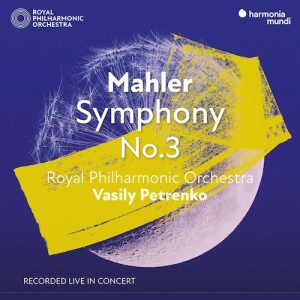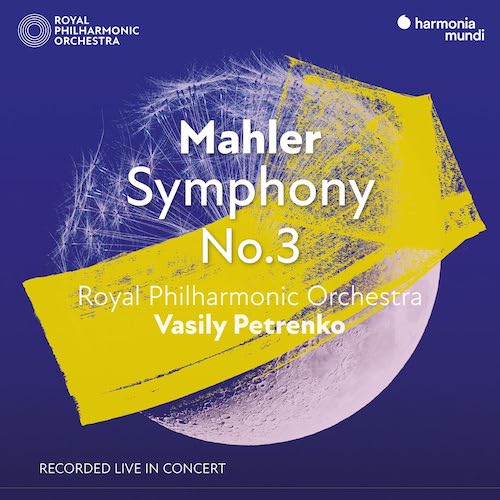
MAHLER: Symphony No. 3 in D Minor – Hanna Hipp, mezzo-soprano/ Philharmonia Chorus/ Tiffin Boys’ Choir/ Royal Philharmonic Orchestra/ Vasily Petrenko – Harmonia mundi HMM 905421.22 (2 CDs = 1:36:12) (5/22/26) [Distr. by PIAS] ****:
I well remember my first encounter with the longest, perhaps most cosmic of all symphonies in the classical repertory: Mahler’s Third, D Minor Symphony (1895-1896), led by James Levine with his Chicago Symphony Orchestra, whose first movement did not fit onto the RCA vinyl disc and had to be continued on the next side! And the music – a six-movement monolith devoted to a pantheistic or eschatological exploration of Nature and Being – as if Nietzsche and Spinoza had been coaching Mahler in the mystical direction of the late Beethoven quartets. In two parts, the work posits a procession from the first, martial stirrings of life, “Pan Awakes,” to a series of naturalistic and preternatural settings, from summer, to flowers, to animals, to Man, to Angels, and to (Divine) Love. The ambitions of this composer invite warnings of metaphysical hubris: his audacious confrontation of the mundane and sublime, the banal and the transcendent. Mahler claimed his symphony realized “a world,” the One and the Many and its every permutation of contradiction. The coda must be Whitman’s “Barbaric Yawp.” When I heard Dimitri Mitropoulos conduct the same work, the intensity became an agonized rage against the diurnal world in spite of its immanent spirituality.
The often dire, funereal harmonic motion of Part I finds some consolation in the allusion to the hymnal theme from the Brahms C Minor Symphony last movement. The shifting themes and emotional contours resemble more a Wagner operatic scene than a sonata-allegro orchestral movement. Hints of klezmer music infiltrate the march, a concession to the mundane embraced with the same optimism as Mahler’s penchant for rapture. Moments of desolation and doubt no less haunt the momentum, and a solo violin (then flute) offers brief solace, as do bird calls and mocking sounds from the natural world. String counterpoint confronts brass syncopations to invite another whimsical clash between mortality and humorous parody. The pungently mercurial character of the music anticipates both Ives and Shostakovich. If Pan has awakened, he has no less died, and it is the thought that “in the midst of life we are in death” that Mahler finds acceptance, Nietzsche’s Amor fati.
A long pause should ensue before the resumption of music for Part II, marked Tempo di Menuetto, a “carefree” excursion among the flowers of the field. The virtuoso execution by the RPO strings and woodwinds warrants the price of admission, persuasive and sensuous, at once. The bucolically languorous and rustic serenity endures, what Edmund Spenser would characterize as “a bower of blisse.” The second section, Comodo (Scherzando) invokes the dancing joy of the forest primeval before the advent of Man. An offstage posthorn announces the appearance of Humanity, and we hear echoes of La folia, appropriate enough as commentary for Man’s contribution to the natural world. A combination of perverse humor and riotous, polyphonic frenzy results from the extended notice of human invention and influence. Posthorn and tremolo strings urge us to the La Folia motif, and “the eternal note of sadness” sounds once more. The furor erupts in echoes of the original dance, but the mirth of the moment has been broken, the coda a whiplash thrust.
From the deeps of Night, we hear a voice, that of mezzo-soprano Hanna Hipp, intoning the words of Nietzsche, from his spiritual mediation, Thus spake Zarathustra, alerting Man that he must awaken to the mystery of life, which eludes all regret. A midnight nocturne, the episode offers consolation beyond dogma, the melody fraught with longing for a joy that denies nothing of existence. The dialogues of winds horns, strings and horns, cast an eerie serenity in “Eternity” that we Mahler acolytes know will haunt the last thoughts in Das Lied von der Erde.
The “child,” the third stage of Nietzsche’s concept of spiritual evolution, appears in movement five, here as a chorus of angelic bells that send forgiveness as a Divine judgment on Man. The spiritual impulse, clearly Christian in nature, seems counterintuitive to the Nietzschean maxim that “God is dead,” meaning that Man must assume total responsibility for his existence without recourse to metaphysical consolations. Yet, here Mahler, via soloist and children’s and women’s chorus, promises Divine mercy. The melody, of course, will engender the “heavenly-feast” vision of the Fourth Symphony.
The last movement, “What Love Tells Me,” seeks the same source for universal salvation, even quoting Wagner’s “Christ’s Suffering” motif from Parsifal. The initial impulse for the grand Langsam – Ruhevoll appears to derive from the slow movement Lento assai, cantabile e tranquillo of Beethoven’s last completed work (1826), his String Quartet in F major, Op. 135. Petrenko and the RPO maintain a crystalline transparency of texture throughout this sustained contemplation of Last Things, Mahler’s stunning, blazing, musical eschatology. Man, Nature, and God find a mysterious reconciliation of spirit, perhaps an exalted tocsin signaling a call to support and redeem the collective, uncreated conscience of our Divine planet.
An absolutely, previously silent audience emerges after the elongated coda, fully alter to Mahler’s call for a better world.
—Gary Lemco