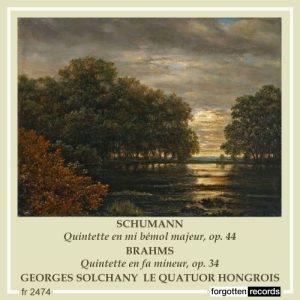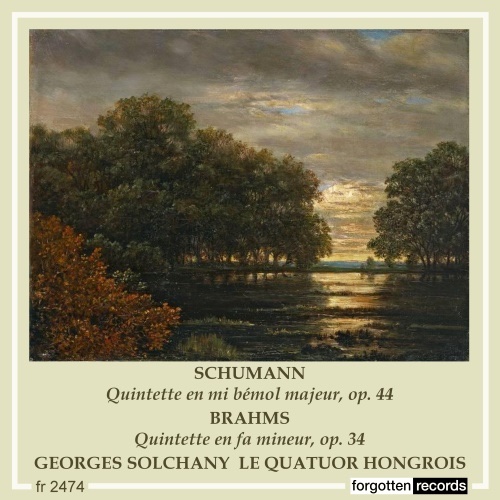
SCHUMANN: Piano Quintet in E-flat Major, Op. 44; BRAHMS: Piano Quintet in F Minor, Op. 34 – Georges Solchany, piano/ Hungarian String Quartet – Forgotten Records FR2474 (66:57) [www.forgottenrecords.com] *****:
Hungarian Georges Solchany (1922-1988) has had scant revival in the CD format, so it is with particular gratitude that we consider Forgotten Records’ offering of the 1958-1959 collaborations with the Hungarian String Quartet of the great Romantic quintets by Schumann and Brahms from Les Discophile Francais. Born in 1922, Sochany studied at the native Conservatory, where at eighteen, Erno von Dohnanyi accepted Solchany as a member of his master class who soon earned the coveted Grand Prix Franz Liszt in1942. Solchany settled in Paris in 1946, and he soon attracted musicians of the highest order – David Oistrakh, Sandor Vegh, and Leonid Kogan – as fellow participants. Besides the Franck, Dvorak, Schubert, Schumann and Brahms quintets, Solchany recorded the latter’s piano quartets and the piano trios of Beethoven. Solchany recorded for EMI, but no assembled collation of his work has appeared.
Robert Schumann’s Piano Quintet (1842) represents an innovation – excepting the infrequently heard piano quintets of Luigi Boccherini – the combination of piano and string quartet, since Mozart and Beethoven had combined the keyboard against the woodwinds. Schumann wrote in the throes of his “song year,” wherein the various keyboard compositions were meant to showcase the talents of the composer’s wife, Clara Schumann. Among my perennial, recorded performances was that by Clifford Curzon and Budapest String Quartet on Columbia (ML 4426), a mixture of emotional stamina and infinite tenderness. Solchany, too, imparts (rec. 27-28 December 1958) bold strokes and intimate gestures in abundance, as the first movement Allegro brilliante proceeds in Schumann’s typical economy of means. Cellist Gábor Magyar imparts a rich counter to Solchany’s top voice, while the equally vibrant tone colors of Dénes Koromzay’s viola enriches the polyphonic episodes and unison passages.
The familiarity of the eerie, C minor second movement In modo d’una marcia, un poco largamente, extends into its appearance (in orchestral guise) in Edgar Ulmer’s classic movie The Black Cat, with Lugosi and Karloff. Schumann’s standard procedure introduces two episodes, here in a sweetly nostalgic C major a contrasting storm in F minor. The strings virtually growl under Solchany’s rapid figurations, especially Koromzay’s fine viola. The C major tune has first violin Zoltán Székely to thank, he the dedicatee of the Bartok Second Concerto. The buoyant Scherzo: Molto vivace proceeds in the manner of a steeplechase, the piano part both dainty and manically alert. Two trio interludes come forth: the first varies the content of the opening movement, while the second rather anticipates Liszt and his gypsy/Magyar folk reveries.
For years, my model of for the fourth movement Finale: Allegro ma non troppo on records lay with Artur Schnabel and the Pro Arte Quartet. A whirlwind combination of sonata and rondo forms, the piece has each instrument add to the melodic richness and athletic vigor of the occasion. Fugal and canonic elements abound as Schumann demonstrates his inventive powers. The piano’s reflective moment precedes the fugue proper, taken perhaps a bit too quickly for some tastes. A grand climax leads to yet another polyphonic procession of resonant glory that again allows Solchany his reflective nostalgia. The coda, once initiated, enjoys a marvelous inertia, cyclically rounding off a work whose aesthetic closure continues to awe us admirers.
That Brahms deeply admired the work of Franz Schubert finds ample testimony in the 1864 Piano Quintet in F Minor, Op. 34, a work that often confounded the composer with the medium to which it would best suited. Having long cherished Schubert’s C Major String Quintet, first tried (in 1862) the same arrangement, but violinist Joachin proclaimed the string parts too difficult to manage. When Brahms chose to recast the work for two pianos, the influence of Schubert’s C Major Grand Duo for 2 Pianos (1826) came candidly to the fore, given that the Brahms Op. 34b offers the Sonata for 2 Pianos. The last movements of the respective pieces share melodic and rhythmic currency, a trait no less evident in the second movement, Andante, un poco adagio, which borrows heavily from Schubert’s lied, “Pause.” One commentator noted that in the last movement Brahms approaches Liszt in having employed a melody using eleven of the twelve notes of the chromatic scale, an example of what Schoenberg dubbed “Brahms the Progressive.”
Solchany and the Hungarian Quartet recorded the Brahms Piano Quintet 4-6 June 1959. The first movement establishes a unison entry in eight measures that immediately assumes a “symphonic” sonority, the mood tempestuous and emotionally taut. The series of expressive melodies unfold naturally, including pregnant ritards in the progress, Solchany’s part restrained in the pedal points that define the menacing periods throughout the Allegro non troppo. Although percussive, the keyboard part does not overwhelm the urgent strings, in which the violins, Szekely and Alexander Moskowsky, realize their parts most expressively. The coda of the movement celebrats the power of the synchronous ensemble.
The second movement proves especially tender, given the 34 bars that set the tone of a lyrically nostalgic lied. The violin and viola will take up the music in unison triplets for the secondary motive set over a strummed effect from Solchany, the music’s having become a troubadour’s song. The low intonations of the cello part exert a sense of deep meditation. The volatile Scherzo: Allegro, with its relentless syncopes and dotted rhythm, has always suggested to me a Bismarckian declaration of martial intent. A pregnant pause leads to Solchany’s rather muted expression of the march in more lyrical terms, though the development assumes a sterner hue. A third theme emerges that links to the restrained trio section before muted rhythmic germs once more release the furies insistent in their fevered pulse.
The last movement evinces the most forward-looking harmonies, Poco sostenuto – in fugue format – chromatically adventurous outlines of the minor ninth. We will meet these eerie impulses later in Brahms, in his Intermezzo, Op. 119, No. 1. The ensuing Allegro non troppo, clearly derived from Schubert, proffers both an energetic dance and an expressive melody dictated by the strings, especially the cello. Once more, tiny ritards introduce the main theme in variation, as lyrically affecting as it rhythmically propulsive, almost in the manner of a Hungarian Dance. The rhythmic inflections demonstrate their own cleverness, slowing down to evolve the coda, blending the dual themes in a propulsive and impetuously mad dash to a most forceful sense of learned, aesthetic closure.
I heartily recommend that admirers of Georges Solchany seek out the remaing discs in the Forgotten Records catalogue.
—Gary Lemco