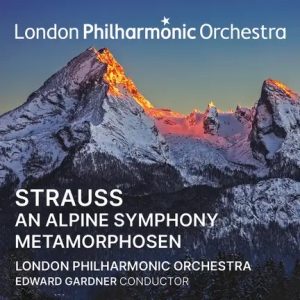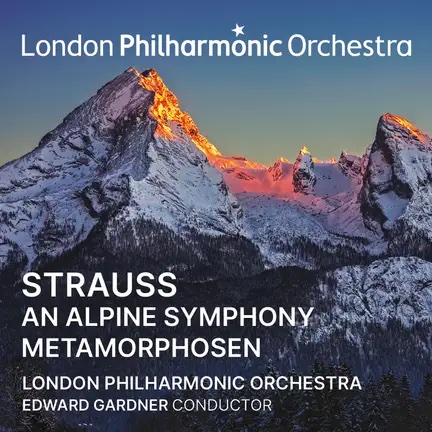
R. STRAUSS: An Alpine Symphony, Op. 64; Metamorphosen for 23 Solo Strings – London Philharmonic Orchestra/ Edward Gardner – LPO-0140 (77:59) (6/26/26) (6/[Distr. by PIAS] ****:
Having already exploited and expanded the limits of the symphonic poem, gleaned from Franz Liszt, Richard Strauss composed two large orchestral works decidedly meant to culminate his notion of “program music.” If the 1903 Domestic Symphony created an iconographic picture of social life, this work instantiated his faith in Nature. Strauss remained an avid mountaineer, and like his philosophical idol Nietzsche, a resolute pantheist. Recall that Liszt’s first of his thirteen orchestral tone-poems, the so-called Bergsymphonie (1848-1854) after Victor Hugo, set the model for Strauss and Mahler. Strauss proffers a journey in 22 sections, beginning and ending with Night, in order to give closure to a kind of musical ouroboros. Nature’s simultaneous beauty and limitless power find musical expression in the composer’s exploitation of the gamut of the orchestra’s capacity for intimacy and majesty.
The etiology of the Strauss mountain journey assumes a circuitous route when we consider the composer’s original intent to call the piece The Antichrist, after Friedrich Nietzsche’s 1888 polemical essay accusing Christian ethics as having enervated Man’s innate seeking of power, without recourse to metaphysical consolations. The mountain ascent and the fearful descent in the midst of a powerful tempest perhaps encapsulate a life crisis surmounted by a confrontation with Nature at its most existentially dire point. Had Nietzsche retained spiritual credit from Strauss, the work would signify a liberation of spirit achieved in the lofty solitude and ontological immanence of Nature. Strauss has both Keats (“Ode to the West Wind”) and Debussy (“La Mer”) as kindred spirits.
Night offers us a theme in dotted rhythm that serves an organic function throughout the entire symphonic poem. The brooding, pedal-point atmosphere suddenly concedes to the thrilling appearance of sunrise, realized by strings, winds, tympani, snare, cymbals, and brass. Encouraged by the sun, the travelers begin their ascent with hearty confidence. The melodic and sonorous allusions to the composer’s Don Juan hover about. Various musical pictures proceed – a la Wagner and Smetana – through woods and streams, including the sounds of bird calls, a waterfall and cowbells. None can deny the Strauss gift – Stravinsky called him a “connoisseur” of effects – for orchestral color and text painting, perhaps making us compare him to Respighi.
Some chromatic leaps and passing, contrapuntal dissonances make us understand we have made some wrong turns on our upward path, the undergrowth’s catapulting us upon a glacier, rife with low-brass perils. But such risks incur the reward of the Summit, invoked by a shepherd’s oboe melody not so far from Wagner’s Tristan. The visual glory persists, embracing a Vision with the same melodic and beatific, sonic currency as had informed the equivalent scene in Don Quixote. With the onset of mists, however, a sense of danger infiltrates the atmosphere, the harmonies modally ambiguous, the sun obscured as to invoke the Elegie, a farewell to security. The Calm before the storm has all Nature in expectation, a preparation for the dynamic means of the mountain Thunder and tempest, utilizing thunder sheet, wind machine, and organ, in tandem with brass, who seem to invoke a Wagnerian peal from the skies.
The precipitous descent leads to the end of diurnal cycle, beginning with Sunset, an exalted moment of sustained rapture and gratitude. The penultimate sequence Ausklang (just ending), nostalgically reflects on the lasting impressions of the journey, the resolution of possible aesthetic and moral imperatives. The bass motif recurs to realize Night, the resolution to “the problem” of existence,” here posited as a Faith if not in some absolute deity, then in Nature, whose awe and beauty stand immemorial.
Strauss composed his Metamorphosen in 1945, a one-movement string serenade or “threnody” commissioned by Paul Sacher Basel, from Basel, Switzerland. This tragic score serves to commemorate a fallen Germany – even more, a fallen era of humanity – which National Socialism all but obliterated from the earth. The original commercial performance (on DG) of this tenderly grueling music, by Wilhem Furtwaengler, came to us 27 October 1947 from the very Berlin that had served the Nazi administration. Leopold Stokowski, however, had rendered a CBS radio performance of memorable intensity even earlier, 19 March 1947. To complete a recorded triptych, I cite the 1953 reading by Jascha Horenstein with the National French Radio Orchestra, of subtle, shifting nuance.
Edward Gardner approaches the music with requisite, studied veneration. The long Adagio unfolds broadly stated and executed in warm, occasionally stringent lines to evince what Strauss noted as “In Memoriam,” in its repeated application of Beethoven’s Funeral March from the Eroica Symphony. The title may well invoke the classical Ovid, in its sad dissolution of a once-epic spirit, both of the man Strauss and his chosen political environs 1933-1945, Hitler’s Germany. The long, chromatic melody assumes three major variants, all intertwined, that project a melancholy yearning no less captured by the German poet Goethe, who claimed the idea of “metamorphosis” as a rubric for his spiritual and psychic development.
Two disparate scores by Richard Strauss, excellently played and recorded live at Royal Festival Hall 15 January (Metamorphosen) and 21 February 2025 (Alpine Symphony), and handsomely produced by Nick Parker.
—Gary Lemco