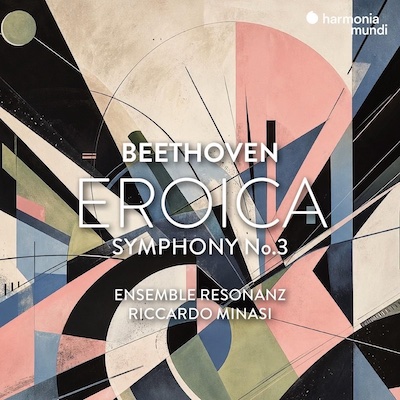
BEETHOVEN: Symphony No. 3 in E-flat Major, Op. 55 “Eroica” – Ensemble Resonanz/ Riccardo Minasi – Harmonia mundi HMM 902417 (46:27)11/6/26) [Distr. by [PIAS] ****:
Beethoven’s 1804 Symphony No. 3 “Eroica” impressed upon him the designation “the man who freed music,” given the scope and emotional breadth of this unprecedented work. Whether we “require” another Eroica recording remains moot, I suppose, given this new, April 2025 account from Hamburg. Recall your first recording of Beethoven’s Third in your collection: mine was to be heard from 78rpm shellacs, with Serge Koussevitzky and the Boston Symphony. Maturity in this matter required further listening: to Matacic, Toscanini, Kletzki, and Furtwaengler. Later, when the matter of “original metronome markings” and “period instruments” became prominent tropes, readings by Zinman, Scherchen, and Harnoncourt rose in debated stature.
The present performance, swiftly executed by a combination of period and modern instruments, emphasizes Beethoven’s metric and rhythmic displacements in movement one, the fierce articulation of accents and attacks, the verve of a driven focus. Beethoven deliberately sets the Eroica as “a musical problem” to be solved: how to reconcile the agogic conflicts and win a convincing resolution born of a self-imposed limitation: perhaps the musical instantiation of Romantic political philosophy.
The sheer hustle of the various voices and shifting modulations finds a false relief (in B-flat major) in the seductive melody of compromise. After the tumultuous development section, the recapitulation hurtles us to the trumpets’ annunciation of heroic resolution. Rarely have Beethoven’s “rocket” figures so explosively urged themselves forward. The grand pauses in the movement bear as much drama as the feverish runs of motion, the bases for all of Bruckner. The punctuations among strings, horns, flute, and tympani wonderfully glide to an astonishing peroration. The manic fluidity suddenly breaks off, and breathless, we arrive at the decisive coda.
The famed Funeral March in C minor (Adagio assai) will inherit conductor Minasi’s penchant for thrusted ascents, even a bit of portamento, and a portentous sense of doom. His basses literally groan prior to the oboe’s thematic entrance, supported by staggered string figures. A lyrical respite arises in C major, still martial but punctuated by flute, tympany, and triumphant brass. The dirge resumes, now moving with ardent, polyphonic sonority as a fugue in fateful F minor.
Minasi’s layers the emergent voices, so as to build a cathedral of sound, potent over a tympanic pedal. The texture clears away, leaving the agony of defeat in our ears, a brass tocsin to be imitated often by Shostakovich. Minasi indulges in some luxurious sighs as the mournful procession into a more resolute stance, the tympanic and brass gestures explosive. A sense of spiritual dissipation concludes the movement, a suggestion of Shakespeare’s “the rest is silence.”
Manasi has been just waiting for the urgent chase of the Scherzo: Allegro vivace, ¾, with its dynamic intensities altered and conflated at will. The music presents thunderous possibilities which Beethoven holds in relative check, allowing the Trio to sing of the joys of the hunt with an unprecedented trio of French horns. The da capo comes hustling back, the tension held taut by the winds and quivering, bouncing strings. The shift to duple time seems only to accelerate the intensity of an already breathless surge of energy.
Palpable compositional genius defines the last movement, Finale: Allegro molto, which presents a hybrid sonata-variation form, using two alternate themes, from the bass and the melody, proceeding in ten variants. Minasi’s troops eminently enjoy their blisteringly fast interchanges of register and texture, with the flute’s literally ascending to the skies. The “Prometheus” theme itself represents more than Beethoven’s application of a motif from his prior Op. 43 ballet and his Op. 35 piano variations: the Greek figure stands as the icon of the Romantic urge to spiritual liberation and defiant, self-development.
Witness the treatments as early as Aeschylus, and followed in kind by the Romantics, the Shelleys and Liszt. That Beethoven constructs, among other contrapuntal inventions, a five-voice double fugue, testifies to the utterly Classical control he exerts upon a “free spirit.” Manasi posts his brass in high relief as the stretti surge and retreat, until the final, manic rush, Presto, to cosmic judgment, a veritable triumph of the spirit.
Purchase yet another Beethoven Eroica, strictly for itself with no other “filler?”
I doubt you will regret it.
—Gary Lemco
More information at Amazon