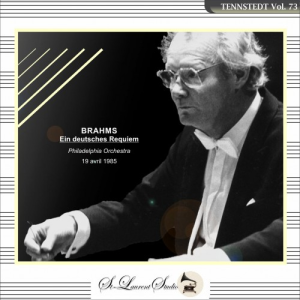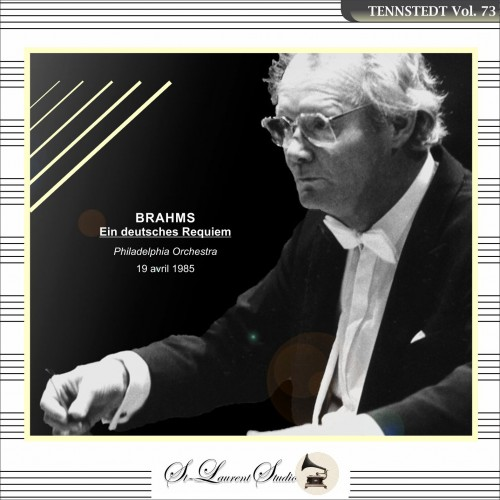
BRAHMS: Ein deutsches Requiem, Op. 45 – Benita Valente, soprano/ Wolfgang Brendel, baritone/ Singing Choir/ Philadelphia Orchestra/ Klaus Tennstedt – Yves St-Laurent YSL T-1562 (77:30) [78experience.com] *****:
A Brahms devotee, I have long cherished the composer’s A German Requiem (1856-1868) for its non-sectarian sense of devotion, its communion with the living, and its immense power of musical, even learned, expression. The EMI recording (1947) with Herbert von Karajan, assisted by Elisabeth Schwarzkopf and Hans Hotter, set a grand but grim tone for the work. Followed the Otto Klemperer version (1961) with Schwarzkopf and Dietrich Fischer-Dieskau, hugely and epically consoling. Ensued a litany of fine renditions from Rudolf Kempe, Bruno Walter, Fritz Lehmann, Wilhelm Furtwaengler, Willem Mengelberg, and Arturo Toscanini, among notable others. The work’s spiritual genealogy traces to both Bach and Schütz, a strictly Lutheran homage that, even in its grudging, skeptical reliance on an afterlife, finds structure and meaning in the Lutheran Bible texts, and their tolerance of doubt as a precondition for faith and acceptance.
Klaus Tennstedt, a confirmed Romantic conductor, leads a performance from Philadelphia, 19 April 1985. The opening presents his violas – the violins absent – with a grinding, grainy sound that literally dissipates from the force of his impassioned, opening chorus, especially the plaintive women’s choir. The Tennstedt penchant for monumental lines does not undermine the solidity of his relatively slow pace (11:59), much resembling Lehmann’s recording for DGG. The phrasing, breathed deeply, resonates clearly, retreating and thrusting forward, rife with doubt and conviction. Tennstedt’s dynamic control, graduating his diminuendos, crescendos, and brisk entries, feels lavish in its flexibility, his spiritual largesse.
The second movement in B-flat minor, longest (14:50) of the set of seven, presents its own challenges, especially in the ambiguous nature of ¾ waltz-death march tempo. Of my many admired recordings, the 1947 Karajan may well remain of first rank for pacing of “Denn alles Fleisch, es ist wie Gras.” Much like Klemperer, Tennstedt invokes a dire, solemn fate into the context, a resolute sense of dark fate. The timpani triplets virtually haunt the utterance of the chorus. The rising tension feels like a doom unleashed, ff, to remind us of existential finitude. With what transcendent light does the music move to “Be patient,” and we must remind ourselves that the most frequent word in Brahms is Freude. The Philadelphia strings grant Tennstedt a plangent warmth that might have illumined a Stokowski reading. At the pregnant pause, the chorus erupts in glorious hope, assisted by potent orchestral counterpoints from Brahms, the result a sweeping sense of conviction. Jabbing accents and huge pedal points collaborate to create a voluminous, spatial effect in the Philadelphia Academy of Music. The distant brass and assisting wind choir signals a compromise with Fate, the timpanic current still insistent.
Enter baritone Wolfgang Brendel, brooding in his meditation on Man’s fate, his characterization quite effective and dramatically poised, even embracing the high F later, although Hans Hotter remains quintessential in this role. The plea in high notes flows without strain, though the context per se questions the validity of faith. Conductor David Randolph and I, at a “First Hearing” audition of this movement, noted both the thematic resemblance to Dvorak’s Cello Concerto and the ensuing, amazing fugue and its sustained D. A dizzying effect emerges from Tennstedt’s mixed choir, asserting primacy of place lies in a well-disciplined chorus.
Section 4, “How lovely is Thy Dwelling Place,” taken from Psalm 84, proffers a choral, lyrical meditation on the attractiveness of both Heaven and Eternal Life. Tennstedt has his forces gently rocking in lulling fashion, the transparency of voices and instruments casting an enchanted spell here, the crux of the symmetrical structure Brahms has built.
The Fifth movement, taken from John: 16:22 “Ye now are sorrowful,” has the talented voice of Benita Valente, often a favorite of the Marlboro Festival and Rudolf Serkin. Her resilient line likely means to capture something of a lament for the passing of the composer’s mother, a death that reverberated perhaps more than that of mentor Robert Schumann. Most affectionately, Valente’s plaint, darker in tone than, say, that of Lucia Popp, offers maternal comfort for the most daunting of life’s trials. This expression of Divine Innocence likely provides the model for Mahler’s final movement of his Fourth Symphony.
The Manichéan struggle of opposed forces culminates in Section 6, “Behold I Show You a Mystery,” from Corinthians combined with a text from Hebrews, contemplations of death, transformation, and the passion for continued existence. The Philadelphia strings and winds seem to suck in a collective breath as the chorus intones the “mystery” of death and resurrection in vague harmony. A steady pulsation marks the way to Brendel’s heartfelt exploration of the Lord’s will. At the word “augenblick,” the blinking of an eye, the wondrous change announces itself, and the chorus and orchestra explode in polyphonic thunder, challenging Death itself, whose “sting” has lost its capacity for fear. The skies open, releasing a glorious fugue of revelatory thanksgiving. Tennstedt’s forces inject a pungent clarity, a passionate insistence into the festive exultation.
Considering the last movement of the Requiem, we realize the orchestra harp has appeared in a mere three of its movements, but it has made its presence felt. Now, in Movement 7, the basses and cellos swathe the initial, choral lines of the opening in the light of Divine Comfort. Brahms set the original tone with first three notes Movement 1, which have appeared in various permutations throughout: here, the beatitude from the Sermon on the Mount consoles the living with the eternal peace of the dead. The radiant character of the sopranos and male choir beckons a cosmic pity, all of life’s resignation compressed into one word, Blessed,” with which the “fearful symmetry” of the Requiem began.
A fine performance, for which we owe a debt to Yves St-Laurent Studios.
—Gary Lemco