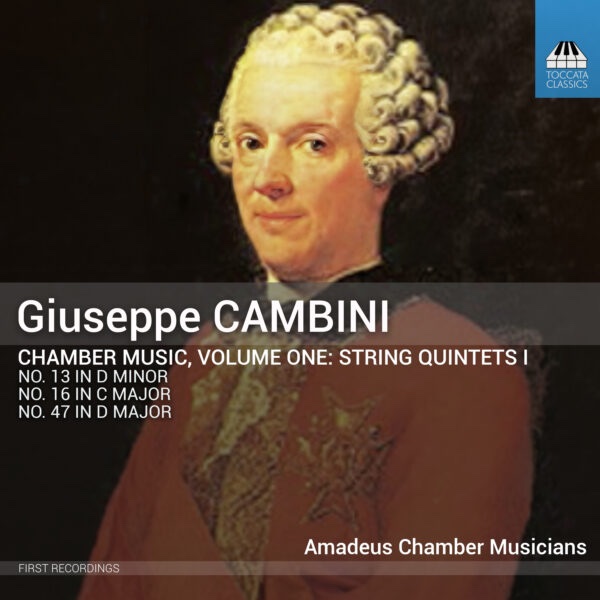
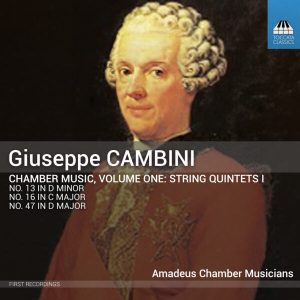
CAMBINI: Chamber Music, Vol. I: String Quintets I = String Quintet No. 47 in D Major; String Quintet No. 13 in D Minor; String Quintet No. 16 in C Major – Amadeus Chamber Musicians -– Toccata Classics TOCC 0810 (57:46) (10/2/26) [Distr. by Naxos] ****:
Giuseppe Maria Gioacchino Cambini (1746 –1825) left a sizable legacy of operas, sacred music, concertos, and chamber music, especially the 110 string quintets attributed to him. He claimed pedagogy from Francesco Manfredi, Pietro Nardini, and Luigi Boccherini, Cambini’s specializing in viola performance. Another composer, the Beligian composer Fétis disclaimed any knowledge of Cambini’s relationship to Nardini or Boccherini. Mozart refers to a 1773 concert in Paris at which Mozart improvised a violin part of a Cambini quartet, to which the composer took exception. Cambini’s devotion to chamber music remains obvious, and The New Grove compliments his “facility” and “galant, Parisian craftsmanship.”
Cambini scores his quintets for two cellos, savoring the deep, rich, low sonorities. The Quintet No. 47 in D Major (c. 1795) opens Allegro maestoso, 4/4, evolving in sonata form with a unison theme in descending 6ths, ff, followed by dotted figures. The first violin will offer both melodic tissue and some bravura runs, modulating to A major, legato and mf dolce, in thirds. The extended development features some turbulence, a move into B minor, with alternating dialogue for the two cellos. The D major recapitulation takes advantage of the various motifs, the initial theme’s having been enriched by low triplets that urge the violin melody to a sonorous finale.
The chromatically colorful Adagio casts a serious mood, ¾, in A major. A repeat of the opening becomes interrupted by martial ff F# minor harmonies, only to regain its initial serenity. Cambini likes to subdivide his cadences, so that the progression between B minor and D major can assert itself. The legato nature of the movement resolves, despite the diverse key changes, and coda resolves pp.
The busy last movement, Presto ma non tanto, suggests a hunt set in ¾. Like Haydn, Cambini couples rondo and sonata form, featuring a concertante violin part. Once more, B minor will compete with D major for supremacy via several episodic periods, but the conversations remain genial and spirited. The drone effect adds a rustic color to a rich tapestry that well becomes a composer grounded in the transition between the Baroque and Classical sensibilities.
Cambini’s Quintet No. 13 in D Minor begins with its own Allegro maestoso, a winding, chromatic melody in eight bars plays unisono, soon becoming “symphonic” and contrapuntal. The modulations occur darkly, D minor to A minor, with shuddering, menacing impulses that dramatically suggest the composer’s personal sturm und drang.
The development – in G minor, E-flat major, and C minor – brings more turbulent polyphony, the drama easily suggestive of moments in Beethoven and later Mendelssohn. The D minor recapitulation becomes virtuosic in its counterpoints, with deep resonances from the low cellos. Abundant figures in arpeggios, triplet scales, many in loud then soft dynamics, urge us to a resolute coda.
Set in 6/8, the D major second movement bears the designation, Pastorella. Andante comodo. The opening shares the melody between first violin and cello, a lilting, affectionate atmosphere. A sense of fluid serenity established, the music could be a nocturne or string serenade rife with pleasing echo effects. Cambini favors the piano dolce dynamic, so the legato ease of motion forms a seamless continuity. The music ends a mite too soon.
The last movement, Allegretto moderato semplice e vego, in D minor, offers a rondo whose designation vego, indicates indecision, uncertainty, to depict the violin’s sad melody. The second subject lies in A major, a counter (in extended variation) to the mournful tone at the opening. Late in the movement, the viola enters a jubilant and virtuosic in the major mode of D to soften the return of the D minor “threnody,” the term applied by annotator William Melton. The coda proffers two ff outbursts to announce Cambini’s own version of a “hard-won resolution” to his expressive, significant composition.
Cambini’s Quintet No. 16 in C Major imparts equal, color vigor due to its plethora of key changes in the first movement, Grave – Allegro, ¾ that likes the piano, dolce dynamic. Again, the initial triadic key theme appears first unisono then in richer harmony.
The violin offers a drooping motif the other instruments take up, Grave, then the Allegro opens more rhythmically active. After settling temporarily in G major to end the exposition, the development has the main theme pass through A minor and B minor. The first violin enjoys a 22-measure legato episode in concertante fashion. A four-note “fate” motif resonates polyphonically throughout. Both C major and G major will compete for dominance, but the classical procedure wins out, in C major, staccato forte.
Follows Andante moderato, 2/4 in C, with a theme in staccato that bears an uncanny resemblance to the famed second movement of Haydn’s Surprise Symphony! Cambini pits the modes of C as counter melodies in quasi-variation format that moves in ternary, song structure. Cambini makes the ensemble perform in delicate shades of color, marked by fluent codetta passages, before G major sets the cadence to return to a loud, A minor conclusion.
Cambini’s last movement enjoys a busy, folkish atmosphere, Allegretto con spirito, ¾, much in the Haydn style. The sonata-rondo form allows the bouncy tune its share of repetitions, and the modulation to G major permits the second violin some defining moments, along with the unease injected by added accidentals. Cambini’s patented polyphony ensues, before two measure of ff in 16th scales deliver us, marcato, to C major, the home key.
The Amadeus Chamber Musicians (estab. 2024) make their base in Winterthur, Switzerland, where they doubtless intend to continue their survey of Cambini’s quintet legacy. The present performances date from March and April 2026 from the Hardstudios, Winterthur.
—Gary Lemco
More Information through Amazon