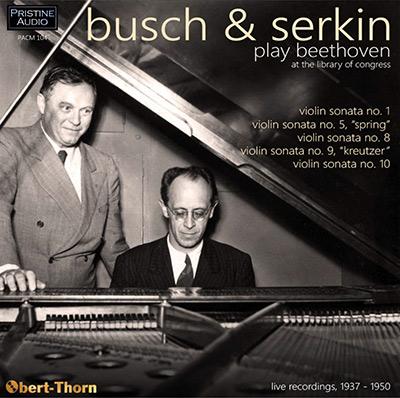
Adolf Busch and Rudolf Serkin plays BEETHOVEN = Violin Sonata No. 1 in D Major, Op. 12, No. 1;
Violin Sonata No. 5 in F Major, Op. 24 “Spring”; Violin Sonata No. 8 in G Major, Op. 30, No. 3 (2 performances); Violin Sonata No. 9 in A Major, Op. 47 “Kreutzer”; Violin Sonata No. 10 in G Major, Op. 96 – Adolf Busch, violin/ Rudolf Serkin, piano – Pristine Audio PACM 104 (2 CDs), 63:28; 71:59 [www.pristine classical.com] *****:
The fruitful association of violinist Adolf Busch (1890-1952) and Rudolf Serkin (1903-1991), already well documented on disc, has here, via recordings from the Library of Congress and the ministrations of Producer and Audio Restoration Engineer Mark Obert-Thorn, a significant addition to their legacy in the form of five Beethoven sonatas, captured 1937-1950. The appearances 14 December and 15 December 1937 helped celebrate the 200th anniversary of the death of the great Cremona violin maker, Antonio Stradivari. With the acquisition of five Stradivari instruments – courtesy of Gertrude Clarke Whittall – the Library could invite succeeding violinists or string ensembles to showcase these instruments in their performances.
The D Major Sonata, Op. 12, No. 1 – dedicated to Salieri – has Busch quite forward in the microphone, while Serkin’s piano sounds somewhat boxy in the sonic background. The Allegro con brio moves in spirited fashion, with razor-sharp attacks from Busch. The piano’s scales and octaves tend to be covered by the salient and piercing Busch tone. Since piano and violin share the melody for the theme and variations in A Major of the second movement, Andante con moto, the disparate sonic weight produces some startling effects, so far as parity is concerned. The variation in the minor mode, nevertheless, makes a poignant impression. The 6/8 Rondo: Allegro allows Busch to dazzle us with pungent sforzandi and a sense of playful mastery that would declare even in 1792 a composer entirely sure of his musical means.
From 15 December 1937 Busch and Serkin perform the 1801 Sonata No. 5 in F Major, Spring.” Here, Serkin’s piano has more girth, and the lovely sonorities – often in echo effect – the two musicians create – in Melville’s words, “enwreathed orisons” – a generous, fervent hymn to both Nature and the art of the violin sonata. The sense of urging the melodic line forward lends to the bucolic mood a dramatic flair all its own. A true serenity of spirit invests the Adagio molto espressivo in B-flat Major, with each instrument’s contributing to the ecstatic flow of the musical lines and their intimate variants. The pert Scherzo enjoys an airy, mischievous character in canonic syncopes. The Rondo finale proceeds in a broad statement of the main theme, to be complemented by three episodes. Syncopated and set in lively triplets, this music has Busch and Serkin blithely reminding us of debts Beethoven owed to both Haydn and Mozart.
The G Major Sonata, Op. 30, No. 3 (1803), dedicated to Tsar Alexander I of Russia, comes to us from a recording of 27 April 1943. The Allegro assai’s constant pulsation of 16th notes instills in us a nervous sense of exquisite balance. Beethoven spreads the melodic curve over three octaves, but the two musicians at work bridge the tracery so smoothly as to make the dynamic and even turbulent moments appear wrought of one cloth. Crisp and articulate, the Tempo di Minuetto achieves its dual nature as both interior dance music and a moment of haunted drama. No dawdling from Busch and Serkin, despite a richly delicate fabric they weave before us. The last movement, a moto-perpetuo marked Allegro vivace, displays the fecund bravura of our noted duo, here tripping lightly and dazzlingly. They come to a full stop just so Serkin and Busch might cavort in the misleading key of E-flat Major. But they prove all’s right with the world with their devil-may-care return to a resounding G Major.
The performance of the 1803 “Kreutzer” Sonata in A Major, Op. 47 (7 October 1944) needs to have been enshrined in asbestos, so inflamed the playing. Even the minor mode of the Adagio sostenuto vibrates with an intensity that only increases as the music proceeds in what the composer calls a “concertante style.” Here, Serkin and Busch each has an opportunity to project that capacity of his instrument to command the entire work as if were a concerto. The Presto literally seethes with bursts of unleashed energy, fulsome scales, and whipping ornaments. That the Busch Stradivari did not explode has to be due to the sheer durability invested by its maker. The few moments of relative repose themselves still vibrate a sense of menace; and at the last rush of emotion, the audience breaks into nervous but sustained appreciation.
Many notes drop out in the course of the affecting Andante con variazioni in F ajor as captured in this performance. Yet the music reveals a humorous virtuosity in its syncopations and continuous trills. In relation to the furious first movement, even the appearance of 16th, 32nd, and 64th notes presents a smooth, seamless surface line that perpetually extends the opening theme, which Beethoven exploits for its tender delicacy. For the gavotte-like variation, Serkin’s keyboard assumes a music-box transparency, over which the Busch pizzicati and high tessitura add a guitar-like dimension. The Finale: Presto takes off from a pungently definitive A Major chord to a whirlwind tarantella rife with the sheer joy of life’s energy. The nervous symmetry the two artists achieve testifies to their thorough rehearsal of the various inflections each brings to the colossal momentum – and their ability to stop on a dime – they achieve. Tumultuous applause barely does justice to this towering rendition of one of world’s greatest violin sonatas.
The grand G Major Sonata, Op. 96 (1812) provides the most “recent” of the recorded concerts (3 November 1950), a performance of lyrical and subdued beauty. The work itself, written for Pierre Rode, eschews technical wizardry and pompous rhetoric, opting for a directness of expression that won the admiration of Franz Schubert. Busch and Serkin here explore various tonal centers, “circuitous” harmonic routes that favor E-flat, in the course a series of contoured melodies and dynamic interchanges. The opening trill itself has become a trope that retains its power to mesmerize. Serkin’s piano part infuses the pungent energy that the violin appears to dispel or soothe, by turns. Even so, the electric intimacy of the occasion has been preserved in ravishing colors.
The second movement, Adagio espressivo, proffers an emotional stillness we associate with some of the late sonatas and late quartets. In E-flat Major, the decorative music allows Busch to display the sustained cantabile of his thinly piercing line, rather similar in its effect to that of Joseph Szigeti. The music, by degrees, builds to powerful yet understated passion. The Scherzo and Trio (G minor and E-flat Major) reassert – attacca – Beethoven’s otherwise restricted power and explosive, irreverent energy. The last movement Poco Allegretto concedes to Rode’s taste for poise rather than emotional display. A rondo infused with elements of variation, the music sets a series contrasting tempos and tempers. The musical journey, however, proves adventurous, wandering into chromatics and the distant key of E-flat Major once more. The music becomes slow, an elongated adagio that hints at moves – tunes from prior movements – Beethoven will repeat in his Ninth Symphony. The two instrumentalists each has moments of solo showmanship. The main theme returns, presto, to a fiery number of pages that convey a power that has deliberately kept itself from expressing the natural ferocity of its creator.
The alternative performance of the more modest G Major Sonata, Op. 30, No. 3 (16 January 1948) tends to be broader than that of 1943. The two parties prove as resiliently energetic as before, and their natural brio caresses every page. The first movement bristles with perhaps more drama than before. The middle movement theme and variations seems chiseled from a lovely block of patrician marble. The last movement’s limitless momentum flows and swells seamlessly, since both players appear at a peak of instrumental mastery. A devilish sense of fun invests the music, as it had in the gleeful Kreutzer finale.
Hats off, gentlemen to all three principals, those on the stage and the fine restorer Obert-Thorn!
—Gary Lemco