Apollo’s Fire — Bach
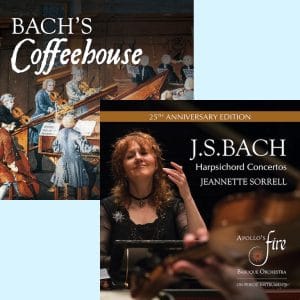
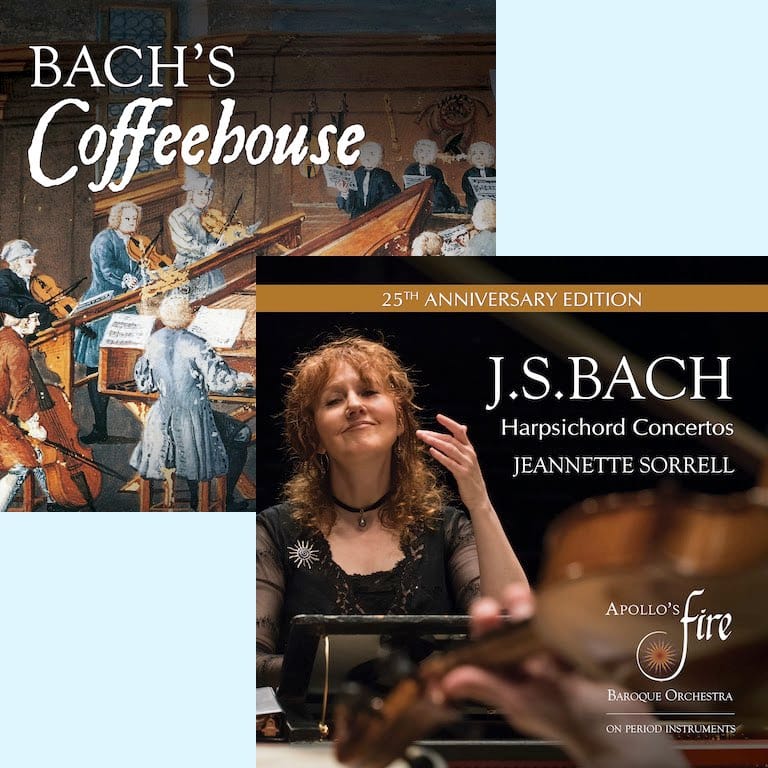
Two 2024 releases from Apollo’s Fire showcase the world of Bach. The first is a twenty-fifth anniversary recording of the Bach harpsichord concertos (specifically, BWV 1050, 1052, and 1056). The second is a new album titled Bach’s Coffeehouse, an imagined concert from Leipzig’s Zimmermann Coffeehouse. This album also includes works by Telemann and Vivaldi. Together, these recordings tell the story of a woman’s dream to become a harpsichordist and start a “band.”
Apollo’s Fire, initially known as “Cleveland’s Baroque Orchestra,” has expanded its reach, now performing in Chicago as well. Their longevity is a testament to Jeannette Sorrell’s vision of establishing a North American baroque orchestra. While other baroque ensembles exist, 25 years is a remarkable milestone. Their programming often includes audience favorites, such as Vivaldi’s Four Seasons or Bach’s Brandenburg Concertos, choices that seem pragmatic given their ticket-selling potential. However, their recordings appear secondary to their primary focus on live performances.
Harpsichord Concertos
BACH, Johann Sebastian: Concertos (BWV 1050, 1052, 1056) – Apollo’s Fire / Jeannette Sorrell (soloist, director) – Avie AV2489 (55:00) ****:
The three concertos on this album were recorded at St. Paul’s Episcopal Church in Cleveland Heights, Ohio, across different years (1999, 2002, 2004). The fifth Brandenburg Concerto features Michael Lynn on flute. I recall hearing Lynn as a soloist in the mid-1990s alongside Emlyn Ngai on violin at Harkness Chapel at Case Western Reserve University. On this recording, Cynthia Roberts leads on violin throughout.
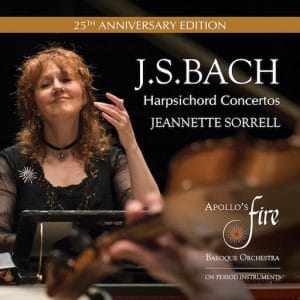 The church’s acoustic enhances the ensemble’s sound, particularly in the D minor concerto, BWV 1052, which feels richer and more resonant than the fifth Brandenburg (BWV 1050). The balance is commendable, steering clear of the overly prominent harpsichord sound often found in historically-informed recordings. While Sorrell’s contributions sometimes require focused listening, this aligns with the live performance experience. Notably, Apollo’s Fire uses multiple string players, departing from the one-player-per-part style prevalent in recent years. This choice gives the ensemble a fuller sound, which I find refreshing.
The fifth Brandenburg’s highlight is the extended harpsichord capriccio. While research by Reinhard Goebel suggests the score may have been tailored specifically for the Margrave of Brandenburg’s admiration rather than intended for an actual performance, the solo itself is a brilliant display of virtuosity. Sorrell’s interpretation is traditional and measured, with the concerto’s overall duration leaning toward the longer side at 21:15. The middle movement, however, could have benefited from a slightly more animated tempo.
In the F minor concerto, BWV 1056, Sorrell’s slightly slower tempo allows the harpsichord’s intricate passages to shine. Her articulation is precise and assured. The slow movement is handled beautifully, though the harpsichord’s upper courses sound slightly out of tune, creating a subtle chorus-like effect. This might have been intentional, but it stands out compared to other recordings.
The D minor concerto, BWV 1052, my personal favorite, is performed with solid pacing. Sorrell adds a tasteful cadenza where most soloists do not, a creative decision that deserves applause. The final movement could have used more drive, but the performance remains engaging.
While there are more electrifying renditions available in 2025, this album reflects the high-quality music-making Apollo’s Fire has offered for decades. It’s a worthy keepsake for anyone who has enjoyed their live performances.
—John Hendron
Bach’s Coffeehouse
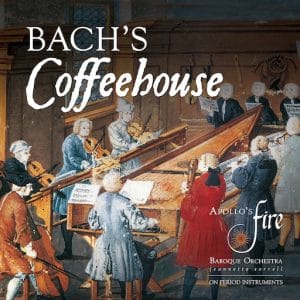
BACH, Johann Sebastian: Brandenburg Concerto No. 4, Air (BWV 1068), Concerto for Oboe & Violin (BWV 1060r); TELEMANN, Georg Philipp: Suite Don Quixote (TWV 55:G10); VIVALDI, Antonio: La Follia (RV 63), arr. Sorrell – Apollo’s Fire / Jeannette Sorrell (director) – Avie AV2520 (63:00) ****:
This album features recordings made between 2018 and 2023 in various northern Ohio locations. Its concept is a recreation of instrumental works that might have been performed at Leipzig’s Collegium Musicum under Bach’s direction. While the repertoire cannot be confirmed historically, it includes baroque favorites: Telemann’s Don Quixote Suite, Bach’s “Air on the G String,” the fourth Brandenburg Concerto, the oboe and violin concerto BWV 1060, and an arrangement of Vivaldi’s La Follia.
 The recording of Brandenburg Concerto No. 4 opens the album, but the sound is less clear than on the earlier harpsichord concertos disc. Still, the performance sparkles, with Alan Choo delivering a virtuosic violin solo and Daphna Mor and Kathie Stewart excelling on recorder. The ensemble’s cohesion is impressive.
Telemann’s Don Quixote Suite transitions seamlessly, despite being recorded decades earlier with different players. It’s helped by being in the same key of G. The performance is tight, particularly in the lively final movement. However, I hoped for more color and expression in Telemann’s vivid tone painting, such as in Son Attaque des moulins à vent. While energetic, the reading feels restrained compared to other interpretations, such as the Drottningholm Baroque Orchestra’s more dynamic take.
Bach’s “Air” is performed by the entire violin section rather than a soloist, creating a unified sound. Alan Choo leads effectively, achieving a convincing interpretation. I like when it’s rendered as a solo, with options for improvisation. Even so, this solution is nicely done.
The concerto for oboe and violin, BWV 1060r, highlights Debra Nagy (oboe) and Johanna Novom (violin). The slow movement is exquisite, with well-balanced phrasing, delicious sound, and a magical muted harpsichord accompaniment.
The arrangement of Vivaldi’s trio sonata into a full-ensemble piece (RV 63), may never have been performed at Zimmermann’s. We know Bach was familiar with Vivaldi’s opus three concerti, but aside from the collection of concertos he arranged himself, it’s hard to say if he’d had access to this earlier piece from Vivaldi’s debut opus. Many composers in the baroque took it upon themselves to create variations on this dance, which Sorrell credits Portuguese origins (I won’t dispute this, but had always thought it of Spanish origin, either way, the general geography is sound). Through the ensemble’s videos, I’ve seen it headlined by Olivier Brault and also Alan Choo. This recording puts Choo at second chair against Apollo’s Fire collaborator Francisco Fullana, who was the soloist in their Four Seasons album.
While there are many recordings of this Vivaldi piece, the Sorrell arrangement is uniquely theirs and may be worth having on disc. The recording engineer, Daniel Shores, was able to capture the two lead players separate from the ensemble, which presents some nice depth in the recording. The appeal of the piece is the use of an ostinato bass and the composer’s use of changing moods in each variation, building up drama over time, as we work things up then relax a bit in repose. Apollo’s Fire turns up the volume and energy for the end, making this a great piece to end upon. I thank them for not ending the recording until the bloom of the ensemble’s reverb was allowed to naturally decay. You can imagine the roar of the audience otherwise.
I will point out that the booklet for this recording has several mistakes. A theorbo or guitar is clearly audible in the Brandenburg concerto without attribution in the accounting of players. Authenticity aside, I like this texture in the continuo. Sorrell’s notes mention that Bach was “Cantor of the Thomasschule,” which was the school attached to the church. Bach was required to teach, but technically he was the Cantor at the Thomaskirche. The TWV number for the Telemann suite is just listed as TWV 55, which uses a different numbering scheme than the BWV system; specific works include the key and the piece requires a secondary number from that particular set. The Vivaldi piece doesn’t include the Ryom number. The notes do include historical references and try to talk about the music without using overtly technical language, which is somewhat different from many booklets produced alongside recordings for European orchestras. Likewise, this booklet is only presented in English.
—John Hendron
————————
Final Thoughts
It became clear in my earlier appraisal of Alan Choo’s recording of Biber’s Mystery Sonatas that Apollo’s Fire had crossed a threshold, able to compete not only with period groups in the states, but across the entire world. These recordings showcase their evolution as well, and despite changes in the personnel among the different pieces and recording venues, the common element between them all is their director, Jeannette Sorrell. I’d conclude by saying that these two releases are closely tied to their major activity of live performances, between northern Ohio and Chicago, catering to a mostly American audience who enjoys baroque music without getting into the weeds of how it is performed. Tafelmusik is probably the most well-known North American band, with an ample collection of recordings under their late director, Jeanne Lamon. The quality of these performances, albeit of mostly well-worn music, showcases the opportunity to begin catering to a larger, worldwide audience. I am hoping Avie can support them with booklet translations and good distribution channels for their future recordings.
It’s only my memory that serves my first exposure to Sorrell in their early days. It’s been so satisfying to see them grow and achieve greatness. Their website highlights the extraordinary amount of support they have received over the years which is a testament to the part of music making we rarely discuss in reviews—all the relationships that are required to provide the funding, support, and energy around an ensemble to be successful and relevant.
For those of us who live in the states, it’s satisfying to know they’ve made this work, and even if you’re not a native of Chicagoland or Cleveland, there is an American baroque band that is ready to take on the industry through recordings. While the music on these recordings is undoubtedly from the canon of Baroque best hits, I can’t wait to see where they go next in the exploration of more less-known repertoire. We all can benefit from it as they reinvigorate a world of wonderful music, written from the same period.
—John Hendron
More information on these Apollo’s Fire releases through Avie