BRAHMS: Piano Sonata No. 2 in F-sharp Minor, Op. 2; Scherzo in E-flat Minor, Op. 4; Piano Sonata No. 1 in C Major, Op. 1 – Alexander Melnikov, piano – Harmonia mundi HMC 902086, 69:23 ****:
Recorded in May 2010, these Brahms works benefit from a sympathetic interpreter in Alexander Melnikov (b. 1973), who performs on an 1875 Boesendorfer with a particularly bright tone. The two large sonatas Brahms composed at the age of nineteen, and they convey a heaven-storming fury and enthusiasm that pay homage simultaneously to Beethoven and Schumann. The 1853 F-sharp Minor Sonata bears a dedication to Clara Schumann, and its second movement in B Minor/B Major derives its chromatic line from a Minnelied, “Mir ist leide.” Melnikov indulges the sighing plaintive rhetoric with loving care, the pedal effects imparting an organ sonority on the striking harmonies. The Scherzo hearkens to the Andante, the music swaggering with aspects of hunting call. Melnikov makes a point to etch the strange transition chords back to the da capo. The Schumann capacity for introspection opens the last movement–though the chord progression suggests late Beethoven–The tonal quality of the Boesendorfer piano bestows a slightly other-worldly character to the open chords, the music soon assuming a decidedly bravura–even Hungarian–character we know from Liszt. Unless I miss my precedents badly, the construction of this expansively improvisatory movement combines sonata-form and rhapsody-fantasia, almost a Brahms version of Chopin’s Op. 61.
The Scherzo in E-flat Minor (1851) is the product of an eighteen-year-old composer. Like his model Schumann, Brahms bestows two trios and a coda on the structure. The energy pounces forward, anticipatory of the third Ballade, from Op. 10. Percussive and thick, the piece exploits parallel thirds and sixths, often in contrapuntal and harmonically wayward combinations. Some have found a precedent for this piece in the fourth of the Chopin set of scherzi. Melnikov’s performance moves aggressively and fluidly, his chord work passionate, sweeping, and bitingly propulsive in broad strokes, after his own favorite interpreter here, Carl Friedberg.
The C Major Sonata pays direct homage to late Beethoven, but much of Schumann’s poetic introspection spills forth as well. Vigor and lyricism compete in studied affects, Melnikov’s keyboard often rendering wonderfully diaphanous effects. At half the length of the opening Allegro, the Andante–which takes its poetic source from an old German Minnelied, “Verstohlen geht der Mond auf”–proceeds as an introspective nocturne on moonlight and blue flowers, through which the rhythmic tattoo of Beethoven’s Fifth passes. A potent Scherzo follows, the staccati jabbing and the gestures flamboyant, especially in the fluttering trio section. Brahms recycles materials from the first movement for his “fiery” finale, the nervously agitated allusions once more to Beethoven’s Op. 106. An intelligent and thoroughly virtuosic rendering throughout.
— Gary Lemco
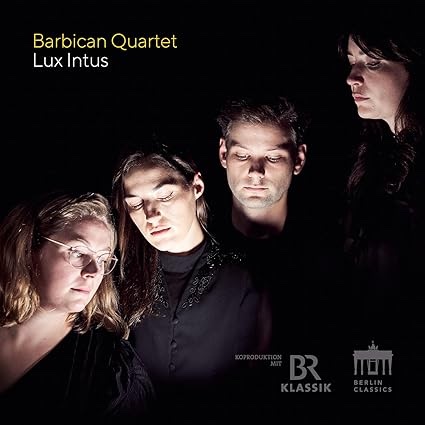
Barbican Quartet – Lux Intus – BR Klassik
“Internal Light”… illuminating the inner voices of the quartet