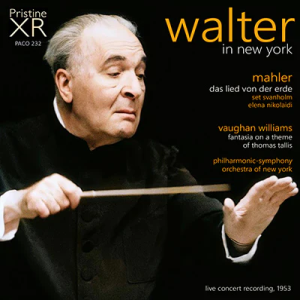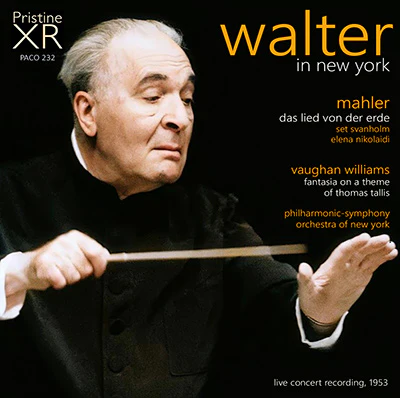
WALTER in NEW YORK = VAUGHAN WILLIAMS: Fantasy on a Theme by Thomas Tallis; MAHLER: Das Lied von der Erde – Set Svanholm, tenor/ Elena Nikolaidi, contralto/ New York Philharmonic Orchestra/ Bruno Walter – Pristine Audio PACO 232 (74:18) [www.pristineclassical.com] *****:
Pristine captures a special moment in the New York musical scene: from Carnegie Hall, 22 February 1953, Bruno Walter leads a radio-broadcast concert featuring the music of Vaughan Williams and Mahler, a most compelling aural spectacle of works set in contrasting modes of expression. Let me comment at the outset that Walter’s sonic achievement, the homogeneity of tone he achieves in the Philharmonic strings, anticipates in phrase and intensity of line, what Dimitri Mitropoulos would brilliantly commit to CBS for posterity in 1958.
Vaughan Williams had been working on his own English Hymnal, when in 1910, he came upon the third of nine psalm tunes composed in 1567 for the Archbishop Parker’s Psalter, Thomas Tallis’ Why Fumeth in Fight. Vaughan Williams conceives his Fantasia as a concerto-grosso study in contrasted string antiphons, comprised of a full string orchestra (as ripieno), a string quartet (as concertino), and a chamber string ensemble. The Fantasia premiered at the Gloucester Festival, and it has since had advocates of divergent temperaments, from Sir Adrian Boult, Sir John Barbirlli, and Leopold Stokowski to Louis Lane. Walter’s forces lean into the lush torment of the string line with a passion only equaled in my view by Mitropoulos. The mounted fury and retreating pulsations of the piece converge at a fearsome climax, a graduated rush tantamount to Wagner’s Tristan.
Gustav Mahler (1860-1911), eternally dreadful of the number “nine” for his symphonic oeuvre, turned to his love for poetry to fashion (1908-09) his six-movement Das Lied von der Erde, assembled after Hans Bethge’s The Chinese Flute, a series of ancient meditations on life and death, a profoundly personal revelation by Mahler concerning his obsession with mortality and the frailty of the human condition. Mahler only resumed the chronological numbering of his symphonies after “the curse of the Ninth” had passed, at least in his estimation. Swedish tenor Set Svanholm (1904-1964), noted for his Wagnerian characterizations after WW II, joins Bruno Walter and Greek contralto Elena Nikolaidi (1909-2002). Svanholm sets the tone in “The Drinking Song of Earth’s Woe,” whose poetic mode by Li Bai remains demure and detached, but whose musical realization verges on hysteria. “Dark is life, dark is death” as a refrain recurs, each entry one half-step higher, a hymn to existential pessimism.
The second movement, “The Lonely One in Autumn” (Qian Qi), provides a subdued, bucolic contrast, both celebrating and lamenting the ephemeral beauty of Nature, with Nikolaidi’s plaintive tone’s demonstrating the same stamina and unsentimental resolve as that of Svanholm. Her approach eschews the staggering drama we find in Kathleen Ferrier but instead provides a searching directness of expression that carries its singular pathos. Movement three, “Of Youth,” depicts a party inside a pavilion that borders a lake, so that the reflected image upon the water of the callow youths “comments” on the lucid illusion of strength and vitality. The “exotic” character of Mahler’s instrumentation basks in colors, transparent and intense, a wonderful, abbreviated ternary-form, alternative to what the French Impressionists were constructing at the same period in musical history.
Another singular contrast in human interaction enters with “Of Beauty,” intoned by Nikolaidi, as a group of young maidens sits by a riverbank plying restrained tones while, on horseback, a small band of young men pass by. Whatever flirtation exists in the meeting, the music explodes into fanfare effects, with Nikolaidi’s becoming more insistently breathless. The postlude proves hazy, transparent, and lyrically nostalgic in a chamber-music texture. “The Drunken Man in Spring” serves as a dramatic comic-relief, a pointed scherzo, an expression of emotional indifference to fate and mortality: “Life is a dream, so why worry and travail? I drink all day, glutting my fill, until I can imbibe no more!” Svanholm thrusts the inflated baits at Fate with hearty passion, the irony of the occasion indeed a snake devouring its own tail.
Mahler’s last movement, “Der Abschied,” compresses poetry by Mong Hao-Ran and Wang Wei with (final) lines added by Mahler himself. We have leave-taking on a grand scale, yet delicately intoned and colored by brass, winds, strings, mandolin, harp and celesta, while the contralto calmly contemplates the terrible neutrality of the universe as we pass away. The Earth does indeed abideth forever, while Man contemplates his ephemeral presence. “Endless, endless shines the blue horizon. . .”
There do appear moments in Nikolaidi’s performance that rival what Walter and Ferrier achieved in pure pathos for their collaborations. Hearken to her repeated “Warum?” in the course of the long narrative. And shall we not credit flute principal John Wummer (1899-1977) for his endearing, oft flutter-tongued, contribution to the unity of effect? But never forget Bruno Walter’s long and fruitful experience in this work, which he launched into the musical world in 1911, shortly after the death of its composer. Walter’s advocacy, his faith in the message of this demanding, doubting, suffering composer, never wavered in stalwart, musical integrity and firmness of vision. Many thanks to Pristine and Andrew Rose for yet another document of musical authenticity on the highest level.
—Gary Lemco