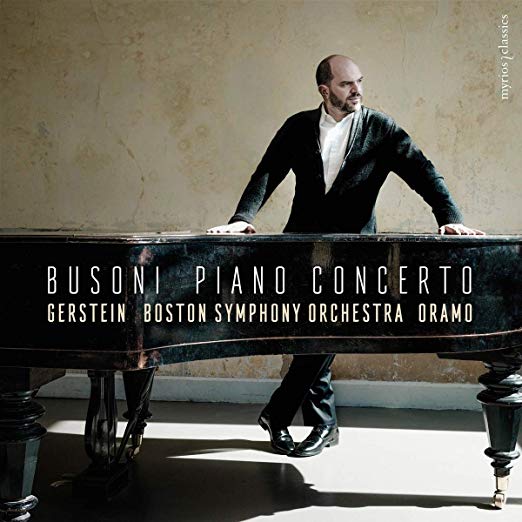
BUSONI: Piano Concerto in C Major, Op. 39 – Kirill Gerstein, piano/ Boston Symphony Orchestra/ Men of the Tanglewood Festival Chorus/ Sakari Oramo – Myrios Classics MYR024, 71:29 (3/15/19)
The published score of Busoni’s 1904 Piano Concerto contains an etching that represents the composer’s visualization of his intentions: exotic birds sit astraddle of Greek temples and cypress trees, with a volcano like Vesuvius erupting in a depiction of 79 A.D. A sense of prophecy and apocalyptic visions out of William Blake interposes itself into Busoni’s aesthetic: he liked to quote from Nietzsche’s Beyond Good and Evil, calling for a “mysterious and evil music. . .which roams among great and beautiful, lonely beasts of prey.” The gargantuan concerto, set in five symmetrical movements, unites a disparate number of styles, some antithetical to each other, as if post-Romanticism itself were an enormous contradiction. Chopin, Brahms, Liszt, and Beethoven pass through the dazzling, often whistling, figures – but Rossini, Italian folk song, carnival music, Scriabinesque mists, Wagnerian climaxes, and Schumann pirouettes – no less inform its meandering, colossal ambitions. The last movement decides to rival Beethoven’s last symphony in audacity: Busoni sets lines from an 1805 play by Adam Oehlenschlager, Aladdin, which invokes a hymn to Allah and the appearance of mysticism in Nature! If such a fusion of polar opposites appeals to one’s sensibilities, he might wonder why. Critic Bernard Holland once called the piece “a hymn to immoderation.”
Recorded live at Symphony Hall, Boston, 10-11 March 2017, this performance means to convey something of the superhuman will urging the music forward. The opening movement, Prologo e introit: Allegro, dolce e solonne – the first of three “buildings” that include the third and fifth movements – intones a solemn nocturne. The tempo indications suggest a religious work, a kind of concerto-requiem. Two scherzos frame the third movement Pezzo serioso. This central “building” provides a layered structure whose mood could be captured in the more disturbed, architectural creations of Chirico.
The fourth movement All’Italiana, Tarantella: Vivace also begins with nocturnal serenity, but the mood shatters with invocations of frenzy, rage, and “impoliteness,” but no less delighting in whispers, trills, arpeggios, and a complete abandonment to the bravura spirit. The last, choral movement joins the end to the beginning, the ouroboros a key concept in Revelation: the Alpha and the Omega, and in Nietzsche’s Eternal Return. For much of the fifth movement pianist Gerstein sits silent, equally awed by the attempt by Busoni to reach beyond Berlioz, Mahler, and Scriabin to wring out “a concerto to end all concertos.” The keyboard part does enter once more, with drums and rolling arpeggios. A manic tempo rushes to judgment, and the feeling of Dionysiac frenzy triumphs, a Roman revel that jars the Devil himself.
In several respects, collaborators Gerstein and Oramo have succeeded admirably in raising the specter of a “dramatic symphony” in the Berlioz tradition, in which the massive keyboard part still subdues itself to an obbligato part for a symphonic surge of power. The often glistening keyboard part has its match in the huge washes of orchestral colors and finally, in the mix of chorus and orchestra, akin to the Beethoven Op. 80 Choral Fantasia. Recording Engineer Nick Squire has captured the spectacle of the occasion in glorious Technicolor, and the various photos within the booklet testify to the visual appeal of this imposing rendition, which should lie side by die with performances by Petri, Ogden, and Donahoe.
—Gary Lemco