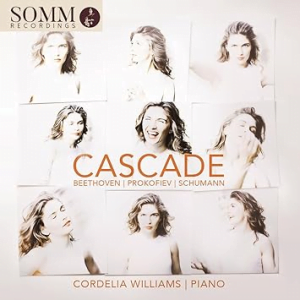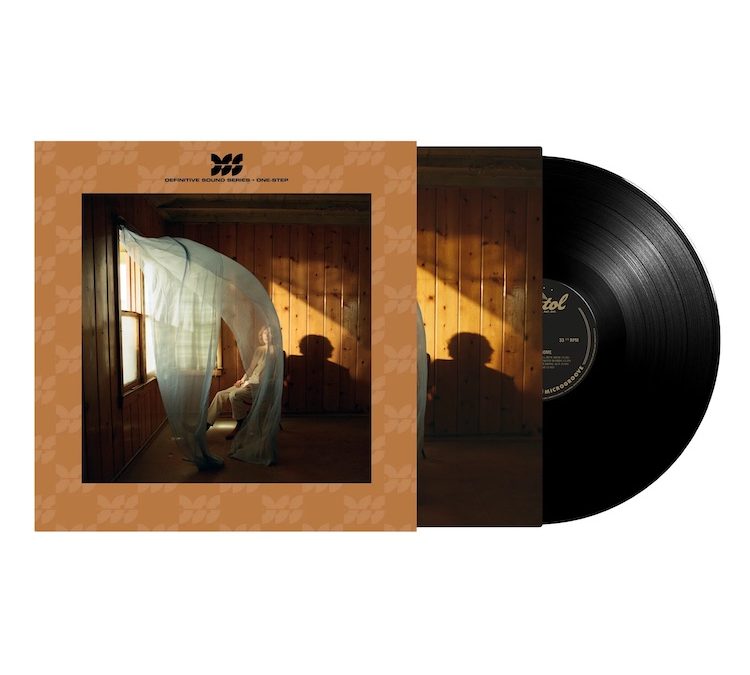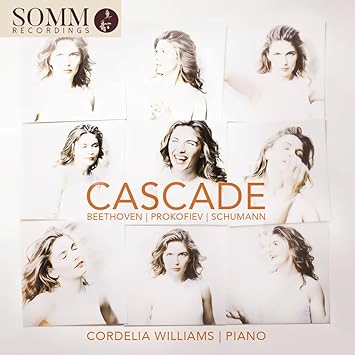
CASCADE = BEETHOVEN Bagatelle in C Major, WoO 56; PROKOFIEV Visions fugitives, Op. 22; SCHUMANN Waldszenen, Op. 82; BEETHOVEN Bagatelles, Op. 126 – Cordelia Williams, piano – SOMMCD 0675 (65:10) (8/7/23) [Distr. by Naxos] *****:
Pianist Cordelia Williams finds inspiration for this album (recorded January 21-22, 2023) in Bohemian-Austrian poet Rainer Maria Rilke’s Book of Hours, composed between 1899 and 1903. In his provocative, religious imagery, Rilke expresses in his Russian diary the limitless vastness of both the Volga and its counterpart in human potential. The old, philosophical dilemma of “the one and the many” finds a solution in Rilke’s metaphor: “Often when I imagine you, your wholeness cascades into many shapes.” The paradoxical relation between poetic, musical fragments and a sense of cosmic unity finds realization in Williams’ selected program.
Some scholars consider the various bagatelles of Beethoven to constitute the first 19th “character pieces,” of which Williams chooses one of no opus number but whose mood becomes more quirkily contrapuntal and assertive as it proceeds. The late section plays almost alla musette but disturbed by passing dissonance. Did the piece have ambitions that its minuet and trio structure should inhabit a larger sonata? Unpublished until 1888, its final intentions remain a secret. The unconventional shape and harmonic audacity warrant the piece’s inclusion as examples of a burgeoning Romanticism in Beethoven’s musical sensibility.
The 20 miniatures of Sergei Prokofiev, composed between 1915 and 1917, exist integrally as his Visions fugitives, op. 22, but they were not intended as a set or cycle. They rather express the composer’s experimental, improvisational attitude, taking their major impetus from lines by Konstantin Balmont: “In each fugitive vision I see worlds/Full of the changing play of rainbows.” Unconventional in harmony and rhythm, the assorted works often embody polytonalities and a neo-Classical, crystalline clarity in piercing accents. On the contrary, several approach the hazy, introspective mystery we find in late Liszt, Debussy and Scriabin. The briefest of the group, No. 5 Molto giocoso, provides the glittery, “cascade” rubric for the recital. The longest of the set, No. 7 Pittoresco, divides its imagery between water and light, much like Scriabin. Williams takes the No. 8 Comodo at a more marcato tempo than some pianists. Prokofiev the eternal ironist emerges at No. 10, Ridicolosamente, juxtaposed with the romantic, preceding Allegretto tranquillo. The popular No. 11 Con vivacita enjoys a crisply buoyant realization. If shadows inhabit terse Nos. 12 and 13, a stern resolve dominates No. 14 Feroce, a kind of forecast of the “wartime” sonatas of the 1940s. Its own successor, No. 15 Inquieto, treads precariously on the environs of Shostakovich. Experiments with suspended, lyrical harmonies occupy No. 18 Poetico, while No. 19 Con una dolce lentezza assumes an elusive, motional stance, not quite Debussy or Scriabin. Like No. 14, No. 20 Presto agitatissimo e molto accentuato gambols with neurotic energy. Williams plays the final Lento as an epilogue, its progress a form of B, asking if any of these visions were real.
It might be appropriate to consider Robert Schumann’s nine pieces 1848, Waldszenen, as the spiritual heir of Carl Maria von Weber’s 1821 opera Der Freischütz, in which Nature’s landscape becomes a source for preternatural visions, akin to many a tale of Nathaniel Hawthorne. The forest, as it had for Hawthorne’s Salem, had become the dark side of Mother Nature, a threat to (religious) order and civilized, predictable modes of behavior. For Schumann, too, the forest proffers a landscape whose beauty may suddenly strike out in either latent or kinetic fury, as expressed in the one poem Schumann retained for his score, written by Hebbel: “The flowers…/Are pale, like death;/Only one…/Stands, a dark red./The color…/comes from the earth,/ which drank of human blood.”
Clara Schumann found these grim sentiments unattractive and refused to perform the entire suite. The nine days Schumann took to create his cycle came at the time of his inchoate mental collapse, so the intimations of mortality abound. Williams intones the opening Eintritt in B♭ major with jaunty confidence, only to adjust to the theme of imminent death in the D minor Jäger auf der Lauer, hunters in concealment. The dramatic juxtaposition continues, attractive life against dire impulses from the land of death, “Lonely Flowers” set against a “Haunted Place.” Williams imbues the latter section with sonic images from both Mussorgsky and Poe. Undulating energies mark the “Friendly Landscape,” in its re-establishing the original key of B♭ major, it refreshes our confidence, briefly, so we may take comfort in hearty fellowship at a “Wayside Inn,” set in good-natured E♭ major. The most often rendered section, Vogel als Prophet (in G minor), flits from branch to branch impressionistically, the sonority close to the music-box effect that Wilhelm Kempff often realized. The central section proceeds in the manner of a subdued hymn. But once more the impulse to triumphant hunting asserts itself, the Jagdlied in E♭. Williams intones the last sequence, Abschied, with the requisite “nostalgia for the dream” common to the Schumann ethos, the tonic B♭ apparently proffering the former security of the hearth, a parting from the woods of sweetest sorrow.
The third and last set of Beethoven’s “cycle of small pieces,” his op. 126 Six Bagatelles, appeared in 1825. Unlike his earlier sets, Beethoven conceived op.126 as a planned group, the score set on consecutive pages of a sketchbook around May 1824. To his publisher Schott, Beethoven wrote that these bagatelles “are probably the best I have written.” These six bagatelles have consistent key relationships between consecutive pieces, especially in their reliance on major thirds. Alternately meditative and extroverted, the six pieces forecast the temperamental shifts in several of the late string quartets. In their compressed kernels of notes the kinetic power of the atom may issue forth in an instant. The No. 1 in G moves in rounded, binary form, in a singing style that includes metric shifts, a cadenza, and the return of the principal theme in high register. The No. 2 Allegro (in G minor) explodes forward, toccata style, then relents into a lovely cantabile in B♭. Emotionally intense, if not schizoid, the piece reaches a climax on A, the furious 16ths having calmed down through triplets and eighths. The No. 3 offers a real respite, marked Cantabile e grazioso, it moves in ternary form in decorative arpeggios that sound in their variants by Williams like ornamental cadenzas. That some auditors find correspondences with the “religiosity” of the late quartets comes as little surprise.
The most dramatic of the cycle, No. 4 in B Minor, Presto, delights in syncopations and the humor of empty spaces between notes. Williams maintains the forte dynamic without exaggerated pounding. Her upper register banter enjoys a fluent ease of transition. As a scherzo in three-part form, we hardly feel the architecture by dint of the performer’s enthusiasm. The No. 5, Quasi Allegretto in G Minor, asks Williams for delicate, stepwise parallel thirds, which she executes with gracious charm. Judicious pedal creates a pure sound for the triplets that repeat as well as for the syncopated accents. We detect a degree of agogic rubato that functions to increase the controlled lyricism of the moment. The No. 6 has, for this reviewer, always proved elusive. It possesses both a prelude and a postlude, opening furiously Presto and then, six measures in, shifting to 3/8 Andante amabile e con moto. The emotional range seems kaleidoscopic, the colors and affects, playful or thoughtful, in perpetual, triplet motion, much like the last movement of Op. 111. The sound of Williams’s Steinway D Concert Grand, the production and engineering courtesy of Siva Oke and Paul Arden-Taylor, has proved admirably ingratiating. That last “cascade” for Beethoven’s coda in No. 6 has made all of Williams’s rhetoric justified.
—Gary Lemco
More information through Amazon