CORELLI: Twelve Violin Sonatas, Op. 5 – Trio Corelli – Bridge 9371A/B (2 discs), 66:27; 59:07 [Distr. by Albany] ***1/2:
“Affettuso” = SCHUBERT–GIOVANNI ANTONIO PIANI: Sonata Op. 1 No. 8 in B Minor; Sonata Op. 1 No. 10 in D Major; Sonata OP. 1 No. 2 in E Minor; Sonata Op. 1 No. 4 in G Major; FRANCESCO GEMINIANI: Sonata Op. 1 No. 8 in B Minor; Sonata Op. 1 No. 7 in C Minor; HANDEL: Violin Sonata Op. 1 No. 13 in D Major, HWV 371 – Emilio Percan, violin; Oriol Aymat Fusté, cello; Luca Quintavalle, harpsichord – Onyx 4099 74:52 [Distr. by Harmonia mundi] *****:
Archangelo Corelli was apparently so busy playing and conducting the musical entertainments for a succession of wealthy patrons that he had little time to compose a great deal of music. At least his output is modest, especially by the standards of Baroque composers: forty-eight trio sonatas, twelve concerti grossi, and twelve violin sonatas. However, like his violin playing, which established a school that carried his style of execution throughout Europe, his compositions are the models for such works from the time of their publication until the last Baroque composer wrote a concerto grosso or sonata da camera.
Among his pupils was Francesco Geminiani, who thus carried on both his tradition of playing and composing. Among his professional contacts was the young Handel, who like Corelli was attached to the household of Cardinal Ottoboni in Rome. Corelli prepared and played in the orchestra when many of Handel’s Roman works were premiered. There’s a famous story about preparations for the premiere of Handel’s Triumph of Time and Truth in 1708. The violin part contained the very highest A that the violin is capable of playing. Corelli refused to play it since it probably would have taxed his abilities, so that whippersnapper Handel showed him how it should be done. Otherwise, however, their partnership seems to have been respectful on both sides, and of course much later, Handel paid Corelli the complement of writing twelve concerti grossi modeled on the older composer’s work. And both Handel and Geminiani wrote violin sonatas that follow the Corellian model.
As in his trio sonatas, Corelli wrote violin sonatas in both the sonata da chiesa and sonata da camera forms. The first six of the Op. 5 Sonatas are church sonatas, while the last six are chamber sonatas. Corelli’s church sonatas are all in five movements with alternating slow and fast movements. The church sonata was supposed to be a more serious and sober affair than the chamber sonata, but by around the time Corelli was writing his sonatas, those distinctions were becoming blurred, and the usual model for the next generation of composers was the four-movement chamber sonata. However, Corelli maintained the distinction between the two genres: in contrast to the church sonata’s alternating movements, Corelli’s chamber sonatas start with a slow prelude followed by a succession of dance movements, such as sarabanda and giga, familiar from Baroque instrumental suites.
Corelli lets down his hair a little in the chamber sonatas. Sonata No. 12 even includes a set of variations on the famous melody of Spanish origin that composers from Lully to Rachmaninoff drew on: La Folia. Rachmaninoff even paid the Italian composer the slightly fatuous compliment of naming his 1931 piano work Corelli Variations. But beside the variations on La Folia, the last six of Corelli’s sonatas contain his most memorable music, featuring some of his finest melodies; along with No. 12, the lovely Sonata No. 9 in A Major, Sonata No. 10 in F Major, and Sonata No. 11 in E Major are understandably the most popular, the Giga from Sonata No. 9, Sarabanda from No. 10, and Gavotta from No. 11 having lives of their own apart from the sonatas.
Complete recordings of Op. 5 hardly occupy a crowded field, but there are well-regarded versions by Monica Huggett, Andrew Manze, and Elizabeth Wallfisch. I was able to compare the recording by Elizabeth Wallfisch and the Locatelli Trio on Hyperion, and I find that Trio Corelli need fear nothing from this comparison at least. Both teams are equally spirited and stylish in their playing. Violinist Elizabeth Zeuthen Schneider of Trio Corelli plays with a sweet tone and a sure understanding of mid-Baroque style. Whereas the Locatelli Trio divides the keyboard duties between organ and harpsichord, Ulrik Spang-Hanssen of Trio Corelli uses only an organ. However, instead of the Locatelli Trio’s continuo cello, Corelli Trio’s Viggo Mangor alternates between archlute and theorbo, giving the continuo a lighter, airier feeling and helping showcase even more the violin line—not at all a bad thing. However, I do have a complaint: the organ so dominates the continuo landscape that little of Mangor’s playing comes through, even when listening on headphones. So if you’re an enthusiast of plucked strings, be forewarned. Otherwise, this is a fine set of performances, handsomely recorded (ironically, with Viggo Mangor as sound engineer) in a church in Copenhagen.
[audaud-hr]
The chief selling point of Emilio Percan’s recording on Onyx is the world premiere of violin sonatas from Piani’s Op. 1 collection, the twelve sonatas in Op. 1 being all that remains of Piani’s work. Though Piani (1678–1760) was of the generation following Corelli, these sonatas must be relatively early pieces; they appeared in 1712, the same year Corelli’s Op. 5 was published. By this time, Piani had left his native Italy for Paris, where he had a flourishing career as a virtuoso—which, as with Corelli, probably accounts for his small output.
In his notes to the recording, Guido Oliveri reveals some fascinating points about these sonatas: “In the Avertissement that precedes the collection, Piani provides explanations on bowings, articulation, fingerings, and dynamic marks—introducing what are considered the first instances of symbols (filled wedges) for crescendo, diminuendo and messa di voce—and gives indications on the performance of his music ‘to those who do not know the practice.’ Such remarks on performance were rather unusual at the time. It is clear that this introduction—written in French, while the dedication is entirely in Italian—was intended to describe the expressive techniques that were part of the arsenal of Italian virtuosos, but were not yet familiar in France.”
All twelve sonatas in the collection are in the form of chamber sonatas. On the other hand, Geminiani, one of Corelli’s most famous pupils, still followed the Corellian model of dividing the pieces in his Op. 1 collection between church sonatas and chamber sonatas. Though published in England in 1716, they were probably written earlier, before Geminiani left Italy for London. Geminiani may be the more famous name, but I find Piani’s sonatas more interestingly varied. As with Corelli, the various dance movements bring out more memorable melodies and zestier rhythms. Sonata No. 4, with which Percan ends his recital, has a concluding Allegro assai that could easily take on a life of its own like some of Corelli’s individual movements. Percan and harpsichordist Luca Quintavalle play it to the absolute hilt.
For bringing us the music of Piani alone, Percan’s recording would have a good deal of value, but the inclusion of the Geminiani and Handel sonatas makes this an even more useful program, showing us the directions in which the next generation of composers took Corelli’s ideas. Handel’s delightful Sonata HWV 371 is always welcome, especially in as sensitive a performance as we have here. Enthusiastically recommended all around!
—Lee Passarella
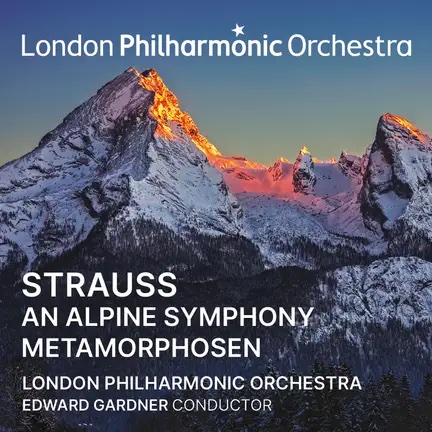
R. STRAUSS: An Alpine Symphony; Metamorphosen – London Philharmonic Orchestra/ Edward Gardner
“Two disparate scores by Richard Strauss, excellently played…”