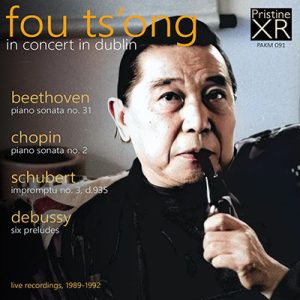
Fou Ts’ong in Concert in Dublin = SCHUBERT: Impromptu No. 3, D. 935/3; BEETHOVEN: Piano Sonata No. 31; DEBUSSY: Six Preludes; CHOPIN: Piano Sonata No. 2, “Funeral March” – Fou Ts’ong, piano – Pristine Audio PAKM 091 (78:59) [www.pristineclassical.com] ****:
Engineer and Restoration Editor Andrew Rose and Pristine Audio have assembled a series of 1991 Dublin, Ireland concerts (1989-1992) given by Chinese pianist Fou Ts’ong (1934-2020) at the National Concert Hall. Ts’ong became the first Chinese pianist whose career began in Shanghai, under the auspices of his scholar-father’s extensive record collection, which featured classic musicians Edwin Fischer, Artur Schnabel, Wanda Landowska, Alfred Cortot, and the vocal talents Elizabeth Schumann and John McCormack. In 1954 Fou participated in a cultural exchange program with Poland, having been auditioned by composer Andrzej Panufnik to determine Fou’s worthiness to enter the 1955 Chopin Piano Competition. His playing of the Chopin mazurkas received particular acclaim, and Fou placed third in the Competition, behind second Vladimir Ashkenazy and winner Adam Harasiewicz. Fou’s success led to his accepting a scholarship to study at the Warsaw Conservatory with Zbigniew Drzewiecki, whom Fou consistently described as his “only serious teacher.”
Fou fled the Cultural Revolution in China, where his father had been labeled a critic of the government, inevitably leading to his parents’ persecution and suicide. Fou settled in London, aided by pianist Julius Katchen and a generous donor, Auberton Herbert. Fou received a recording contract from Westminster Records, the 10-CD legacy recently issued on Eloquence (484 3712). He married Zamira Menuhin, daughter of the esteemed violinist and conductor, Yehudi Menuhin, having formally defected to the West, so as to perform with luminaries Solti, Krips, and Giulini. Promoter Peter Charleton arranged for Fou Ts’ong to play in Dublin in 1989,1991, and 1992. This CD extracts key repertory that fits the limits of a CD’s time constraints.

Franz Schubert,
by Wilhelm August Rieder
Fou opens (4 May 1991) with Schubert’s 1827 Impromptu in B-flat Major, its instantaneous, singing line graced by sparkling pearly-play from Fou, the ensuing variants in high gloss. The fine tracery proceeds in a taut arc, relaxed without succumbing to sentimentality. The dark variation projects a firm sense of drama, akin to the songs from Schubert based on Goethe poems. The lyric impulse Fou maintains conforms to both Rosamunde and the Trout Quintet for ardent consistency of tone.
Fou turns to the late Sonata No. 31 in A-flat Major, Op. 110 (1821) of Beethoven, also given on 4 May 1991. His approach diverges from his concept for this piece some 30 years prior, in his Westminster record of August 1961, which plays with broader tempos. Fou streamlines his opening Moderato cantabile molto espressivo without having sacrificed the delicate filigree and tempered musing that permeates this extraordinary idyll in Beethoven. An explosion of sound awaits us in the F Minor Allegro molto, a scherzo rife with humorous syncopations and aggressive accents. Here, at 2:11, Fou virtually repeats his earlier realization, timed here at 2:14. The D-flat Trio no less has its chromatic and dynamic perils, only to relent at the coda to end in the tonic major.

Ludwig van Beethoven,
by Hornemann
Alfred Brendel once analyzed the third movement, Adagio ma non troppo – Arioso dolente as possessing six sections, including two lyrical sections and two fugues, the whole serving as a polyphonic introduction to the last movement, the A-flat Major Fuga: Allegro ma non troppo. Fou makes all debts to Johann Sebastian Bach luminously and potently clear, with Beethoven’s already projecting the bass repetitions and high trills as aspects of liberation in extremis. Though his pace for the extended last movements is relatively swift, the devotional character of the music, often compared with Bach’s St. John Passion, loses none of its solemn majesty. The emphatic peroration that concludes Fou’s rendition thrusts a mystical closure on all that has preceded.
Walter Gieseking, when asked what music he found the most challenging, replied immediately, the 1915 Debussy Etudes. The Etude Np. 7 from Book II, Pour les degrés chromatiques is marked Scherzando, animato assai in 2/4, and is performed on 4 May 1991. The piece has an ungainly, melodic line half steps, furious in accompaniment and yet carefully expressive of a martial or mincing dance tune. The clash of brisk running notes and chime figure creates a weirdly fascinating, sonic image.

Claude Debussy, 1908
by Félix Nadar
Fou proceeds (31 October 1992) to the latter half of the Debussy 12 Preludes, Book II (1912-1913), that depend upon visual and theatrical images or references, less so – except for No. 11 – on purely musical syntax. La terrasse des audiences du clair de lune offers a piercing vision in F# Major, a dream (of India) dominated by an exotic tritone: C# – G set in 6/8, lent, that rings in the fashion of Debussy’s favored gamelan chimes from Indonesia. Fou brings out the music’s evocative cadences and milky colors, often sliding or gliding past us in a warm, almost static, haze. Scherzando arpeggios contribute to Debussy’s Ondine, the water-nymph whose liquid, mercurial temperament is not so malignant as Ravel portrays her. Rapid, hexatonic scalar patterns (centered on D) suggest the allure of bubbles that no less contain a siren’s song that has its own perils for mortals. Fou gets to parody the British music-hall in the F Major Hommage a S Pickwick Esq, with its quote from “God Save the Queen,” the reference simultaneously to Charles Dickens. Fou’s rendition plays a mite stentorian to my taste.
Debussy’s perhaps most enigmatic prelude, Canopes, calls upon Fou’s color resources to an extreme degree. A depiction of an Egyptian or Etruscan burial urn, the piece opens in mystery, très calme et doucement triste (D minor, 4/4), in an environment of awful solitude. Accented notes play against legato riffs, the music having opened in parallel chords that soon proceed parlando, virtually a note or chord at a time. A kind of chimed chorale rises up, perhaps an invocation of Osiris. But the coda leaves us in harmonic limbo. Les tièrces alternées presents a brilliant study in alternating thirds that anticipates the demands of the Études (1915). Debussy achieves great, kinetic effect through a subtle rise and fall of dynamics, using a minimum of musical material. Fou imposes a terrific tension in his performance. Likely the most technically demanding of the set of preludes, the last, Feux d’artifice celebrates Bastille Day with an array of rocket figures, set as two major thirds in runs a semitone apart, then breaking into individual points of nervous light. The bass chords under dazzling harmonies thicken the texture into a stretto-laced panorama, only to dissipate, until a tremolo bass invokes a section of La Marseillaise. We can only imagine the enthusiastic audience response.

Chopin
The recital concludes (15 April 1989) with the composer many consider Fou’s trump card, Frédéric Chopin, whom Fou described as, if “not the greatest composer of all time. . .He is, however, the greatest ‘artist’ of a composer [who] appeals very much to us Orientals. There is just that incredible quality of taste and subtlety.” Fou plays a sturdily potent Piano Sonata No. 2 in B-flat Minor (1840), often cited for its structurally iconoclastic layout, impelling Schumann to declare Chopin inept in large forms. Fou invests the opening movement – taking the repeat – with a momentous fury, so that the secondary theme, in D-flat, assumes a sense of conciliation. The sense of meandering emotions moves ineluctably into a series of aggressive stretti, though the main theme disappears in the recapitulation. Instead, the lyrical second theme acquires a tragic wistfulness, moving to stratified conclusion in the solid, tonic major.
The ensuing Scherzo in E-flat Minor receives a towering realization on octaves, anxious and dynamic, in an aggressive mode not so far removed from Beethoven. The G-flat Trio (Più lento) assumes rhythmic adjustments that place it among Fou’s noted milieu of the mazurka. The da capo, too, moves to a sweet reprise of the Trio, set in the relative major.
Fou’s Marche funebre possesses breadth and color, the potent accents and heavy trills perhaps reflecting Fou’s early admiration of the French titan of the keyboard, Alfred Cortot. The Trio in D-flat counts among the loveliest, sincerest of versions we have, a nocturne of unremitting regret. Fou’s Finale: Presto instills in this manic perpetuum mobile in 2/2 a toccata ferocity set as a single line that throbs ambitiously for Bach’s thick, chromatic harmony. After the forceful coda, Pristine grants us a moment of audience glad reception.
Yehudi Menuhin, in his book Unfinished Journey, speaks of Fou Ts’ong as a rare and gifted talent, true. But one day, Menuhin laments, “the poetry was gone.” For us, here in these Dublin recitals, the muse remains palpably evident.
—Gary Lemco
Fou Ts’ong in Concert in Dublin
SCHUBERT: Impromptu in B-flat Major, D. 935/3;
BEETHOVEN: Piano Sonata No 21 in A-flat Major, Op. 110;
DEBUSSY: Etude, Book II: Pour les degrés chromatiques; 6 Preludes from Book II;
CHOPIN: Piano Sonata No. 2 in B-flat Minor, Op. 35 “Funeral March”