FRANCK: Chamber Works = Piano Trio No. 1 in F-sharp Major, Op. 1; Piano Trio No. 2 (Trio de salon), Op. 1; Grand Fantasia sur des motifs de Gulistan de Dalayrac; Andantino Quietoso in E-flat Major for Violin and Piano, Op. 6 – Mariana Sibu, violin/ Ruxandra Colan, violin/ Mihai Dancila, cello/ Mihail Sarbu, piano – Dynamic Delizie Musical DM8030, 77:08 [Distr. by Naxos] ****:
Cesar Franck composed his three piano trios in 1841, dedicating them to King Leopold I as a concession to his Belgian heritage. Only the Trio No. 1 in F-sharp has had anything like endurance in the concert hall, despite the fact that No. 2 (Trio de salon) offers a lighter affect and utilizes the cyclical principle for the first time in a Franck composition.
These recordings date from 1981-1982 from Genoa, though the labeling does not specify them as reissues, and the recorded sound remains quite “present.”
The Trio in F-sharp Major, however, employs the piano in rather unique gestures and sonorities that make its appeal exotic and appealing. The use of ostinato figures certainly captures the ear. Often the melodic contour suggests the influence of both Beethoven and Schumann; but also the harmonic ploys prove indicative of Schubert’s influence, perhaps even more clearly in the E-flat Major Andantino Quietoso, in the same key and mood as Schubert’s famous E-flat Nocturne for piano trio. Centered between two outer movements of virtual equal length, the second movement Allegro molto proffers a martial four-note rhythm rife with Beethoven’s Fifth. Busy figures in the violin and piano keep this scherzo hyper-active, and it breaks out into an assertive melody that soon repeats the militant motif in a lighter vein, rather like Mendelssohn.
The darker, contrapuntal modes of the music hint at the Wolf’s Glen idea in Weber or the morbid aspects of late Schumann. Heavy, pounding chords and ostinati in the keyboard segue directly into the Finale (Allegro maestoso), whose gloomy urgencies point to the later Piano Quintet. The cello part at first seems subdued to pizzicati until it sings along with the violin over repeated scale figures from pianist Sarbu. The texture, typical of Franck, can become thick and Wagnerian, though the modulations easily suggest Schubert. The tenor becomes more intimate, despite the rhythmical insistence, though moments of passionate outburst occur in the manner of Schubert’s Op. 100 E-flat Major Trio. The second third of the movement assumes operatic airs, in which high melodic sentiments find the piano writing virtuosic, a la Liszt. The cello now sings rather artfully, and the violin takes up the pizzicati accompaniment until the two strings sing together. The music achieves a repetitive obsessive frenzy as it moves to a peroration for its last minute, a cross between feverish march and chorale.
The four-movement Trio de Salon, from the outset, sets a tone of amiable affection and ease, again in a strongly Mendelssohnian cast. The violin part sails forth, concertante, and the keyboard adds luxurious chords and arpeggios. The violin and cello often trade a lyrical melody at an octave apart. A particular, descending scalar passage seems lifted right out of Schubert, Der Erl-Koenig. But the general tenor of the Allegro moderato remains liquid and ardently melodic. Prior to the coda, cello and piano have their moment in the sun, and the violin puts the garland atop a bouquet of sound. The Andantino subdues the keyboard dance figures so that the cello may sing with a folkish fervor that recalls Grieg or Faure. The Minuetto seems “borrowed” from the same movement in Beethoven’s Op. 20 Septet, perhaps a kind of staccato “variation.” The last movement Finale: Allegro molto proves a hectic affair, yet the tone and touch of the playing resembles a musical box. Lovely effects from the keyboard and alternating arco and pizzicati of the strings. A bit of counterpoint appears to “legitimize” the piece to academics. This Mihai Dancila plays a sweet cello! The last page’s élan could be attributed to Dvorak, if one were not careful.
Sumptuous of gesture and ostentatiously dramatic, the opening of the Grande Fantasie (1846), a duo for violin and piano, arrests our attention so that Franck may execute a series of thematic integrations based on the opera Gulistan ou Le hulla de Samarcande by Nicholas-Marie Dalayrac (1753-1809), an acolyte of the Opera comique in Paris. The two themes, rather four-square, receive treatment in four sections we well know from Beethoven’s Op. 66 Variations on tunes from Mozart. Again, the liquid piano figurations seem borrowed from Schubert, namely his own Violin Fantasie in C, Op. 134. Violinist Mariana Sirbu plays a lovely instrument, and her pointed intonation reminds me of another fine Italian chamber musician, Pina Carmirelli. Like the Schubert Nocturne, Franck’s Andantino achieves melodic, cantilena fullness and idyllic intensity but within a narrow range of repetitions. The heartfelt collaboration between Sirbu and Sarbu, however, more than redeems the piece in our affections.
—Gary Lemco
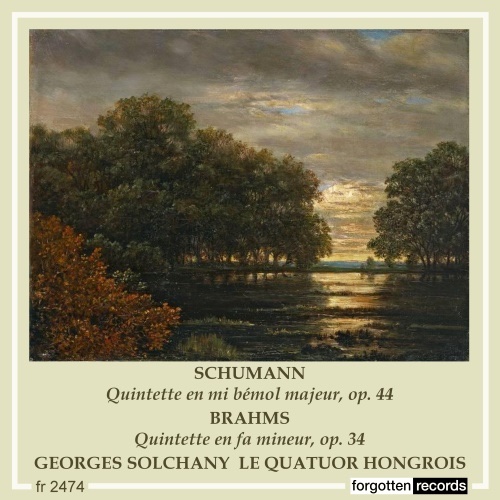
Georges Solchany and Hungarian String Quartet – Piano Quintets of Schumann; Brahms – Forgotten Records
Two mid-century recordings by Solchany and the Hungarian Quartet