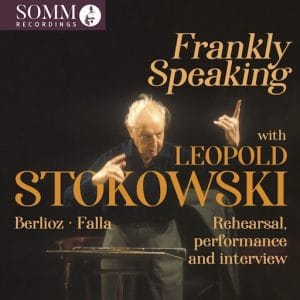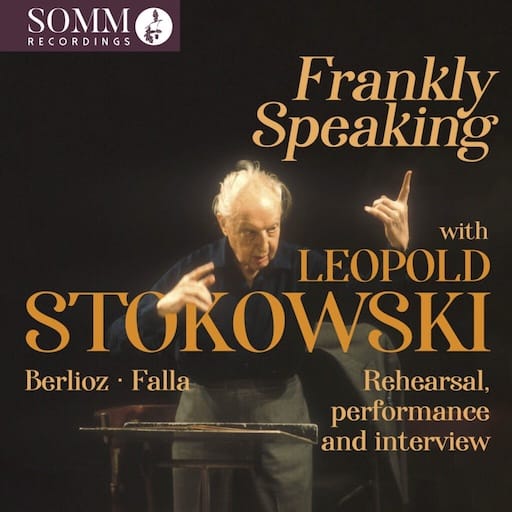
Frankly Speaking with Leopold Stokowski = FALLA: El amor brujo Ballet; El amor brujo Suite – in rehearsal; BERLIOZ: Le Carnaval romain – Overture, Op. 9 – SOMM Ariadne 5035 (75:03, complete content and credits below) (2/21/25) [Distr. by Naxos] *****:
The guiding spirit for this release on conductor Leopold Stokowski (1882-1977) seems to have been Jon Tolansky, a radio and television documentarian devoted to the global, classical music community. For this 24 September 1964 performance of Falla’s ballet El amor brujo with Gloria Lane, from a BBC Third Programme aircheck, SOMM revives a prior issue from1993 by Music & Arts (CD-770). The Berlioz Roman Carnival Overture rehearsal excerpt derives from the War Memorial Opera House, 19 December 1952; while the Home Service “Frankly Speaking” interview occurred at the BBC Studios, London 25 August 1959.
The central idea centers on presenting the ever innovative and ever controversial Stokowski at work and in a perspective that illuminates the vast scope of his contributions to music. Stokowski gleaned historical import by virtue of the sheer number of premieres of contemporary music compositions – while detractors remain quick to point out that despite all the “first performances,” there exist few “seconds.” What does emerge of real value lies in Stokowski’s work ethic, his paradoxical insistence on thorough technical accuracy to a score while fostering a palpable sense of musical spontaneity.
Immediately, from the opening pages of the Falla complete ballet score, we experience that great mystery “the Stokowski Sound” that he elicited from virtually every ensemble he led. Whether from the placement of the participating musicians, his insistence on violin free-bowing to achieve a homogeneity of tone claim responsibility, the effect remains viscerally palpable. Gloria Lane (1925-2016) does her best to intone the flaming, passionate gypsy flavor of the texts, perhaps not so sensuously as either of Stokowski’s former recorded colleagues, Nan Merriman and Shirley Verrett-Carter, but heartily effective. The level of string and brass virtuosity from the BBC quite resonates with strident luminosity. The grand leisure Stokowski evokes from The Magic Circle episode strikes us powerfully, if only because the prior section, the Dance of Terror has so menaced us.
The ubiquitous Fire Dance has no aspect of easy familiarity but erupts in throbbing motion, impulsively carnal. The serpentine woodwind playing now establishes its own power before Lane enters once more for the Will o’ the Wisp episode, marked by sudden string and wind interjections. The most emphatically melodious section, the expansive Pantomime, features gorgeous cello and violin solos. The French horn and string and wind lines, set a sumptuous prelude to the last vocal interludes that announce an uncanny, ghostly, sunrise marriage of the principals, the wedding bells rife with gypsy mysticism. The applause is earthly and unabashed.
We go to 1952 San Francisco for rehearsal number 14 and the tricky tonguing section from the brass amidst nervous strings and piano obbligato. Stokowski admonishes his players to get out into Spain’s local villages, where black and white magic reign supreme. He whistles the curls invoked by Falla’s musical line. The monumental life of the village curves is what Stokowski wants from his first trumpet in the Magic Circle. Dynamic levels Stokowski adjusts to suit the tone, especially from the cellos. “Don’t hurry,” Stokowski insists. “Phrase more,” he demands, then he notices that it is so written, “Not roughly; play delicately.” We continue to No. 24, the Fire Dance. The oboe pierces our soul, and the tutti moves, inflamed. More diminuendo before bar 26. He tells his solo piano to soften the left hand. The flutes must be ff ostinato. The change is palpable, and we proceed to No. 33 for the febrile coda. Silence for 30 seconds.
The Berlioz begins at No. 10, “No accent, light.” He wants detached tones for the crescendo, light accents that bounce. Two bars before 13 he coaches the trombones, then viola, cello, bass, investing a schwung into the phrasing. At 14 and 15 he insists on attentive delicacy, molto diminuendo in rhythmic accents, secco, short and dry. Eight bars before 16 he asks legato from his glissando trombones. “You don’t like to make glissandos, eh trombones?” Insisting on accuracy at Letter K, Stokowski has his ensemble in stitches. The tympani must use wind sticks, staccato, the trombones diminuendo. The crescendo instruments must lift the bell slightly. At nine before the end, mf, then readjusted for more, pert accuracy.
The interview, some 29 minutes long, begins with introductions and reminiscences. The issue of press mis-representation arises immediately, and Stokowski takes some responsibility. Stokowski believes in musical evolution, and he sees great musical minds active in the musical community, like Schoenberg and Stravinsky. In “defense” of his movie endeavors, Stokowski believes such a medium permits jedermann, everyman, to have access to musical listening across diverse cultures. In Finland for Sibelius concert, just stopping at a local tavern, Stokowski felt the magic of friendship. Music expresses for him some depth of feeling beyond words, of infinite preciousness. The conductor and his ensemble must find the source, the inspiration, behind the black notes on the paper, a continuous creative process. The real conductor, he claims, possesses the sense of cooperation, not distance from his players. The conductor is not a ”showman” as such, since he remains in the ear, not the eye.
Stokowski entertains mixed feelings about Fantasia (1940), that some elements felt cheap, while other aspects he respects. Disney had proposed the Dukas originally, then he suggested a longer feature. Stokowski feels that the work of Picasso would work effectively for cinematic treatment, if there were to be a sequel to Fantasia. Stokowski envisions a new renaissance, perhaps emergent with the evolution of humanity. Stokowski objects to the word “job” in his making of music. Some discussion revolves around Stokowski’s origins, his ancestry; but he insists music was easy for him. He wanted his study of harmony to introduce him to new chords, but the old system proved too limited.
The violin was his first instrument, which inflamed his youthful imagination. Conducting exceeds simply beating time; it has mystery for Stokowski. Power in itself is not his object, especially with the example of power-hungry men like Hitler. Friendly cooperation, not autocracy, remains his aim to achieve an ideal performance. He tries to find all the range of emotions in music, to make eloquent whatever lies in the music. He mentions the music of Revueltas as an example of “elemental, primitive music” without becoming brutal. Stokowski mentions both Furtwaengler and Koussevitzky as examples of “friendly magnetism.” The critics insist on the power element in conducting, but Stokowski feels authority comes from knowledge of the scores. Stokowski admires Bruckner, but his instinct tells him Bruckner is not for him. Stokowski jokingly speaks of his early impression of America as “cowboys and Indians,” but now he conducts in Houston, Texas, without any of the exaggerated stereotypes of “the West.”
Stokowski sees himself a citizen of the world, beyond nations. Born a Catholic, Stokowski now lives according to his own, ethical principle, which instinct provides him, without dogma or labels. Has Stokowski had to make amends? Yes, but he wishes to preserve his privacy and focus on the future; he resents having to talk about himself.
The conductor’s natural candor and humility refresh us with his sense of mission. A pity no recorded document has emerged from the Stokowski concert sessions in San Francisco. A precious, eloquent moment with one of music’s supreme orchestral colorists, a master of his art.
—Gary Lemco
Frankly Speaking with Leopold Stokowski =
Falla: El amor brujo Ballet
Gloria Lane, mezzo-soprano/ BBC Symphony Orchestra/ Leopold Stokowski
Falla: El amor brujo Suite – in rehearsal
Berlioz: Le Carnaval romain – Overture, Op. 9 – in rehearsal; “Frankly Speaking” Interview with Stokowski
San Francisco Symphony Orchestra/ John Bowen, Reginald Jacques, George Scott – interviewers