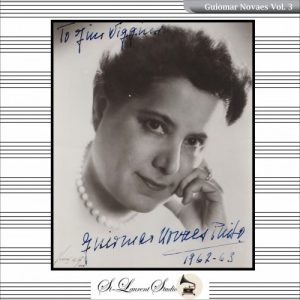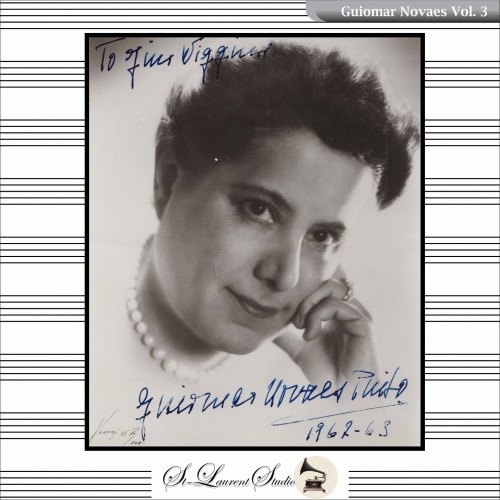
GUIOMAR NOVAES Vol. 3 = PHILIPP: Feux follets; GLUCK (arr. Brahms): Gavotte; GOTTSCHALK: Grande fantasie triomphale sur l‘Hymne national brésilien, Op. 69; IBERT: Histoires: Le petit âne blanc; R. STRAUSS: Ständchen Op. 17/2; ALBENIZ: Tango in D Major, Op. 165/2; VILLA-LOBOS: A prole do bébe, livre I: O Polichinello; As trés Marias; Brazilian Folk Songs; PINTO: Scenas infantis; PHILIPP: Feux-follets; MOMPOU: Jeunes filles au jardin; GUARNIERI: Toccata; CHOPIN: Piano Concerto No. 2 in F Minor, Op. 21 – Guiomar Novaes, piano/ New York Philharmonic Orchestra/ Leonard Bernstein – Yves St-Laurent YSL 78-1688 (76:23) [www.78experience.com] *****:
Once dubbed by James Gibbons Huneker “The Paderewski of the Pampas,” Brazilian pianist Guiomar Novaes (1894-1979) garnered a potent reputation as a keyboard individualist, projecting a rich, keyboard tone and a refined capacity for nuance in her broad, chosen repertory that embraced the Romantics – particularly Beethoven, Chopin, and Schumann – and musical ambassadors of her own country and the Iberian peninsula. Though a pupil of Isidor Philipp at the Paris Conservatory (in 1909), she had already a fully formed musical personality, a fixed yet spontaneous notion of tempo and color dynamics that she brought to the score at hand. Yves St-Laurent in his Volume 3 has collated, chronologically, 14 recordings, 1919 – 1958, made for Victrola and Columbia Records, including a live broadcast from the archives of the New York Philharmonic.
The collection opens with homage to Novaes’ first important teacher, Isidor Philipp (1863-1958), his Feux-follets (rec. 17 June 1919), essentially a brilliant étude for touch and rapid notes, mostly staccato and pearly glissando. Novaes invests a liquid patina into this French display piece, Lisztian in its concentrated ambitions. From the same session, we have the Brahms arrangement of Gluck’s Gavotte, a favorite of no less than Josef Hofmann. The music-box sonority Novaes draws forth enjoys both clarity and studied delicacy. From two distinct recordings sessions – 3 April 1920 and 12 June 1923 – we have Novaes’ rendition of Louis Moreau Gottschalk’s Grande fantasie triomphale on the Brazilian national anthem, a colossal color piece that testifies to the keyboard capacities of the composer, the first to incorporate Creole sensibilities into Classical music. One must wonder if Paganini had not impressed Gottschalk, since the shape of this mighty piece of bravura resembles the great violinist’s treatment of the Moses theme from Rossini. The sheer range of color effects from Novaes belies the acoustic medium of the recording from the American Victor Company. The elongated crescendo from Novaes proves stunning, just prior to the triumphal march effects. Novaes’ percussion resounds of the titanic qualities attributed both to Liszt and Paderewski, even while her diminuendos purr like Siamese cats.
Novaes’ series of electrical recordings begins with music of Jacques Ibert (1890-1962), his “Little White Donkey” from Histoires, recorded as part of a long session for Victrola, 8 April 1927. A dainty character piece rife with hasty, soft accents, it serves as a color étude. The “Serenade” of Richard Strauss retains its liquid, clarion sonority throughout, her dragonfly finger-work dazzlingly effective. The familiar Tango in D by Albeniz does not need Godowsky’s additions to capture the suave eroticism of the moment; Novaes’ suggestions of an Iberian tryst suffice. The triptych of pieces by Villa-Lobos date from 27 March 1927 (O Polchinello, on Victor) and 5 February 1941 (for Columbia). Each captures the composer’s nervously animate, illumined keyboard style, rife with the pagan and pious undercurrents of his native Brazil. The nine Brazilian folk songs enchant via their innate charm, harmonic gambits, structural – even childlike – simplicity, and their evocation of a simpler, more direct lifestyle.
Music by Novaes’ composer husband, Octávio Pinto (1890-1950) from 22 November 1946 ensues, his Scenas infantis, a series of five busy études, the first for wrist articulation in quick notes followed by a simple cantilena. The second of them offers a martial mood, as does the third, after its repeated childlike fanfare. The fourth proffers a melancholy parlando close to the spirit of Brahms, before it becomes whimsical. The last, a syncopated dance in sprightly figures, likely owes debts to Debussy’s salon style. From 3 January 1947 Novaes repeats her teacher Philipp’s Feux follets, this time for Columbia in swifter tempo. The luxury of speed increases the piece’s kinship to Chopin and Liszt. Federico Mompou (1893-1987), a composer equally admired by Alicia de Larrocha, appears in a suavely poignant “Jeunes filles au jardin” (rec. 20 February 1947) from his Children’s Scenes. From that same session we have a delicately knotty Toccata by Camargo Guarnieri (1907-1993), a real staccato study with sudden, scalar elevations. Its last page is lush with bravura.
To enjoy an evening of Novaes’ artistry without her beloved Chopin constitutes a kind of blasphemy, so she and Leonard Bernstein collaborate 9 October 1958 in the F Minor Concerto. The opportunities for bravura and flamboyant, ardent poetry come served with an enthusiastic vigor made fertile by long experience in Chopin’s especial conceits. Novaes occupies the same illustrious Chopin salon as Artur Rubinstein, exalted and convinced of the value of each roulade and fervent, rubato-guided gesture. The orchestral tissue under Bernstein, no less inflamed, sets a consistent, illumined mystique for each of Novaes’ entries. The splendid Larghetto movement, alternating between a floridly poetic bel canto style and a dramma maestoso, provides Novaes and Bernstein a potent vehicle for their respective, musically thespian gifts. The finale, Allegro vivace, the most “Polish” of the three movements, unleashes the playful spontaneity in both collaborators and their responsive orchestra, rife with wind and brass fanfares and aggressive, keyboard roulades. The famous col legno episode sounds thoroughly Spanish or gypsy in its suave contours. Novaes’ keyboard resembles more the prima ballerina in an exotic, often seductive ballet. Bernstein’s corps of players whistles and cavorts with the piano, a mutual intoxication of boldly exuberant spirits, finally intoning a magical, gypsy mazurka of epic proportions, which the New York audience embraces with a whole heart.
—Gary Lemco