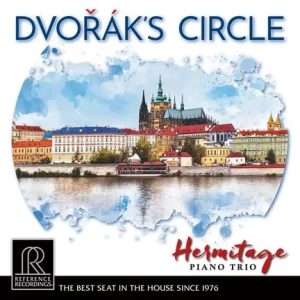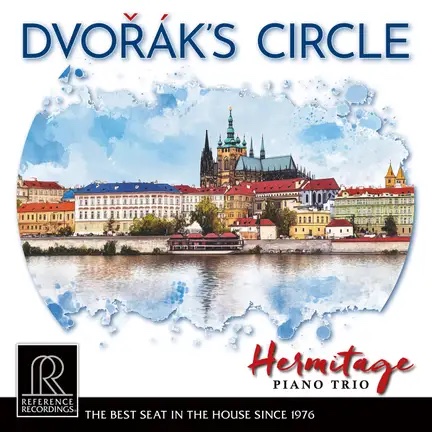
DVOŘÁK’S CIRCLE = DVOŘÁK: Piano Trio No. 3 in F Minor, Op. 65; SUK: Elegy in D-flat Major, Op. 23; Piano Trio in C Minor, Op. 2; FRIML: Piano Trio “Rural Life in Bohemia,” Op. 36 – Hermitage Piano Trio – Reference Recordings RR-1535ACD (72:28) (7/3/26) [www.ReferenceRecordings.com] ****:
The stated intent of this album (rec. 15-18 April 2023) realizes the “intersection” of Antonin Dvořák (1841-1904) and two of his gifted pupils, Josef Suk (1874-1935) and Rudolf Friml (1879-1972). The selected compositions demonstrate the “creativity, connectivity, and diversity” of their individual styles in the chamber music genre, utilizing Dvořák’s F Minor Piano Trio (1883) as the expressive fulcrum around which the composers generate their Romantic sensibility. The members of the Hermitage Piano Trio – Misha Keylin, violin; Sergey Antonov, cello; and Ilya Kazantsev, piano – agreed that “the majestic and powerful” Op. 65 of Dvořák remains “one of the most monumental works in all forms of chamber music.”
Several commentators mention the death of Dvořák’s mother in December 1882 as a possible source for the dire tone of the F Minor Trio, cast in much of the same dramatic terms as his Seventh Symphony, Op. 70. Another debt may well lie in the Brahms Piano F Minor Quintet (1864), a darkly passionate composition with strong ties Franz Schubert, whom Dvořák no less admired. Hermitage Trio addresses the opening movement, Allegro ma no troppo, with immediate, even grim, vivacity, sustaining an unrelieved tension. It soon becomes apparent that the scale of the sonata-form movement exceeds the appellation “chamber music” and assumes a “symphonic” proportion. The few moments of repose evaporate quickly in a storm of tragic impulses, some martial, others nostalgic.
Marked Allegretto grazioso, the second movement (in C# minor) assumes the character of an offbeat peasant dance. A kind of obsession with triplets dominates the strings, resembling a scherzo motif in mixed agogics, while the piano alternates note values to insert the requisite angst. The major mode of the Trio section allows a sense of temporary relief, in an arching melody of rare beauty. Hermitage invests an acerbic but appealing energy into this emotionally ambiguous movement.
The cello then announces the lyric appeal of the music’s “heart,” the third movement, Poco Adagio in A-flat major, which may well serve as a lament for Dvořák’s departed mother, much as the slow movement in the Brahms Horn Trio intimates a similar pathos. Keylin’s violin proves ardently expressive here, while the cello underlines the depth of emotion. Brief moments of imitation move the melodic progress forward without any sense of “academic” procedure. The duet of violin and piano for the coda invites the cello to dream of lovelier times.
Dvorak’s natural gravitation to folk idiom of the Bohemian furiant dominates the last movement, Finale – Allegro con brio, a dance noted for its explosive alternations of mood and tempo. Dvořák maintains the minor mode for his viscerally driving finale in descending octaves, which suddenly sways into a nostalgic waltz that soon gains a new gravitas as it segues to the da capo reprise. Again, moments of canonic imitation urge the music forward with a sense of voluptuous determination.
With the arrival of the main theme from movement one Dvorak yields to the temptation of cyclic form. A temporary concession to the major mode does not alleviate the vivid momentum of this dramatically constructed music, whose coda sums up each of the inspired energies prior, that sense of “so you see, my children” that no less informs his magnificent tone poems.
At the Prague Conservatory where he was enrolled, Josef Suk studied composition with Dvorak and became a favorite pupil, even marrying Dvorak’s daughter Otylka in 1898. Though the Elegy (Adagio) celebrates the happy event of the birth of a son, its literary source lies in the epic poem Vyšehrad by Julius Zeyer (1841–1901), a sentimental portrait of the same fortress celebrated musically by Smetana to open the cycle Ma Vlast. Besides the obvious influence of Dvorak’s style (and that of Brahms) on Suk’s compositions before the 1905 Asrael Symphony, a touch of (Gothic) morbidity colors his work.
Originally scored for violin, cello, string quartet, harmonium and harp, the Elegy assumed its trio form by Suk’s own hand. The adagio suddenly breaks off, ceding to a most ardent evocation of languor before returning to its nocturnally melodic beginning. The violin-cello duets prove thoroughly beguiling, over a soft ostinato from the keyboard. Another surge of emotion – including a brief piano solo – ensues, before each of the instruments enters to collaborate in a swaying, tearful farewell.
While Rudolf Friml’s American reputation rests on Broadway compositions, operettas, and popular songs, his classical output includes some 100 opera of piano music, a one-movement piano concerto, and his one-movement Piano Trio in C Major (1918). The music plays like a Czech pastiche of Bohemian melodic impulses, varying from nostalgic waltzes to operatic allusions to gypsy flourishes. The violin part often mimics his teacher Dvorak and countryman Smetana, while the keyboard alludes to Chopin and Liszt. The cello enjoys a lovely cantilena section that bursts forth in joyous collaboration of the three instruments in a rising crescendo. A pizzicato sonority introduces a frivolous, gypsy finale, a swirling, round dance that breaks off for a sentimental moment before resuming its course to a flippant, bravura coda.
Josef Suk’s Op. 2 Piano Trio (1889) derives from his studies at the Prague Conservatory, originally in four movements for its 1891 premiere. His teacher at the time, Karel Stecker, recommended that Suk show the score to Dvorak, whose composition class Suk joined by invitation. At Dvorak’s suggestion, Suk eliminated the brief scherzo and tightened the structure to its present form.
A powerful series of chords from piano and strings opens Suk’s Allegro, reminding us why Dvorak’s work provides the rubric for this album. The cello introduces the second theme, slow and melancholy, sharing lyrically competing registers. A tripping figure emerges, suddenly becoming ardent over ostinatos and arpeggios from pianist Kazantsev. The urgent, repetitive sequences suggest that the music of Brahms was well known to Josef Suk, as it had been to Dvorak. The second movement, Andante, owes debts to Bohemia’s folk tradition, basking in a nocturnal form of folk dance, almost a tango rhythm. The secondary theme proves equally romantic, and one may find melodic intimations of Grieg even as the “tango” persists.
Two impulses mark the finale, Vivace, a syncopated dance and a march. The writing for all three instruments dwells on the bravura level, with sudden incursions into more melodious riffs despite the bouncy motor element. In its dark er turns, the dotted tune resembles a parody of Beethoven’s “fate” motif, here become a modal Slavonic dance. A pedal point has the instruments sail into the stratosphere and then down amongst us mortals, when a raucous chord alerts us that the coda appears imminent.
Besides some fine ensemble playing, this album features excellent commentary from Marina A. Ledin and Victor Ledin within an attractive and colorful booklet, handsomely produced.
—Gary Lemco