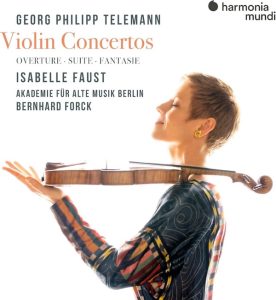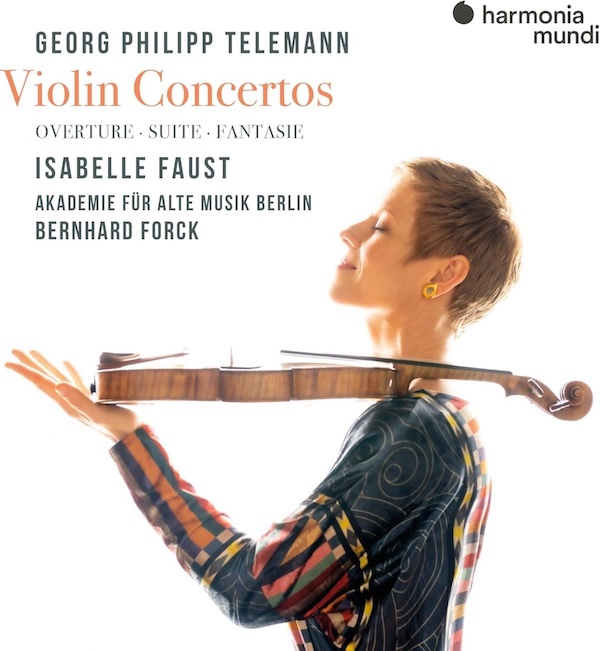
TELEMANN: Overture Suite in B minor; “The Frogs” Concert; “Guilliver’s Travels” suite; Fantasia No. 3; QUANTZ: Circle Canon, Violin Concertos – Harmonia Mundi Harmonia Mundi HMM 902756 (79:35; complete content listing below) (9/26/25) [Distr. by PIAS] *****:
Having previously not succumbed to the charms and virtues of the Hausmusik of Georg Philipp Telemann (1681-1767), given my predilections for Bach and Handel, this 2024 release captured my fancy, convincing me it should be subtitled “the effective Telemann,” given the sheer range of musical combinations and violin techniques demanded of Isabelle Faust and her deftly gifted companions. Not the least of the ingredients in this dazzling mix, Faust’s instrument, the 1704 Stradivarius, “The Sleeping Beauty,” generates its own, piercing energies in the course of a series of compositions that easily rival Vivaldi and Bach for their blend of artistic invention and bravura musicianship, at moments jaw-dropping for articulation at astonishing speeds.
The lively proceedings open with the relatively familiar seven-movement Suite in A Minor conceived for the Dresden court and featuring ardent use of bariolage technique, which Isabelle Faust negotiates with fluent aplomb, if not downright ferocity. The various titles indicate some playful, programmatic content, as in “La Bravoure” and the final, bustling movement, “Rodomontate,” this latter alluding to a haughty character in Ariosto’s Orlando furioso.
Telemann glibly confessed his “proclivity for sonatas,” and his Sonata in D for Trumpet, Strings and Continuo combines concertante elements with plastic impulses from concertos and sinfonias. The initial Sinfonia utilizes a chaconne procedure, the main tune’s returning in a manner reminiscent of Vivaldi. The Largo projects Italian lyricism, with the violin parts in flowing dialogue. The Presto, an animated bourrée, invokes the spry trumpet to heighten the dance’s bristling appeal. The electricity generated between Faust and trumpet Hartwich proves most infectious.
The “star” celebrity of this collection may well lie in the A Major Violin Concerto “The Frogs,” in which the violin, by way of bariolage and harmonic expansiveness, imitates the natural sounds of the marsh reptile and its distinctive, wheezing song. Shifting dynamics and chord positions keep Faust and our ears imaginatively active, especially when the ripieno strings participate in an amphibiously raucous chorus. The shimmering, pastoral second movement Adagio extends the ungainly but dreamy, natural bliss even further. For his last movement, Telemann conjures a courtly Menuet whose middle section suddenly reverts to the animated velocity of the opening movement before persuasive alighting on the niceties of courtly repose.
Hamburg around 1727 provides the social milieu for his so-called “Gulliver’s Travels” Suite in D Major, scored for violin solo duet. Following the odyssey of Swift’s protagonist, an Intrada (Spiritoso) beckons the tiny inhabitants of Lilliput, in the form of a Chaconne in compressed note values, 3/32. On the contrary, the Brobdingnagian monstrosities appear in a Gigue, 24/1. The third movement parodies self-absorbed science, in the sporadic energies of the “Reverie of the Laputans and Their Awakening,” an Andante in broken (brisé) style. The two violins part expressive company for the final movement, “Loure of the Houyhnhnms and Fury of the Yahoos,” in which Swift parodies the famed, Cartesian mind/body dualism, Telemann’s responding with civilized and wild musical gestures, and the encounter’s barely lasting one minute.
Faust and company alter their focus slightly, addressing lesser works either by Telemann or those formerly attributed to him but now assigned to Johann Joachim Quantz (1697-1773), noted for his flute opera. Telemann’s Fantasia No. 3 in B Minor, in five brief movements, does in fact derive from a set of 12 Fantasias for Flute without Bass, TWV 40:4 (c. 1731). Besides Isabelle Faust, violinist Aaron Rosand would periodically perform one of these pieces. As a solo work, it serves to display Faust’s fluent articulation of long and quick notes, with trills that end in extended cadences.
The Circle Canon in E Minor, now credited to Quantz, has Faust play with concertmaster Bernhard Forck a clever composition in polyphony – double counterpoint at the octave – the last movement of a duo from Sei Duetti a due Fluti Traversi, 1759. The strict adherence to structural, however, proceeds in a galant style that softens the effect. Follows one of the more “vocal” pieces in the Telemann collation: Concerto in A Minor, set in he four-movement pattern of the sonata da chiesa. Faust will serve both as a lyrical, even operatic soloist and subordinate her part to that of the principal violin of the ripieno ensemble. The initial Adagio plays like a lament from Purcell, a tragic moment of yearning. An Allegro ensues, lively and explosively virtuosic in the manner of Vivaldi. The music cedes to another, if brief, lament, only to erupt in a frantic Presto that challenges Vivaldi’s “Winter” for whiplash effects.
The final selection, Concerto in D Major for Trumpet, Violin, Cello, Strings and Continuo boasts a mysterious etiology. High tessitura and multiple double-stops permeate the opening Vivace, in which Faust’s ardent violin in dotted rhythms has obbligato accompaniment from Harwich’s trumpet and the ripieno cello. Frankly, the music could easily have served as a trumpet concerto. The lyrical Adagio tiptoes in a lovely cantilena over plucked or sustained chords in the other strings. The final movement, an expansive Allegro, ¾, assumes again the festive atmosphere, with the trumpet and strings in Lombardic rhythm that catches fire at every virtuosic turn, the dance often too lively for human feet but not for the soaring imagination.
—Gary Lemco
Isabelle Faust – Violin Concertos
TELEMANN:
Overture-Suite in B Minor, TWV 55:h4;
Sonata for Trumpet, Strings and Continuo, TWV44:1;
Concerto “The Frogs” in A Major for Violin, Strings and Continuo, TWV: 51A4;
Suite “Gulliver’s Travels” in D Major for 2 Violins, TWV 40:108;
Fantasia No. 3 in B Minor, TWV 40:2-13;
QUANTZ:
Circle Canon in E Minor for 2 Violins, Op. 2/6;
Violin Concerto in A Minor;
Concerto in D Major for Violin, Trumpet, Cello, Strings and Basso Continuo –
Isabelle Faust, Violin/
Bernhard Forck, violin/
Ute Hartwich, trumpet/
Akademia für Alte Musik Berlin