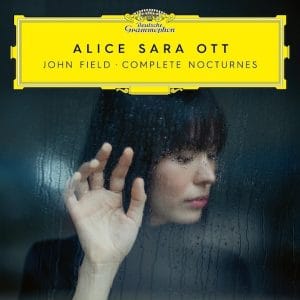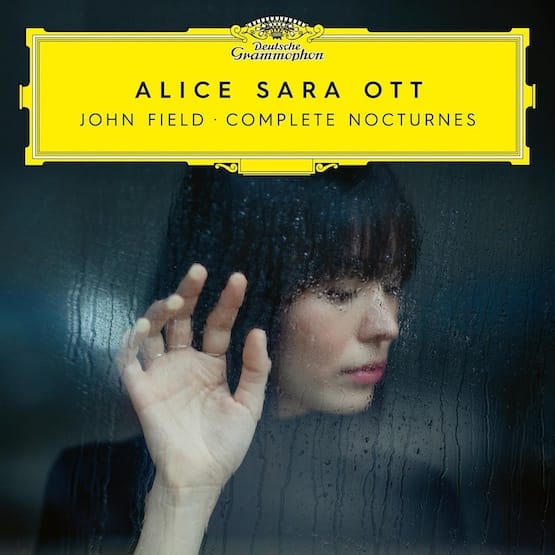
FIELD: Complete Nocturnes – Alice Sara Ott, piano – DG 486 6238 (76:02) (2/7/25) [Distr. by Universal] ****:
We may presume from pianist Alice Sara Ott’s accompanying essay to this set of Nocturnes by the Irish composer John Field (1782-1837) that she had become impatient of the standard assessment of his contribution to music, the relative neglect of him as both original thinker and practicing musician, who in his own time accrued singular celebrity. Field appeared in London a considerable number of times, thirty-one, between 1793-1801, and he programmed concertos by himself or by a contemporary twenty-five times. Field’s studies and apprenticeship with Muzio Clementi (1752-1832) influenced his decision to compose pieces that would emphasize delicacy of touch, like Clementi’s 1795 Sonata in G Minor, Op. 34/2. While the term “nocturne” had been employed by both Haydn and Mozart, the application of the notion to light, dreamy, evening-mood pieces really seems to originate in Field. The chronological order of the Field nocturne opera remains a problem, given a fallow period of some ten years in which Field composed nothing. Add to the quandary Field’s own careless attitude in cataloguing his compositions. Franz Liszt around 1837 took up the Field pieces and imposed his own sense of time-ordering. Within the eighteen nocturnes we appreciate the evolution of a rudimentary national style, rooted in Field’s Irish heritage, while several gravitate into something like fantasias. Frankly, Field rather disliked what his younger, Polish contemporary Chopin did with the form, exploring its darker possibilities – only three of the Field works venture into minor keys – and he suggested strongly that Chopin ought to choose a different name for his versions.
Already, with the Nocturne No. 1in E-flat Major, we hear in the right hand’s “nostalgic familiarity” (Ott) the liquid quality of his implied Irish rhythms, playful and sentimentally attractive. The No. 2 in C Minor has something of Mendelssohn’s natural melodic suasion and elusive mystery. The dotted parlando near the coda proves irresistible. The No. 3 in A-flat Major reveals a thicker texture, close to quartet sensibility, and its color, somewhat agitated, moves closer to what Chopin would exploit more deeply. With No. 4 (Poco adagio) in A Major, we savor the elastic, folkish melody line of which Field is capable, again making itself a companion for the Mendelssohn Songs without Words. The writing features moments of sparkling fioritura in its expansive evolution, a nervous quality in the bass reminiscent of Schubert. No. 5 in B-flat Major (Cantabile) evinces the same, rocking character of Irish lullaby we have in No. 1, and Ott lavishes a haunting tenderness in the scalar textures, up and down.
Franz Liszt found No. 6 in F Major, Berceuse (Andante tranquillo) a pastoral of quaint beauty, lovely in its transparent roulades, a testimony to the Clementi influence. In its liquid course, the music provides Ott a cadenza or two and a texture easily translated into the Chopin ethos. Something mesmeric inhabits the repetitions in No. 7 in A Major (Andante), a blend of simple parlando and modal, folk harmony. Almost sonata-like, the music suddenly develops and then breaks off to engage in ornamental eloquence. It was in these kinds of display that Field made a reputation both in London and in Russia, where he resided for the better part of thirty years. Robert Schumann favored expressive No. 8 in E-flat Major (Andante spianato), possibly for its pertly flashy lyricism. No. 9 in E Minor (Adagio) stands out for its melodic appeal, set over an arpeggiated bass line close to Beethoven’s Moonlight Sonata but tempered by Clementi transparency. The expansive No. 10 in E-flat Major – Nocturne pastorale (Andante con moto) basks in quick bravura roulades and impulsive changes of texture, occasionally making an emphatic statement over arpeggiated ostinatos. Ott holds the fermata at the coda to preserve our sense of restrained profundity.
With No. 11 in E-flat Major (Moderato) we return to the gentle, bass line inject a light depth to Field’s sense of romance. This piece and its successor, No. 12 in E Major. En forme de Rondo (Allegro), seem to invite the 3-2 3-2 fingering favored by Clementi, instilling in us the sense that artistic touch and elastic, bravura ambiance meant more to Field than establishing a solid legato tradition. Funereal bell tones suddenly intrude on the music-box sonority, quite the musical surprise. No. 13 in C Major proves a real hybrid: subtitled Rêverie-Nocturne, it projects a slightly militant aspect to its dreamily hypnotic surface, where the competing sonorities might anticipate pieces by Debussy. A sense of improvisation inhabits No. 14 in G Major (Lento), which, though brief, captures an elusive freedom close to Schumann. The last of the minor-key nocturnes, No. 15 in D Minor. Song without Words (Lento) projects an intimate, melancholy moment of reflection, and Ott does manage well what Schumann often labels innigkeit. Its latter half becomes more sprightly, folkishly extroverted briefly, only to return to its inner contemplation, resembling a piece by Grieg.
The final triptych of nocturnes, the Nos 16-18, each bear the tempo designation Molto moderato. The epic, No. 16 in C Major at first looks forward to Chopin’s Prelude in E Minor, then it proceeds in a more scherzando demeanor, even descending into some depths and operatic gestures. The whimsical attacks and tugs in dynamics and broken melodic line have now assumed the character of a piece by one of the Bach sons.
Before the meanderings of this C major piece conclude, we have been witness to an imaginative fantasy of grand proportions, with few compositions within the genre to which to make analogies. Only the steady bass line has given us any sense of an ongoing concept, realized by a distinctly sympathetic interpreter. The ensuing Nocturne No. 17 in C Major seems like a refreshing, playful study in staccato articulation, much reminiscent of Haydn, cross-fertilized by Clementi and Mendelssohn. The last of the collection, No. 18 in F Major, bears the designation “Midi,” or “noon” in French. It plays as a duet in brightly lit colors, tender and sentimental, with sudden caesuras, much in the manner of the Bach sons. Another late stop, and a bit of presto; and one more pause, and a martial moment soon transformed into a charmed lyric. Exploratory and original, these pieces provide us a fascinating glimpse into a side of Romanticism neglected too long.
—Gary Lemco