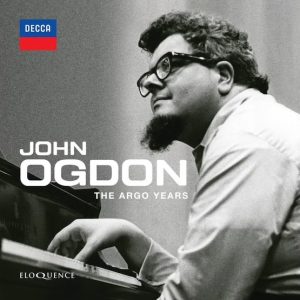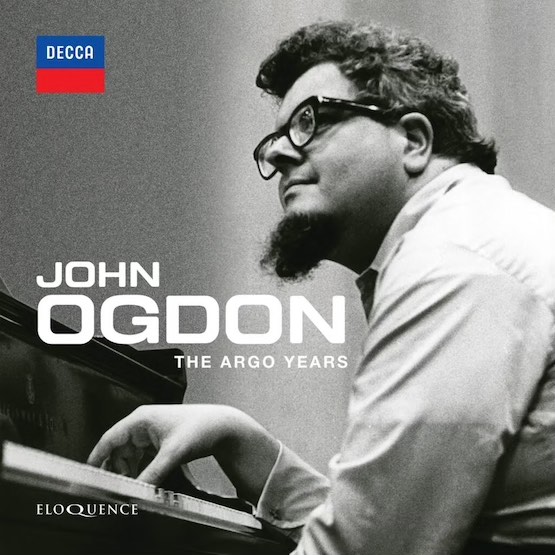
John Ogdon: The Argo Years – Piano works by Mendelssohn, Liszt, Schumann, Stravinsky, Shostakovich, Mozart, Messiaen (complete contents and credits listed below) – Decca Eloquence 484 6430 (6 CDS = 79:57; 49:34; 38:08; 54:28; 73:58; 50:48) [Distr. by Naxos] *****:
My only direct experience of British piano virtuoso and musical phenomenon John Ogdon (1937-1989) came at a concert with the Atlanta Symphony Orchestra, when he appeared in a spectacularly swift, transparent rendition of Ravel’s G Major Concerto. He then vaporized from view after a most perfunctory acknowledgement of the audience response, and his companion, wife Brenda Lucas, would permit no visitors backstage. From various biographical sources, we who admired Ogdon read of his fine pedagogy, which included Busoni master Egon Petri, and of Ogdon’s mental issues, diagnosed either as schizophrenia or manic depression. Some who followed Ogdon’s own creative career, knew of his 200 compositions in varied genres, including solo keyboard works, concertos, transcriptions, cantatas, chamber music, and opera. His large but selective discography embraces some of the most demanding and musically intricate pieces in the keyboard canon, with a “specialty” in the music of Busoni, Scriabin, Rachmaninoff, Alkan, Messiaen, Schumann, Liszt, Sorabji, Bliss, Medtner, and Brahms.
True, Ogdon shared the Gold Medal at the 1962 Tchaikovsky Competition with Vladimir Ashkenazy, but their respective careers took disparate journeys. Innately more experimental than his Russian colleague, Ogdon courted modernism without apology, a trait which had exasperated one of his teachers, the classically inclined Iso Elinson (1907-1964). Appropriately, Ogdon began his Decca series of recordings in December 1968 with the daunting 1944 piano cycle (Discs 4-5) of Olivier Messiaen, Vingt Regards sur l’enfant-Jesus, which may be translated as “Twenty Contemplations (or Apperceptions) of the Infant Jesus.” Messiaen means to capture the essential, mysterious paradox of God the Father and the Child Jesus, which, to the faithful, remains a revelation. The breadth of Messiaen’s virtuosity requires virtually every shade of keyboard dynamic, colored by ecstasies of power, both poetically intimate and colossally inflamed. There exist in Messiaen moments of violent brutality, like the XVIII Regard de l‘Onction terrible, and in the 1970 recording – with Brenda Lucas – of the Visions of the Amen on Disc 6, sections II and III, Amen des étoiles, and Amen de l’Agonnie de Jésus. Contrast such images and suggestions of The Passion with the intimacy of Première communion de la Vierge, with its “Magnificat” episode, and Le baiser de l’Enfant-Jésus, whose “Theme of God” is rendered in the manner of a lullaby. We feel not only the inspiration of the music at hand, but the real communion of the two musicians, Ogdon and Lucas, here embarked upon and within a life of spiritual transcendence.
If we turn to Disc 1, the 7-8 January 1969 Argo recordings of youthful Mendelssohn, the atmosphere becomes infinitely lighter, with the 1823 2-Piano Concerto in E Major, originally conceived as a virtuoso vehicle for Felix and Fanny Mendelssohn. Despite the composer’s youth, fourteen years, the deft character of the scoring, mostly reliant on Mozart syntax buttressed by a hint of sturm und drang, proves quite effective, its sweet, second movement Adagio non troppo’s belying Mendelssohn’s suppression of the work for its immaturity. Neville Marriner’s contributions in the form of Mannheim rockets are hereby noted. Mendelssohn’s A Minor Concerto for Piano and Strings (1822), even more obscure, did not find publication until 1997. Its opening Allegro smacks both of Mozart and Paganini, glibly melodic and rhythmically robust. Ogdon and Marriner realize a plastic, brilliantly genial rendition, sometimes dazzling for inflection and pace. Once again, the second movement Adagio, having come from a 13-year-old composer, reveals a burgeoning lyricist of special gifts.
Disc 1 concludes with the 16-17 June1983 recording of Mozart’s 1784 Piano Quintet in E-flat Major, the wind ensemble led by the gregarious and eminently talented horn player Barry Douglas (1931-2020). Mozart himself declared the work “the best thing I have written in my life.” Mozart doubtless took pride in his balancing of the wind instruments – each with its own sonorous and scalar idiosyncrasies – with the naturally overpowering capacity of the keyboard. Limiting his melodic tissue to brief phrases assigned to diverse instruments in variegated combinations, the players could breathe freely while maintaining a fluid, nuanced line while the piano could indulge in occasional polyphonic tissue.
The first two bars of the Largo theme will supply the material for the compressed development of 16 measures. The plaintively piercing tone and acrobatic trills of Derek Wickens’ oboe proves effective here, given its sprightly realization of Mozart’s dance impulses. The B-flat major Larghetto movement indulges the individual colors of the wind group to magically lyrical effect, intensified in the second half’s modulation into the (E) minor mode just prior to the soft coda, blending the Ogon’s nervous figures and the dolce chords in the woodwinds. The Rondo: Allegretto proceeds in five parts, begun by Ogdon and gradually moving to an operatic or concerto cadence that announces an extended cadenza a tempo for collaborative improvisation. Wickens’ oboe trill ends the solo virtuosity of each principal, so as to reintroduce the ritornello theme that soon bursts forth in opera buffa fasn into a high-toned coda.
Disc 2 has Ogdon and Lucas in a sterling 18-19 May 1972 collaboration in Franz Liszt’s Concerto pathétique in E Minor, in the 1856 arrangement of the work that had begun in 1849 as Grand Solo de Concert. Opening in percussive, stentorian octaves, the Allegro hints at the Hungarian scales we hear in the various Rhapsodies. The second keyboard provides staggering tremolando sostenuto passages, over which a chorale melody emerges, close in spirit to the call of the St. Francis Legends. The music relents drastically, becoming interior, meditative, a parlando expression of pious serenity as it segues into the second movement, Andante sostenuto.
We recognize elements, structurally, of the B Minor Sonata, lyrical, birdcall gestures juxtaposed against moments of dark, deep contemplation. Bell tones in trills carry us to a glissando scale that dives and then rises as another of Liszt’s sweeping chorales. The art of bravura enters, and the piece becomes a thrilling, tumultuous storm, the final Allegro movement. The Lisztian principle of transformation of theme has been economically active, while the dynamic energy could feed Busoni for years. The knotty counterpoints and running passages rival the orchestral, heroic textures of the symphonic poems, like Tasso. At moments, contrarily, the texture resembles a Baroque concerto grosso’s competing forces, finally finding resolution in Liszt’s patented, exalted melodies, ecstasies of both bliss and damnation.
The studied, polyphonic music of Robert Schumann proffers a series of restraints of emotion, beginning with the 1843 Andante and Variations for Two Pianos in B-flat Major, Op. 46. We recall that fellow Tchaikovsky Competition winner Vladimir Ashkenazy recorded this intricate work with Malcolm Frager. Schumann called the composition’s variants “elegiac. . .I must have been very melancholy when I wrote them.” Ogdon and Lucas bring out, besides the Bach imitation, the innate, passionate sweetness that invest the score. The music manages to elicit a feeling of character sketches, as the tempos and filigree assume meditative or lively gestures. With his penchant for marches, Schumann introduces a contrapuntal, antiphonal variant on a maerchen, a fairy-tale procession, not so far from Kinderszenen in spirit. The bass and middle voice bell tones ring out in patented, Schumann nostalgia.
The Six Studies in canonic form of 1845 have Debussy to thank for their two-piano transcription. Having moved from Leipzig to Dresden, Schumann became enamored of the pedal piano and its sonorous, contrapuntal possibilities, much in the manner of beloved Sebastian Bach. No. 2 in A minor stands out as a delicately lyrical application of polyphony, intriguing and melodic, marked Mit innigem Ausdruck, with intimate expressiveness. No. 7 Andantino projects a nervous energy close to Grieg and Brahms. So, too, No. 4 in A-flat major, Innig, exploits echo effects to achieve a folk atmosphere, until its middle section, in minor, unfolds a serious side, Schumann’s Eusebius demanding a certain passion. Is it coincidental that this music foreshadows Fauré? No. 5 in B minor, marked Nicht zu schnell, offers a choppy, rustic dance in close imitation, a combination dance-novelette. The last of the set, No. 6 in B major, Adagio, proves a stately gavotte-like procession, sentimentally serving as a typical Schumann postscript that indulges trills and turns in close imitation. Its drooping figures bid farewell to Sebastian Bach, if only momentarily. Some passing dissonances suggest that much remains unsaid.
The intellectual range of Ogdon’s art reaches out to Stravinsky and youthful Shostakovich for Disc 3, recorded 14-15 December 1970. Commentator Mark Ainley points out the “biting rhythm and piquant harmonies” of these seminal twentieth century works, “well served by Ogdon’s vivacious enthusiasm, deft articulation and transparent textures.” The 1929 Stravinsky piece offers an amalgam of musical style, neo-Classical in form, mostly French a la Saint-Saens and Poulenc, with a mischievous gypsy color from Liszt and Baroque antiphons thrown in. All three movements enjoy a strong dash of jazzy, whimsical paprika, a buzzing energy that thwarts easy identification, but entirely virtuosic. Marriner’s St. Martin’s players appear thoroughly engaged as well, offering diverse splashes of wind, string, and brass colors. The last movement, Allegro – capriccioso, saunters along in breezy motions, irreverent and aggressively witty, concluding with a resounding thump.
The 1933 Shostakovich Piano Concerto No. 1 in C Minor features a trumpet solo (John Willingham) who in performance usually sits next to the keyboard. Recall the composer premiered the work, whose own pianistic style seemed intent to convey his particular, musical sarcasm. In four movements, three of which share a similar duration, its slow movement, Moderato, stands out for its brevity. A good sense of spontaneity marks the first movement, Allegretto, with Ogdon and trumpet Willingham in fertile colloquy. The succeeding Lento projects an almost abject sincerity, its waltz impulses becoming increasingly passionate, sometimes in the manner of a Bach toccata. The dark-hued stringed Moderato serves as an introduction to the final movement, Allegro con brio – Presto, a vivacious synthesis of musical styles and allusions, from klezmer and Mahler to Haydn and Beethoven, especially his own Capriccio, Op. 129, “Rage over a lost Groschen.” Willingham’s trumpet steps up appropriately to the occasion, soon displaying his own, manic energies, a blistering, mad dash that might have had Chico Marx in mind.
Typically, the Eloquence production qualities shine, with a 19-page booklet to accompany the marvelous sound restorations, the pictorials of Ogdon, Lucas, and an annotated score of Messaien’s “Regard de l’Église d’amour” appropriate on several levels.
—Gary Lemco
JOHN OGDON: THE ARGO YEARS
1,2MENDELSSOHN: Concerto in E Major for 2 Pianos; Concerto in A Minor for Piano and Strings;
3MOZART: Piano Quintet in E-flat Major, K. 452;
1LISZT: Concerto pathétique in E Minor for 2 Pianos;
1SCHUMANN: Andante and Variations for 2 Pianos, Op. 46; Six Studies in canonic form, Op. 56;
2STRAVINSKY: Capriccio for Piano and Orchestra;
2SHOSTAKOVICH: Piano Concerto No. 1 in C Minor, Op. 35;
MESSIAEN: Vingt Regards sur l’Enfant-Jésus;1Visions de l’Amen
1Brenda Lucas, piano/
2Academy of St. Martin in the Fields/ Neville Marriner/
3Derek Wickens, oboe/ Robert Hill, clarinet/ Martin Gatt, bassoon/ Barry Tuckwell, horn and director