JOSEF SUK: Fantasy for Violin and Orchestra in G Minor, Op. 24; Pohádka (Fairy Tale), Op. 16; Fantastické Scherzo, Op. 25 – Michael Ludwig, violin / Buffalo Philharmonic Orchestra /JoAnn Falletta – Naxos 8.572323, 69:13 *****:
It was Josef Suk’s misfortune to assume the mantle of his teacher and father-in-law Antonín Dvořák just about the time another Czech composer with a unique musical voice was establishing himself. Twenty years Suk’s senior, Leoš Janáček often seems twenty years more advanced in style, and his operas, orchestral music, and instrumental music established him as the true successor to the tradition of Smetana and Dvořák. Now, thanks to recordings, Suk is getting the due he deserves as a late-Romantic composer whose finest works can stand comparison with Mahler’s and Strauss’s.
That’s certainly true of Suk’s greatest piece, the Asrael Symphony (1906), one of the most moving compositions of the twentieth century. The painful, near-grotesque tragedy of the work reminds me of the Mahler Sixth; if you don’t know this symphony, you’re in luck: there are no fewer than four well-received recordings available, including two on SACD!
Forgive me for digressing before I even start to talk about what should be the subject of this review, Suk’s Opp. 16, 24, and 25. However, I was reminded as I listened to the composer’s strangely appealing Fantastické scherzo of just how individual a composer Suk is. Here is Suk special sound-world, immediately familiar if you know the Asrael Symphony. It’s there, too, in the Fantasy for Violin and Orchestra, of the same year, 1903, though with a less sinister tread than at points in Scherzo, where a sudden dark mood seems to anticipate the symphony Suk couldn’t have known he would write following the death of his young wife and revered father-in-law.
As the notes to this recording suggest, the Fantasy is in the tradition of the late-Romantic works for violin and orchestra by the likes of Wienawski that develop some unspecified program or other in the fashion of a tone poem. The violin soloist often seems to be telling the story; at others, the violin seems to be dancing to the bright orchestral accompaniment. The Fantasy is a work of fresh inspiration and non-stop virtuosity that, I hope, violinists and orchestras will take up in the concert hall with deserved regularity.
Fairy Tale is more forthright in its storytelling, being based on incidental music to the play Radúz a Mahulena, composed in 1898. The story involves the love of Prince Radúz for Princess Mahulena and the series of ordeals the pair must undergo at the hands of a sorceress queen before they can live happily ever after. The work begins with a bardic introduction, complete with extended passages for the harps and solo violin, in a narrative posture à la Scheherazade. The folk dances of the following Intermezzo sound as if they’ve come right off the pages of The Bartered Bride. Yet another Intermezzo brings somberness in the form of funeral music for the dead King, a sober reminder of the hardships the lovers must endure. The last section begins with grand dramatic music representing the tragic separation of the lovers, who are finally united in a rhapsodic finale. It’s lovely music that finds Suk working more closely in the tradition of Dvořák and Smetana than in the more “modern” music of Opp. 24 and 25.
This disc offers a superb introduction to the color and variety of Suk’s orchestral music, in performances that don’t at all make me pine for the Czech musicians who once seemed to own this music. Michael Ludwig is a powerful virtuoso presence in the Fantasy, and he’s accompanied expertly by Falletta and her orchestra. The other works are all theirs, and they truly shine. The Buffalo musicians seem to be thoroughly inside this music, and much of the credit must go to JoAnn Falletta, who brings out all the splendor and verve of Suk’s writing for orchestra. Add to this just about the best recording I’ve heard from Buffalo—big and bright, with a very convincing sense of the hall. Naxos’ price may be budget, but everything else about this disc bespeaks aural luxury. I highly recommend it.
— Lee Passarella
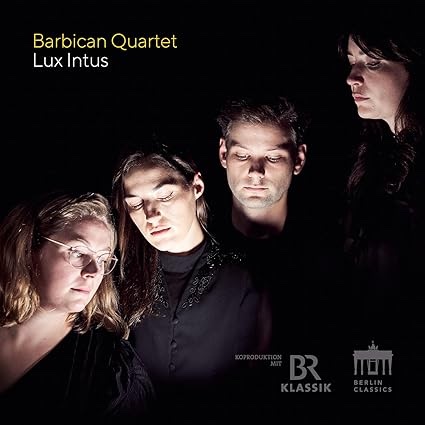
Barbican Quartet – Lux Intus – BR Klassik
“Internal Light”… illuminating the inner voices of the quartet