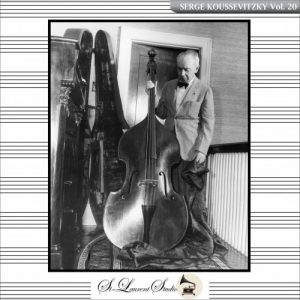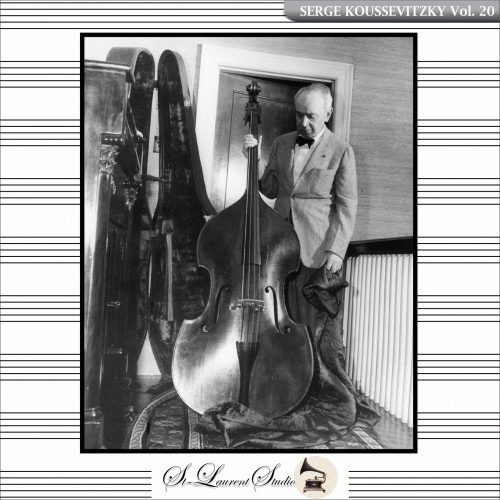
KOUSSEVITZKY Vol. 20 = BACH: Clavecin Concerto No. 1 in D Minor, BWV 1052; BEETHOVEN: Piano Concerto No. 5 in E-flat Major, Op. 73 “Emperor” – Alexander Borovsky, piano/ Boston Symphony Orchestra/ Serge Koussevitzky – Yves St-Laurent YSL T-1660 (50:40) [78experience.com] ****:
Two powerful, Russian musical personalities converge in this rare document: Of Serge Koussevitzky (1874-1951), we have ample testimony to a lifetime of monumental music-making. Alexander Borovsky (1889-1968) demonstrated musical prowess early, and his parents had him study with Mme Essipova at the St. Petersburg Conservatory of Music. Although deliberately held back from public concertizing, Borovsky taught master classes at the Conservatory from 1915-1920. He fled the newly established post-revolutionary government in Russia and came to play for Concerts Koussevitzky in Paris, 1921, then making his American debut in 1923. A favorite in Berlin as well as in Paris, Borovsky soon acquired a phenomenal touring schedule, amassing 400 concerts world-wide. The American response proved enthusiastic: American critic Lawrence Gillman of the New York Tribune wrote: “Mr. Borowsky’s rapid achievement of distinction is not surprising. He is a pianist of imposing technical equipment.” Another reviewer, Pitts Sanborn, wrote: “Borowsky has a tremendous technique; he plays with crystalline clearness, with a sure command of dynamic gradations, with unlimited nerve and dash. But it is always scrupulously clean playing, even when he splashes the tonal canvas with ochre and vermilion. His crescendo is one of the most thrilling things to be heard in’ our concert rooms these days, and his diminuendo is as faultlessly, controlled.”
Yves St-Laurent provides two performances that add to the mighty Koussevitzky discography. First, we have a truncated version of Bach’s D Minor Klavier Concerto (4 August 1945, Tanglewood), missing movement three. Admittedly, the sound quality proves distant and acoustically compromised, yet the fluency of approach remains undeniable. Propulsion and tonal articulation vibrate with color and consistent, stylistic closure at key periods. Borovsky’s runs and trills project power and poetry, and his top line sings with an easy suasion. Koussevitzky has the polyphonic lines from the orchestra dance as well as sing. The final crescendo of the opening Allegro vibrates with an authority that elicits immediate audience affection. Koussevitzky sets the second movement Adagio as grave, an austere, solemn procession. Borovsky’s delicate, arioso tracery exudes innate nobility and grace. It becomes apparent that both players conceive this pathos-laden movement as passion music, ornamental and anguished. A brief cadenza from Borovsky segues into the orchestra’s last, resigned utterance of the main theme.
Beethoven’s Emperor Concerto (15 December 1945, Symphony Hall) is, so far, our only example of any of the five piano concertos preserved on record from Koussevitzky. The lush coordination of strings, brass, and timpani mark the opening tutti as a grand enterprise for the Boston players, molded to the conductor’s fierce and heroic temperament. Borovsky, too, delivers the grand line, a sculpted pattern of runs, block chords, pungent attacks, and dragonfly diminuendos that attest to a superb color command. The persistent crackle in the sound source does not compromise the tonal arsenal on display, the seamless blend of keyboard and instrumental effects. The thunder in that uncanny, Allegro scale pattern from Beethoven still shocks: Bernard Shaw claimed, “I did with my ears what I do with my eyes when I stare.” Even without a formal, first movement cadenza, the Borovsky technique has been authoritatively, muscularly alive, a dazzling experience in keyboard color application. Then, there appears the music-box statement as the culmination of rising scales and traveling trill: delicate, transparent, a glittering pearly-play. The coda, if only for the collective schwung, is worth its weight in musical gold. No surprise: applause.
The Adagio un poco mosso offers Koussevitzky first dibs at the expressive dolce from his string and wind sections he had honed to perfection. Borovsky enters in kind, a poised, extended arioso ripe for color variation. The strength of the moving trill never wavers, then it concedes to the full, legato statement of the main theme. The progress of the movement proves so hypnotic and compelling, we hardly feel the transitional tension that arises at the momentous half-step descent into the rousing Rondo finale. And what a buoyant dance ensues! We do miss the instrumental color contributions of horn and bassoon, given the bleached sound. But Borovsky’s keyboard part asserts itself with luminously propulsive power, and we must wonder why RCA, the Koussevitzky/BSO label, did not offer these artists immediate repertory for the recording turntable.
For those fellow collectors, I end by paraphrasing from the disclaimer offered by Yves St-Laurent: “here is realized a rare, extant example. . .despite its limited sound quality. . .whose artistic and historic interest justifies the importance of its diffusion.”
—Gary Lemco