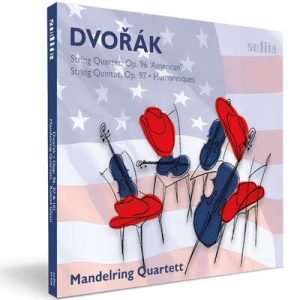
DVORAK: String Quartet No. 12 in F Major, Op. 96 “American”; 1String Quintet No. 3 in E-flat Major, Op. 97; 8 Humoresques, Op. 101 (arr. Matthias Eichhorn) – 1Roland Glassl, viola/ Audite 97.828 (79:56) (4/21/25) [Distr. by Naxos] *****:
Recordings from western Germany, 2023 and 2024 (Op. 101) of essential Dvorak repertory reveal the Mandelring Quartet – Sebastian Schmidt and Nanette Schmidt, violins; Andeas Willwohl, viola; and Bernhard Schmidt, cello – in pungently alert form as they explore the Czech master’s opera from his American sojourn of the early 1890s. Initially impelled to visit America as part of his assuming the directorship of the National Conservatory of Music in New York City, Dvorak also found consolation for his homesickness for Bohemia in Spillville, Iowa, home to an exclave of Czech nationals. The combination of Bohemian and native American energies has well earned Dvorak esteem for the spontaneity and invention of his American Quartet and Third String Quintet, while the Humoresques in quartet form provide new fodder for the Mandelring’s heralded “luxurious poetry of sound.”
The disc opens with the ubiquitous “American” Quartet, completed in an astonishing 16 days, a miraculous synthesis of melodic content and classical structure. The predominance of pentatonic scales infuses the work with a nervous, slightly exotic color, even as the rhythms convey Dvorak’s innate, Bohemian earthiness. Dvorak’s own instrument, the viola, here the part realized by Andreas Willwohl, often leads the penetrating melodic line, while the production qualities, supervised by Ludger Boeckenhoff, insure a voluminous resonance to each of the offerings.
The very first bars, Allegro ma non troppo, project the F major aura in a hazily pastoral mode akin to Wagner’s “Forest Murmurs” from Siegfried. The 6/8 D minor second movement, Lento, proves especially poignant in its sycopations, given the viola’s contribution and the glorious harmonizing of themes taken either from Afro-American or native-American sources. The brief Scherzo lays claim to bird calls as its inspiration, though Dvorak found the original songster irritating. The cross-rhythms typically identify the Dvorak style. The last movement, Vivace ma non troppo, exploits the rondo form with pentatonic modality, cross-fertilized by the composer’s great love for locomotives and their ceaseless, chugging energies. Last, but not least, enters Dvorak’s patented gift for chorale motifs, which in this case adds a palpable, spiritual dimension to a most gratifying camber work.
The Kickapoo Indian tribe of Spillville, Iowa has been cited as the source of much inspiration for the 1893 E-flat Major String Quintet, especially for the drum effects of the last movement, Allegro giusto. The initial Allegro non tanto has the guest, second viola anticipate the main theme, another pentatonic inspiration that generates its own mesmeric colors. The rhythmic pattern of drumbeats does not become overly repetitive, while “Indian” hues (all original with the composer) move the energies in symphonic or organ sonority. Roland Glassl does the honors once more, opening the “Indian” second movement Allegro vivo in a duple rhythm, most hypnotic.
The elastic continuity of the movement delights us in the suppleness of the coloration and shifts of register, the dialogues between first violin and cello. The trio section introduces a distinct melancholy over plucked accompaniment, the music haunted by a homesickness for Bohemia. Sebastian Schmidt’s first violin evokes a tearful sentiment that retains a nobility of expression. The da capo virtually explodes with native life and the pantheism that defines Dvorak’s character. The heart of the work, Larghetto, exploits Dvorak’s trump card in theme-and-variations. He had considered developing the tune (and five variants) as a source for a new American national anthem. Moving between major and minor modes, the music floats in the Mandelring ensemble ethos, especially in tremolando, with poignant gravitas. The last movement rondo, Allegro giusto, asserts the dotted rhythm that began movement one, proffering two episodes of alternately Bohemian and American character. Rustic and naturalistically buoyant, the music virtually sails in sympathetic harmony, with an especially poignant secondary motif. All of late Dvorak’s evince an “and so my children” moral ethos, as if imparting a truth so essential we require being reminded of its humanity.
The seventh of the Humoresques for keyboard, that in G-flat major, having long established its primacy – and movie-star status via John Garfield and Joan Crawford – has tended to diminish the sweet, 2/4 melancholy power of its companions. Their essentially Bohemian nature shines forth in pentatones, dotted rhythms, and syncopes. The distribution of colors among the quartet members gives the individual pieces both charm and sonorous, vividly-etched attractiveness.
—Gary Lemco