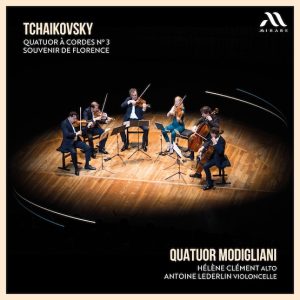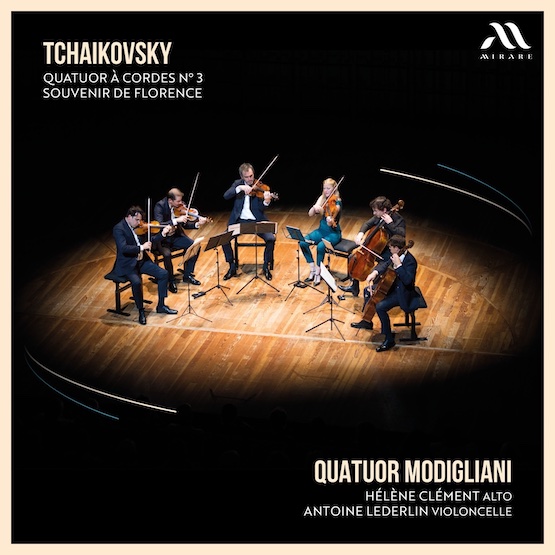
TCHAIKOVSKY: String Quartet No. 3 in E-flat Maor, Op. 30; String Sextet in D Minor, Op. 70 “Souvenir de Florence” – Quatour Modigliani/ Hélène Clement, viola/ Antoine Lederlin, cello – Mirare MIR580 (75:00) (9/19/25) [Distr. by PIAS] ****:
The year 1876 became for Peter Tchaikvovsky yet another time of personal crisis, exacerbated by the death of Bohemian violinist Ferdinand Laub, whose quartet ensemble had premiered Tchaikovsky’s first two string quartets. This Third String Quartet, dedicated to the memory of Laub, expresses the composer’s profound grief in the third movement, Andante funebre e doloroso, ma con moto whose valedictory procession. 4/4, invokes an adventurous, harmonic syntax that urges us away from conservative tradition.
The opening movement, Andante sostenuto – Allegro moderato, evolves along a grand, even symmetrical design, structurally indebted either to Beethoven or Schubert for its “heavenly length” that fuses melancholy with passionate, rhapsodic development. Conceived in Paris, the music meant to shed the composer of his sense of Moscow weariness, but his innate, Slavic personality insists upon cantabile motifs rife with his country’s ethos. If the opening Andante 6/8 sounds much like a dirge, the presentation of the melancholy theme, Cantabile e molto espressivo, by first violin Amaury Coeytaux, establishes the nobility that may emerge from solemn grief. The ensuing Allegro moderato – also in the key of E-flat minor and in triple meter – proffers two themes developed in what the composer felt is “German” counterpoint, eventually returning to the touching theme of the Andante for dramatic closure.
The Scherzo in B-flat major, 2/4, projects a skittish energy, a nervous “respite,” to say the least. Marked Allegro vivo e scherzando, the music has the instruments in tussling motion, back and forth, perhaps indicative of the ambiguity in the composer’s troubled heart. The ensuing Andante funebre could well invoke Beethoven’s Eroica second movement as a model, though the Slavic turn of melancholy belongs entirely to Tchaikovsky. As the emotional fulcrum of the quartet, the Modigliani ensemble invests a dynamic, potent urgency into the occasion, the violin and cello (Francois Kieffer) in duet, piangendo e molto espressivo, “weeping with much expression.” The last movement Finale offers a light tug of war, a rondo in E-flat major, Allegro non troppo e risoluto, 2/4, that proceeds unmolested by tragedy, except the sudden pause for a pizzicato episode that hints that Laub’s contribution remains conspicuous by his absence.
In 1890 Tchaikovsky was inducted into the St. Petersburg Chamber Music Society as an Honorary Member. Having vacationed in Florence, Italy to work on his opera The Queen of Spades, Tchaikovsky conceived his only string sextet, dedicated to the St. Petersburg music society. Tchaikovsky claimed in a letter that writing for six voices demanded the same skills as writing for an orchestra, “and then only arranging the work for six string instruments.” The finished work proves more Slavic than its title “Souvenir de Florence” suggests, though a sense of the Italian bel canto lyrical style permeates the abundance of melodies that informs the piece.
With the addition of two string players, Clément and Lederlin, the Modigliani Quartet launches, literally thrusts, forward for the opening Allegro con spirito, whose declamatory D minor theme embodies vigor and spontaneity. The move to the dominant A major for the arioso second theme invites first violin Coeytaux to ply his tender affections while the assisting instrument provides a lush halo of sound around him. The development either using the full theme or broken, melodic kernels in minor ninths, evolves in sonata form but without any sense of academic formulas. When the ensemble plays unisono, the effect becomes more like an organ sound than “orchestral.” The coda breathes pure fire, Russian lava for the soul.
The haunting D Major cantabile e con moto Adagio provides the principal violin and cello – over a plucked guitar accompaniment – some wonderful colloquy in the manner of Tchaikovsky ballet pas de deux. If Florence may be construed as a city for (Slavic) romance, this music asserts its ingratiating power. The middle section invests a sense of mystery into the lyrical elegy, until a bass pedal in the low cello allows the ardent duet theme its sway over pizzicatos. The last two movements clearly expand the sextet medium into an orchestral vehicle, with the A minor Allegro moderato’s relishing the throbbing, Slavic motion that supports the upper violin melody. The middle section improves upon Mendelssohn for light dexterity of motion, hustling and quivering in flying, fugal colors, allowing Tchaikovsky to superimpose his main theme upon the competing figures, once more asserting his Germanic, aesthetic taste.
The last movement, Allegro con brio e vivace, certainly looks to the Mendelssohn Octet, Op. 20 as a model, but Tchaikovsky imposes his own Russian folk-melodic character upon the contrapuntal proceedings. The Modigliani corps achieve a fierce momentum here, almost breathless but thoroughly savoring the concertante elements that let individual voices shine in startling alternation. The thrilling effect, much a product of the glorious Stradivari, Guadagnini, Mariani, and Goffriller instruments sported by the ensemble, has been rapturously captured for our musical delectation.
—Gary Lemco