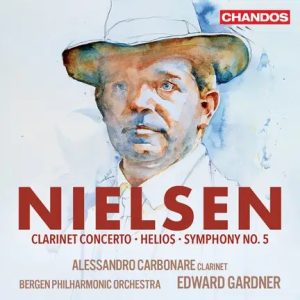
NIELSEN: Symphony No. 5, Op. 50; Clarinet Concerto, 57; Helios Overture, Op. 17 – Alessandro Carbonare, clarinet/ Bergen Symphony Orchestra/ Edward Gardner – CHANDOS CHSA 5314 (70:45) (6/20/25) [Distr. by Naxos] ****:
Conductor Edward Gardner, leading the Bergen Philharmonic, extends his Carl Nielsen (1865-1931) cycle of recordings with three, colorfully diverse works, all of them indicative of a highly idiosyncratic, musical personality, who commands a potent range of modalities and contrapuntal techniques in the service of a singular, expressive vision.
In 1903, Nielsen and his sculptor wife Anne Marie Brodersen sojourned to Athens, Greece, in particular the Acropolis, where Anne Marie had permission to make copies of the Classical statues. Nielsen’s Helios Overture, essentially an Introduction and Allegro, addresses the Greek sun god with the low Gs and soft Cs we find in Richard Strauss, overcast with Wagner pedal horn points. With the advent of D Major and E Major, the sun has risen in full, martial splendor, the trumpets asserting his glory. An episode in fugato eighth notes asserts itself, with the composer’s demonstrating his contrapuntal prowess in terms of a double fugue in celestial regalia. Unlike the Saint-Saens’ tone-poem Phaeton, the course of the sun’s chariot remains distant and untroubled, an eternal symbol of Nature’s penetrating, life-affirming energy.
By 1928, Nielsen’s declining health impeded his writing a concerto for each member of the Copenhagen Wind Quintet, so the Clarinet Concerto marks his penultimate creation with opus number, having been dedicated to Aage Oxenvad. As Brahms had been inspired by the Meningen player Richard Mühlfeld, Nielsen saw in Oxenvad’s virtuosity the spectacular range of color effects, from the instrument’s bristling high register to the sultry depths of its chalumeau register. Similar in contentious tone to the Fifth Symphony, the Clarinet Concerto sets a one-movement conflict between F Major and E Major, while – again, we invoke the same of Saint-Saens – his single movement subdivides into the traditional four-movement structure. The grumpy opening tune assumes the joining of the jaunty clarinet with easy aplomb, but the intrusion by the snare drum inserts the first of a series of altercations. A lyrical theme ensues, wistfully nostalgic, despite the snare’s sporadic, even muffled, insistence. Carbonare has an early cadenza based on the opening theme in fragment, creating a lonely, bluesy meditation. Bassoons in thirds enter, the snare, the main theme in the strings, and a cacophony erupts, tutti. A short, fluttery cadenza leads in a gasp to the Adagio, set as a horn solo in tandem with bassoons.
The slow section, calming as it appears, Poco adagio, soon transforms into a march-scherzo, just another, churning skirmish-line in a battle of musical wills marked by a hot-blooded snare drum. The emotional, syncopated distemper results in fugue between bassoon and soloist. The clarinet performs another virtuosic cadenza in staggered riffs, advancing slowly to the high-flown finale, Allegro vivace. As the last measures settle in, we can appreciate the reference to “ruthless poetry” which the solo part has gleaned in this highly original contribution to the concerto medium.
Composed between 1920 and 1922, Nielsen’s Fifth Symphony proceeds in just two movements – the only piece by Nielsen adopting this structure. Avoiding any programmatic subtitle, Nielsen described the symphony in Manichéan terms, as ‘the division of dark and light, the battle between evil and good’ and the opposition between ‘Dreams and Deeds.” Considered by many as a “war symphony,” Nielsen insisted that he had not been thinking of World War I whilst he was composing the work, but he also commented “not one of us is the same as we were before the war.”
Nielsen remained a bitter foe to the idea of nationalism, and his opening movement Tempo giusto -Tranquillo – Tranquillo – invokes an ambiguous, oscillating rhythm in the violas, pitted against bassoons in slow speed. Woodwinds compete against the strings, suggesting a “concerto for orchestra” concept, just waiting for more signs of distress, which the cello line soon provides. At 4:06 the march snare arrives, a militant, uncompromising tread worthy of Shostakovich, ironic and bitter. A temporary cessation ensues, having been sounded as bell by t he celesta, and the music indulges us a gratifying G major.
The Adagio affords us some serenity, but that comfort proves short-lived. The snare drum serves like Rachmaninoff’s patented Dies Irae, a harbinger of lingering malice, of Faustian negation. A full-flown militancy erupts, ineluctable and colossal, whose swirling motives induce vertigo, a psychic miasma that concludes with a plaintive clarinet cadenza and the cruel snare drum.
Movement two appears a succession of false starts, superficially optimistic, as will be the Shostakovich Fifth finale. Repetitive and fragmented, the music meanders into a kind of solemn dirge or nocturne in potent string lines, with wind and tympanic punctuations. A Presto section proffers a fugue as a source of logical balm, but this becomes a St. Vitus dance in careening figures, soon emptied in its exhaustion. A string Andante poco tranquillo attempts a consolation, a chromatic study in graduated, polyphonic lines. The music sounds a cross between late Sibelius and middle-period Shostakovich. A last surge of elemental optimism ensues, Allegro, but so condensed and abbreviated in its rhythmic thrusts and competing metrics that the whirlwind leaves us unresolved, our heads bloodied but unbowed?
—Gary Lemco