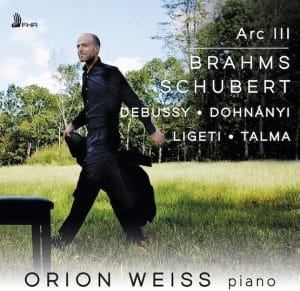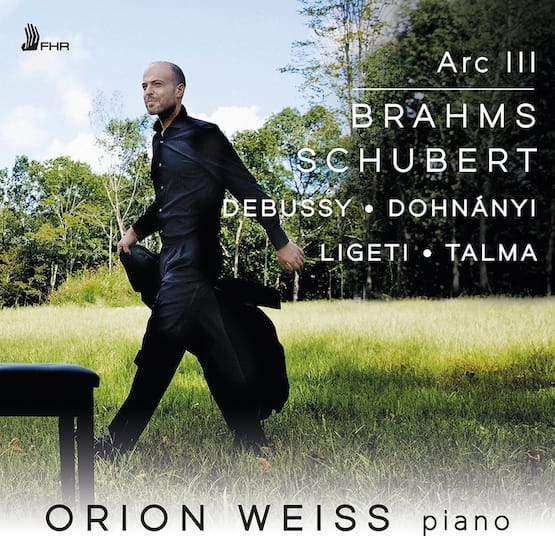
Arc III = TALMA: Alleluia in the Form of Toccata; DEBUSSY: L’isle Joyeuse; DOHNÁNYI: Pastorale on a Hungarian Christmas Song; BRAHMS: Piano Sonata No. 3 in F Minor, Op. 5; LIGETI: Études, Book I, No. 5: Arc-en-ciel – Orion Weiss, piano – First Hand Records FHR 129 (76:56) (2/21/25) [Distr. by Naxos]
Arc III completes a three-part project of pianistic, spiritual exploration, here devoted to retreats from crises, what Weiss calls “foreboding from the brink of disaster.” The tone remains optimistic, since the music conveys fulfillments of various energies to hope, ambition, peace, love, and visions of the divine, “the million shades of happiness.” Recorded 12-13 January 2022 at Drew University, the Weiss Yamaha CFX concert grand benefits from the engineering and editing efforts of Thomas Frost, Jenn Nulsen, and Orion Weiss.
Weiss opens with a composition by Louise Talma (1906-1996), her Alleluia in Form of Toccata, a celebration of the 1945 VE and VJ defeats of the WW II Axis forces that threatened civilized humanity. Set in high, staccato register, the piece bounces in fertile, jabbing motion, jazzy and whimsically polished in the French style absorbed from studies with Nadia Boulanger. The piece gains thickness and momentum, true to toccata demands, with flurries that resemble exhilarated Prokofiev. The sheer stamina for wrist action and fleet accentuation of the competing rhythms says much about the Weiss technique.
Weiss next attacks Franz Schubert’s 1822 bravura piece. The Wanderer Fantasy in C Major, his musical template for a single-movement structure that subdivides into the conventional sonata-sequence in four movements. The pattern affected later composers Liszt and Schoenberg. Schubert’s melancholy, C# minor lied Der Wanderer, D. 489 (1816) provides the basis of the slow second movement, which evolves into a series of plastic variations.
Two generations ago, pianist Gary Graffman made this virtuoso exercise his signature piece. Weiss takes a more intimate, introspective approach, building the song into a potent transition rife with threats in the bass, assuaged by the poignancy of the lied’s melody. The flow persists even through syncopations, tremolos, and fleet cascades of scalar patterns and thunderous octaves. The pounding rhythm asserts itself once more, Presto, for the third movement, a fine contrast in chiaroscuro dynamics in the manner of a swaggering scherzo. The tension increases to resolve into a mighty fugue of a force competitive with Beethoven. Weiss has this sustained moment of polyphony resounding with resolute authority, what he characterizes in his notes as “a musical party. . .imbued with relentless rhythmic energy.”
Another “feast of rhythm” arises in Claude Debussy’s L’isle Joyeuse of 1904, the composer’s tribute to the 1717 painting by Watteau, L’embarquement pour Cythère, the mythical island of Aphrodite. In the Weiss commentary, his view rings more of pantheistic ecstasies in Henri Rousseau: “the snakes slithering through the dense jungle undergrowth and exotic brightly-plumaged birds trilling in the canopy.” Set in A minor, the piece opens with a chromatic cadenza, the succeeding roulades and rhythmic currents alive with fluid motion. The competing lines and tones from diverse registers, the sudden intrusions of color, all converge into a sensuous kaleidoscope beyond even the composer’s means to realize at the keyboard. The bell tones and evocation of clarion, climactic trumpet calls invoke a passion in Nature, embracing man and the immensity of the sea.
Having survived the bitter horrors of WW I, Dohnanyi’s 1920 setting Pastorale on a Hungarian Christmas Song arranges the carol “The Angel of Heaven” into an idyll of shepherds or pilgrims before running streams or celebratory campfires, with cascades of quick notes to intimate falling snow and faces aglow with the crisp air. The keyboard writing clearly owes debts to Liszt, especially in the crisp bell tones that remind us of Abbé Liszt’s excursions into pious liturgy. A shimmering vibrancy overtakes the canvas, literally showered in arpeggios and delicate, rippling scales.
The Romantic epic addressed by Weiss, his paean to the power of love, arrives in the form of Brahms’s Sonata No. 3 in F Minor, Op. 5 (1853), conceived as a dual homage to Beethoven and Robert Schumann, the latter who became Brahms’s chief sponsor. In five movements, the work projects a robust aggression and poetic temperament at once. The opening, often percussive, Allegro maestoso resonates with impulses, dotted rhythms, directly quoting Beethoven’s 5th Symphony “fate motif,” though Weiss charms us with the modulations to A-flat and D-flat major. Despite the convulsive sturm und drang of the moment, Brahms already anticipates the harmonic gambit of Gustav Mahler, who no less opts for “progressive tonality,” and so finishes in the major mode.
The poetry of C.O. Sternau inspires the duality of the second movement, Andante. Andante espressivo – Andante molto that gravitates between A-flat major and D-flat major, begging for comparison with Schumann’s inner, kindred spirits, Florestan and Eusebius. The poem claims “two [moonlit] hearts join in love, and embrace in rapture.” Slowly evolving sequences mount to an erotic, symphonic climax worthy more of Wagner than Schumann, an expressiveness the older Brahms eschewed in favor of subtle harmonic and agogic modulations, the music in small forms, intermezzos and caprices that ever veil his intensity.
As an immediate foil to his excess of sentiment, Brahms offers an ironic Scherzo in F minor, which Weiss executes with minimal pedal. The outer sections and the middle, D-flat major Trio ring with the “fate motif,” here in rustic, pompous affectation. The notion of a heavy fate immerses the fourth movement, Intermezzo in B-flat major in gloomy, retrospective variation of the love music of movement two, “Rückblick,” Schumann’s patented expression of nostalgia.
For the final movement rondo, Allegro moderato ma rubato, Brahm indulges the Schumann cryptogram F-A-E, frei aber einsam, “free but lonely,” to clash with the martial impulses that emerge, albeit softened by arpeggiated figures. Brahms stratifies his diverse themes– which Weiss must maintain in clear lines – until a kind of folk song emerges that Brahms accelerates to a clarion coda, in which F, major and minor, compete for a last, assertive dominance.
Weiss chooses another clarion message for an epilogue, since Ligeti’s 1985 Étude seems a declaration of radiant randomness, almost aleatory in its progression of dynamically shifting tones, burning in degrees of luminous intimacy. Do we feel a kinship with Samuel Becket or the poets of the Existential persuasion, when we read Ligeti’s inscription over the final measure, “quasi niente,” fading into nothing, that “nothingness is the only reality?” Or is it a luminous, tragic moment prefacing some glorious enlightenment?
—Gary Lemco
More information through Amazon