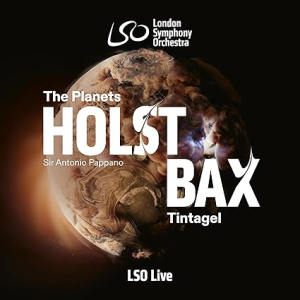
HOLST: The Planets, Op. 32; BAX: Tintagel – London Symphony Orchestra/ Sir Antonio Pappano – LSO LS00904 (69:30) (3/20/26) [Distr. by PIAS] *****:
Sir Antonio Pappano leads yet another performance of Gustav Holst’s 1914-1917 astrological odyssey The Planets from Barbican Hall (12 September 2024), with its superb acoustics. The characterization of the last movement, “Neptune,” the Mystic,” as a siren-song symbol of veiled unity expresses Holst’s individual credo. “Mars,” which opens the suite, had been conceived prior to WW I, and so illuminates “the stupidity of war,” rather than glorifies it. For over sixty years, conductor Sir Adrian Boult achieved a total identification with the score, even in the face of fine interpretations by Sir Malcom Sargent and André Previn. The LSO percussion section projects a luminous, hammered vitality throughout, and we must surrender to the throes of the snare drum in this score, whose only rival in execution might lie in Ravel’s Bolero. The credit for the high production quality falls to Stephen Johns.
The pungency of effect in “Mars,” its five-to-the-bar rhythmic thrust, sets the tone for the entire seven-movement work, with the clash of D-flat and C ensuring a supreme dissonance. When the silences fall, they seem staggering in their intimation of those dire words of Tacitus: “they make a desert and call it peace.” Clarity of line and intonation marks “Venus,” in which, alternately, horn solo, flutes, and solo violin color the texture with the signs of Peace. A delicate, dreamy tracery emerges, with hues from flutes, harps, and cello augmented by the celesta, whose sparkle had come to classical music via Tchaikovsky’s The Nutcracker. Fragmented scalar patterns over pedal points bring the paean to a translucent conclusion.
The scherzo in the suite occurs as “Mercury, the Winged Messenger,” who quicksilver, warbling figurations capture what Holst quipped is “the process of human thought.” The celeste, solo violin, and muted violins conspire to weave a slightly oriental tapestry, potentially explosive, reminding us that Hermes embodies tricksters as well as cosmic messages, a point well made in Joseph Conrad’s The Secret Sharer. Again, a vibrant transparency defines this movement, lithely rendered. And so enter “Jupiter, the Bringer of Jollity,” with his retinue of horns afire, a combination of sturdy dance and then sacred hymn. The folk elements of both impulses shine forth, Pappano having given a glorious patina to the whole, a seamless, towering realization. This is broad, Elizabethan mirth, a song conceived in the mind and heart of Sir John Falstaff.
“Saturn, the Bringer of Old Age,” Holst’s personal favorite among movements in the suite, opens at first suggestive – in twenty-six measures – of the origin of life in syncopated, reluctant chords that could have been conceived by Bartok. That Saturn possesses a Janus-like character comes from Holst’s comment that “Saturn not only brings physical decay but also a vision of fulfillment.” Both martial in middle age and funereal in dotage, the music achieves an epic grandeur and nobility of expression, a maturity of resigned contemplation. The LSO percussion has assumed an awesome presence, assisted by flaring brass, tolling bells, and anguished strings. But the menace evaporates, leaving us with another, veiled sense of illumination, a consummation devoutly to be wished.
“Uranus, the Magician” establishes his authority with a four-note motif, a spell whose lower register grumbles resemble our friend apprentice in Dukas. The twittering energy bursts forth in a resolute swagger of confidence, a mystical brew of mixed major and minor tonalities. A march thunders forward, interrupted by twitters and tumult in the timpani. The music becomes obsessive, a reeling and spasmodic nightmare that breaks off into turbulent echo of itself, with huge, dissonant chords to announce its liquidly eerie evaporation into the aether.
“Neptune, the Mystic” must suffice as Holst’s answer to Zarathustra via Richard Strauss.
Played sempre pp from the outset, the music means to sound distant and glacial, lacking any discernible melody or consistent rhythmic pulse. The sonic texture feels derived from aspects of Debussy, still vibrant with the influence of Neptune. Woodwinds mix with harp filigree and strings in high register. A haunted sense of expectation ligers throughout, and we may see the forerunner of both “space music” and minimalism in the repeated riffs. A wordless female chorus beckons us, insistent, alluring, “subtle and mysterious,” to cite Holst. Cymbals softly pierce the air, played with sticks. While the timpani sound has been wrought by a wooden stick. The female choir becomes mute, and the rest is silence.
Pappano and the LSO recorded Arnold Bax’s 1917 tone-poem Tintagel 15 December 2024 at the Barbican Hall. A strikingly coloristic work, the music depicts a vision of the Atlantic Ocean as seen from the cliffs of Cornwall, where the castle Tintagel dominates the vista. Inspired by Celtic sensibilities, the music of Wagner and Scriabin, Bax constructs a vivid seascape in three sections. The textures churn with Romantic impulses, the colors merging with the same finesse either in Debussy or J.W.N. Turner.
The brass theme, a leitmotif for the ruined castle, evolves in diatonic harmony until it meets the limitless space of the Atlantic, whose power we know from Shelley’s “Ode to the West Wind.” A rising tide eventually subdues all other forces, and so the waves smash themselves “upon the impregnable rocks,” to quote Bax, ushering in a tumult worthy of admired Rimsky-Korsakov, even as strains from Tristan filter into the mix. Pappano induces a thrilling sound from his ardent, responsive ensemble, the brass especially exuberant. Even as the ecstatic chords diminish, we sense that Tintagel, in all its Celtic splendor, resides intact, much as Smetana had set the standard for his own “High Castle.” Credit producer Andrew Cornall for the intensities here preserved.
—Gary Lemco