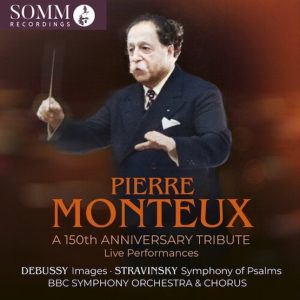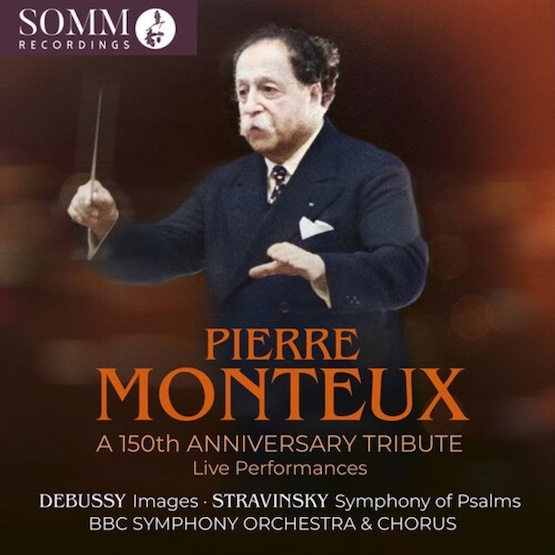
PIERRE MONTEUX: A 150th ANNIVERSARY TRIBUTE = DEBUSSY: Images pour orchestra; STRAVINSKY: Symphony of Psalms; Alex Nifosi remembers Pierre Monteux – BBC Symphony Orchestra and Chorus/ Pierre Monteux – SOMM Ariadne 5042 (63:29) [Distr. by Naxos] ****:
SOMM offers an impressive 150th birthday salute to veteran French conductor Pierre Monteux (1875-1964), by restoring his appearance before the BBC Symphony Orchestra and Chorus, 18 October 1961, in music by Claude Debussy and Igor Stravinsky, both composers having been admirers of Monteux’s skills. In the case of Debussy’s 1913 Images pour orchestra, Monteux had prepared the Colonne Orchestra for the work’s world premiere. While Stravinsky’s 1930 Symphony of Psalms received its world premiere in Brussels from Ernest Ansermet and its Boston premiere from Serge Koussevitzky, Monteux had already won acclaim for his performances of Le Sacre du Printemps and had maintained a constant, symbiotic relationship with the Russian composer.
English and Scottish folk tunes provide the fertile kernels of melody for the opening, melancholy Gigues, the songs “Dansons la gigue” and “The Keel Row” played either intact or pulverized for their rhythmic motifs. A wonderful transparency suffuses Monteux’s performance from Royal Festival Hall, the oboe d’amore’s having found itself surrounded by the BBC wind section and lusciously muted strings. The much-touted middle section, Iberia, proffers its own triptych, in which the woodwind choir dominates, opening the movement “Along the streets and paths” with an immediate combination of Andalusian and Moorish colors of throbbing vigor. The clarinets, the strings in fifths, the tambourine, castanets, and triplet wind figures coalesce into an intensely seductive series of undulations and proclamations of native sevillana. The viola and oboe, horns and trumpets, alternately conspire to mesmerize our ears and inner visualizations with erotic, languorous possibilities.
Impressionistic, hazy enchantment reigns in movement two, Les parfums dela la nuit, in which color battery instruments xylophone, celesta, and tambourine accompany high, muted strings and the winds, led by a cautious oboe. The oboe’s tune extends the melodic fragment it intoned in movement one; but now, Debussy adds string syncopations and harp textures. Muted trumpets contribute a misty chorale, and the strings break out with a voluptuous gesture. Once again, the modal harmonies of Moorish origin beckon us to a superior, exotic space. The winding paths, ardent with scented life, suggest a labyrinth of pleasures akin to Coleridge’s vision in “Kubla Khan.”
Tolling bells announce a day of festivities, here colored by shimmering strings that more than suggest the sirens’ songs of guitars. Violin and castanets intone a somber but compelling motif that the woodwinds insist must be obeyed. Trumpet, celesta, and raucous horns instigate a manic dance that gains intensity and sonorous propulsion, ending with the explosion of the bells.
A pair of folk tunes infiltrates the last section, Rondes de printemps, whose ecstatic spirit obviously nods to Stravinsky’s pagan impulses. The two songs, “Nous n’irons plus au bois” and “Do, do l’enfant do,” suavely sachet in arresting metrics, the first in 15/8. Debussy juxtaposes the folk tunes to create a woven, color fabric whose texture adumbrates his experimental Jeux ballet. A martial element enters the mix, its pulse vibrant but metrically insecure, interrupting itself on what seems a climactic journey that concludes with the clash of cymbals, immediately followed by audience applause.
To celebrate the 50th anniversary, 1930, of the Boston Symphony Orchestra, conductor Serge Koussevitzky commissioned Igor Stravinsky’s Symphony of Psalms, a treatment of the Vulgate Latin Bible, especially Psalm 150. Structurally in three, unbroken movements, the work forms a pyramid, each consecutive movement longer than the last. Set in a neo-Classical style, Stravinsky’s luminous testament to aesthetic, if not religious, piety, points to Bach’s St. Matthew Passion as a possible model: it utilizes two pianos – Gerard Gover and Arthur Sandford – where Bach uses two organs; and, though omitting clarinets, violins and violas, Stravinsky asks for oboes, trumpets, trombones, tuba, flutes, cor anglais, cellos, and basses. He frames the whole in tonalities, E minor and C minor, those same colors selected for the massive Bach oratorio.
Monteux’s innate musical chastity contributes to the intentionally spare, archaic effect at least for Psalm 38 and Psalm 39 – of the Symphony, and his demand for transparent lines intensifies the effect of Stravinsky’s fugal counterpoints of movement two, as realized by a large choral ensemble. Harmonically, Stravinsky pointed out that an octatonic scale, containing two minor thirds joined to a major third, supplied the essence of the evolving structure. The piece combines passionate, even harsh, ardor, devout spontaneity, in the service of liturgical piety. The second movement, drawn from Psalm 39, opens with bird calls, a wind serenade, or the pipings of gratitude for a call to the Lord which has been answered. The controlled, dynamic layering of the sonorities has been effectively captured by Audio Restoration Engineer Lani Spahr. The extended Psalm 150, Alleluia, Laudate Dominum, proceeds with dark solemnity, a nervously ecstatic celebration of God’s awesome power that the elect may witness and fear.
Alex Nifosi, cellist and musician, appears at the Intermission Feature. He calls Monteux “the complete musician.” A self-taught viola player, Monteux became the principal of the Colonne Orchestra, though he found the conductor himself “disagreeable.” Monteux himself rarely disparaged other conductors and musicians. Like Toscanini, Monteux thoroughly relished the Enigma Variations of Elgar. Monteux esteemed the music of Brahms, and his performances were “first class.” Light and transparent, his readings were special from a French musician, less heavy in the music of Beethoven and Brahms than the German conductors, always elegant. He remained affectionate to his orchestras, having learned his craft from that milieu. “No use playing jokes on me, mes enfants; I played them all long before you were born.” His advice to his conducting students consisted of dos and don’ts, such as: “Never bend for a pianissimo, since the effect is too obvious; and do not conduct for the audience. Don’t interrupt a rehearsal for an accidental wrong note; don’t stop the rehearsal if you’ve nothing to say.” Nifosi brings up the notorious first performance of Stravinsky’s Rite of Spring, remaining calm while rival factions demonstrated in the theater. Monteux worked in Amsterdam for ten years, along with the gifted but “difficult” Willam Mengelberg, whom Nifosi calls “a mass of contradictions.” In 1961, the LSO offered him a lifetime contract. In 1964, he suffered a fall from the rostrum, but continued the concerto with Debussy’s La Mer. He died at his home, having been “a good father to orchestras all over the world.”
—Gary Lemco