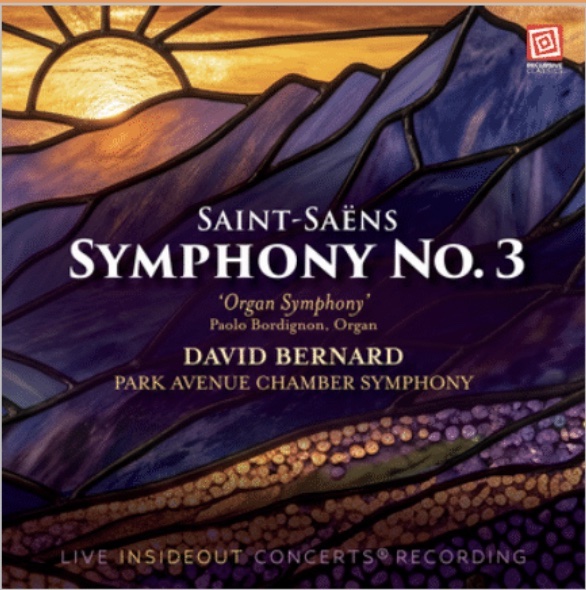
SAINT-SAËNS: Symphony No. 3 in C Minor, Op. 78 “Organ” – Paolo Bordignon, organ/ Maxim Lando and Keyi Wang, piano/ Park Avenue Chamber Symphony/ David Bernard – Recursive Classics RC 5230977 (7/10/26) (37:20) [Distr. Orchard/SONY] ****:
What this present album lacks in quantity may compensate in quality, when we consider the aesthetics of the occasion. Saint-Saens’ Third Symphony (1886) offers a challenge in balances, given that the organ serves an obbligato function, along with duo-pianist keyboard, essentially brilliant, color elements. The symphony proceeds in two major sections after having established a theme that will operate organically along cyclic principles, reappearing in rhythmic and timbre variation. The examples Saint-Saens follows derive from both Liszt and Schumann, in symphonic poems and symphonies, respectively. Conductor David Bernard addressed the problem of a statically positioned pipe organ and the orchestra – and audience – in the same room was to utilize a digital organ with speakers strategically placed to surround the ensemble and the hall, “immersing” players and audience in the full spectrum of Saint-Saens’ epic orchestral effects. The performance, then, has become an organic document, “a guerilla concert” conceived rather from the “inside out” to include the spectators, thus realizing Bernard’s conviction that “the relationship between a great symphony and its audience is not fixed but discoverable.”
The soft Adagio opening to the C Minor Symphony – shades of Schubert’s “Unfinished” Symphony – suddenly explodes Allegro moderato 6/8 in a relentless flow of eighth notes colored by strings, brass and battery. The periods of the movement alternate dramatically, with hints of chorale figures in the midst of blazing polyphony. The sense of mortality makes an appearance via the Dies Irae motif from the Requiem Mass. Huge stretti layer the various impulses upon each other, adding a sense of monumentality to alternately dramatic and lyric figurations. The elongated coda bears a resemblance to ballet music, leading prior to the formal Poco adagio a sense of entr’acte.
The organ pedal point provides the seque, attacca, to the hymnal Poco adagio, whose theme receives from conductor Bernard a broad sigh. A theme and variations, the music proceeds in soft cadential periods, still retaining allusions to the Dies Irae motif. Soft strings in counterpoint, with organ accompaniment, take up the melodic tissue, carefully etched by Bernard. The pizzicato motif itself becomes lyrically transparent, even transfigured, as various instruments alter the sonic atmosphere.
The Allegro moderato – Presto movement, essentially a scherzo, reminds us of the score’s dedication to the memory of Franz Liszt (1811-1886), given the wizardry applied to the one keyboard by a pair of accomplished virtuosos. This scherzo opens what becomes Part II of the symphony, now in compound rhythmic tumult with tympanic explosions, employing passing dissonances urged by a panoply of orchestral colors. The woodwinds and strings still insist the Dies Irae make its presence felt. The strings hustle us to a restatement of the main idea with the tympany’s palpable aid, the woodwinds now in full fettle. Suddenly, the low strings and brass demonstrate their polyphonic capacities, moving to the strings, the tessitura ascending over the Dies Irae, as we enter, attacca, the precinct of the last movement, Maestoso – Allegro.
Organist Bordignon does the honors with a huge chord, and the piano adds a distinctive sense of chimed harmony. The organ will itself indulge in a massive fugue, a specially of Saint-Saens the organ virtuoso. The potent fugato that ensues achieves a monumental texture, as brisk as it is learned. Tremolo strings, triangle, cymbals, and scalar strings contribute while the Dies Irae refuses to quit. The chorale aspect of the music reigns supreme, another Saint-Saens artful gambit used in his Violin Concerto No. 3 and Piano Concerto No. 4. The heaving momentum indeed casts a Lisztian fervor about it, perhaps in memory of the famous Liszt Totentanz, but now headed to a stunning C major peroration, all the rising orchestral forces unleashed in a glorious annunciation of French symphonic mastery.
The whoops that ensue seem a natural consequence of this “performance from within,” if you will, passing a firm, affirmative judgment on conductor Bernard’s experiment in blending the titular instrument’s presence into the living mass of musicians and spectators. For my money, I would still prefer a complementary work of some girth, say, Saint-Saens’ The Youth of Hercules.
—Gary Lemco
This CD is available through Record Store Day