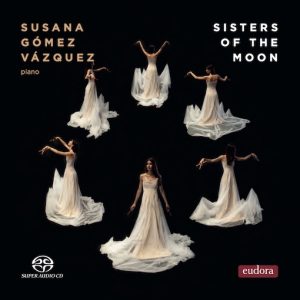
SISTERS of the MOON = MONTEGEROULT: Two Études from Cours complet pour l’enseignement du forte-piano; F. MENDELSSOHN: Das Jahr: VI June; IX September; BEACH: A Hermit Thrush at Eve; A Hermit Thrush at Morn, Opp. 91; BOULANGER: Petites pieces pour piano: Nos 1, II, III; LARROCHA: Festivola; PÉREZ: Le Sette Sorelle dal Cielo for piano and electrcoustic; VÁZQUEZ: Interludio; MONTERO: Rondo; PRICE: Fantasie Negre No. 1 in E Minor – Susana Gómez Vázquez, piano – EUDORA EUD SACD-2407 (51:54) [eudorarecords.com] ****:
Recorded 2023 in Zaragoza, Spain, this collection of composition by female composers owes its inspiration, admits pianist Susana Gómez Vázquez (b. 1995), to the Pleiades, the Seven Sisters of Greek myth, who served Artemis while remaining devoted to love and eroticism. Vázquez selects a series of virtuoso and nocturnal pieces that reflect their amorous or dance impulses, the music’s spanning a diverse palette of styles and cultures that range from the 18th through 20th centuries.
Vázquez opens her selective repertoire with two études in the modes of G by Hélène de Montgeroult (1764-1836), first female professor at the Paris Conservatoire. The G Major (no. 37) rushes in 32nd notes in less than a minute; the G Minor (No. 111) has more of a Mendelssohnian girth, buttressed by percussive accents. Fanny Mendelsohn (1805-1847) enjoys two entries from her 1841 suite Das Jahr: 12 Characterstuecke: No. 6 June and No. 9 September. June presents a flowing nocturne that elicits traces of Schumann as well as those from brother Felix, especially in the later use of fluid arpeggios. September offers what pianist Vázquez calls “riverside melancholy,” a haunted, liquid piece likely influenced by Schubert.
The call of the woodlands beckons to companion pieces by American composer Amy Beach (1867-1944) composed in 1921: A Hermit Thrush at Eve, Op. 92/1 and A Hermit Thrush at Morn, Op. 92/2, inspired by a poem by John Vance Cheney. The trilled effects seem to point to Schumann’s own “Prophet Bird” from his Op. 82 Waldszenen. The expressive melancholy belongs to Beach. The initial chords of the Morning Thrush might combine Schumann with Satie, given Beach’s idiosyncratic parlando. The piece speeds up in étude fashion, gathering an assertive personality, momentarily, returning later, rondo-fashion.
Music by Nadia Boulanger (1887-1979) reminds us of a monumental influence she bore on composers in both Europe and America, not the least of whom were Aaron Copland and Ned Rorem. Her suite of D minor pieces, three Petites Pièces pour piano (1914), emerge in crystalline staccato marked by a boulevard nonchalance we will find in Poulenc. Vázquez imparts an Italian vigor to the set. The last of the set might well claim Debussy as a forebear.
Ensue four recording debuts by Vázquez: Festivola presents us a rarity from famed Spanish virtuoso Alicia de Larrocha (1923-2009), an early work the composer does not seem to have meant for publication. That the score exists at all derives from a transcription of an informal recording made late in her life. The rhythms, part malaguena and part habanera, elicit some passion we might attribute to Falla. The album’s dedicatees, the Pleiades, receive homage from Spanish composer Iluminada Pérez Frutos (b. 1972) in her hybrid piece Le Sette Sorelle dal Cielo, “The Seven sisters of the Sky” for piano and electronics. Definitely “space music” in a better sense than some of the trivia that genre produced, the nine-minute piece adds a haunted, distinctive, non-threatening atmosphere to the occasion.
Our artist herself contributes what she terms an “Interlude” based on a hymn by the early female composer of Byzantine Greece, Kassia, which Vázquez created in 2023. The chime-laden Oda a Kassia means to bridge the sonic world of outer space with the Rondo of the Argentinian Claudia Montero (1902-2021), a dancing piece in duality, switching from polyrhythms to a distinctively passionate, tango expressiveness. As the piece moves to the coda, the affect becomes melancholy with the tango but now ascending in bravura chords and glissando.
The recital concludes with the woman of the moment, Afro-American Florence Price (1887-1953), her Fantasie Nègre No. 1 in E Minor composed in 1929. Based on the Negro spiritual “Sinner, please, don’t let this harvest pass,” the improvisatory style embraces direct chordal variation and jazz/stride elements that link her work both to Scott Joplin’s Afro-Creole impulses and to contemporary, 20th Century harmony. Pianist Vázquez conceives this piece a fitting, rather explosive coda to a cavalcade of stars. The recorded Steinway sound echoes long after the final notes, courtesy of Gonzalo Noqué.
—Gary Lemco