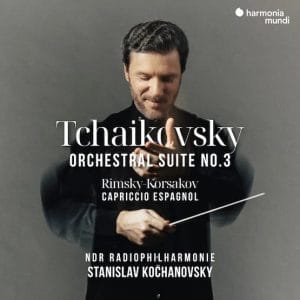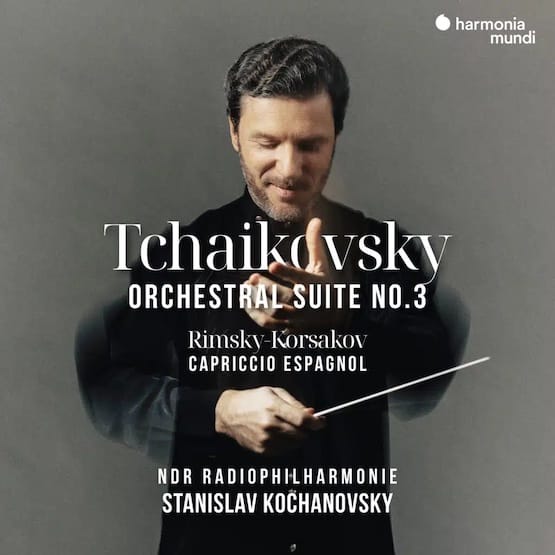
TCHAIKOVSKY: Suite No. 3 in G Major, Op. 55; RIMSKY-KORSAKOV: Capriccio espagnol, Op. 34; TCHEREPNIN: Prelude to “La Princesse lointaine,” Op. 4 – NDR Philharmonie/ Stanislav Kochanovsky – Harmonia Mundi HMM 905 102 (65:18) (2/14/25) [Distr. by PIAS] ****:
Conductor Stanislav Kochanovsky assumes the director’s post at the NDR Philharmonic, Hanover, for the 2024-25 season, where notables Hans Schmidt-Isserstedt and Hans Rosbaud once reigned. In this album recorded in September 2024, Kochanovsky leads a program of Russian music dear to his heart and training in St. Petersburg. The most familiar work, Rimsky-Korsakov’s 1887 brilliant display piece, Capriccio espagnol, a virtual catalogue of orchestral color and timbre. My own preference remains George Szell and his honed Cleveland ensemble on the Epic label (BC 1002). The four-movement Tchaikovsky Suite No. 3 caught my imagination by way of Thomas Scherman and his own Little Orchestra Society LP on Columbia (ML 5256), which in my opinion warrants CD incarnation.
The Rimsky-Korsakov score remains the most innately exciting selection; yet, for all of the propulsion assigned to the faster, national dances, the Alborada and the Fandango, Kochanovsky opts to take the Variations: Andante con moto at a glacial pace, likely to show off concertmaster Sarah Christian’s warm violin tone. The lively, quick dances enjoy proper spirit and studied phrasing, but George Szell and the Cleveland Orchestra cannot be surpassed for blazing discipline and unbridled élan.
The Tcherepnin tone-poem begins in an aural world close to Liadov’s Enchanted Lake, enamored with Provencal Nature’s mysteries and shimmering beauties. The cello passage rings of Korsakov’s Russian Easter Overture. When Tcherepnin hits his melodic stride, however, the effect proves richly engrossing and exceedingly vibrant in timbres. The music expands as the poet-troubadour sings of his amorous intoxication with the faraway princess Mélisande, for whom no peril daunts him. Thr middle section incurs a sense of turmoil, marked by syncopes and cautious polyphony, only so the initial, enraptured vision may return in full splendor. The NDR string and brass choirs enjoy a resonance and radiant glow, courtesy of the production team: Daniel Kemper, Lars Wartenberg, and Jorrit Zeising.
Tchaikovsky’s Third Orchestral Suite has led two lives: as a complete score in four movements, only sporadically performed; and, as a more popular excerpt by virtue of its last movement, Theme and (12) Variations. Among these spectacular set pieces lie a fine evocation of the Scottish countryside and an appearance of the Dies Irae, from which Serge Rachmaninoff never recovered. Much of the opening three movements may “reduce” to aspects of the ballet, offering the affective life of nostalgia, lyricism, fairy-tale mysticism, and grievous melancholy. That The Sleeping Beauty and Fifth Symphony hover on Tchaikovsky’s creative horizon seems obvious. The first movement, Elegie: Andantino molto cantabile basks in Tchaikovsky’s patented gifts for endearing melody and instrumental color. We sense the relatively rare ethos of G major for the composer in the ongoing development of themes in this score, its generally optimistic sensibility. The last movement proves proportionally imposing, essentially beyond the combined length of the prior movements. The initial, martial tune comprise a panoply of character pieces worthy of Schumann, with color elements individually attractive, as in the use of English horn (Variation 8) for a sense of rural serenity. Concertmaster Sarah Christian once more asserts her fond presence in the tenth variant in gypsy hues by way of Swan Lake. The final tableau, if you will, derives from the Slavic polonaise, Tempo di Polacca, an aroused celebration of the dance Tchaikovsky used for his “ballet” in his opera Evgeny Onegin. The affection Kochanovsky feels for his chosen repertory shines through every recorded measure of his chosen selections, but I wonder if his veneration does not bog down occasionally into unintentional, stodgy sentimentality.
Élegie: Andante molto cantabile exerts the Tchaikovsky trademarks of lush melody and canny instrumentation. Kochanovsky’s penchant for slow tempos works well to procure a sonorous grandeur to the whole. The second movement, Valse mélancolique, reprises Tchaikovsky’s patented gift for dance forms touched by impending tragedy, certainly blatant in the funereal Allegro moderato section. The ensuing Scherzo dispels the gloom, skittishly highlighting instrumental colors in a fashion reminiscent of the admired composer Hector Berlioz. The dervish momentum soon anticipates (martial) dances from The Nutcracker.
—Gary Lemco
More information through Amazon