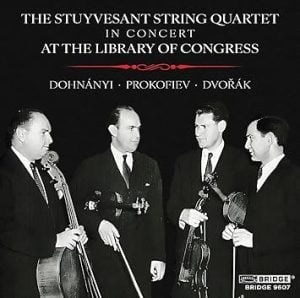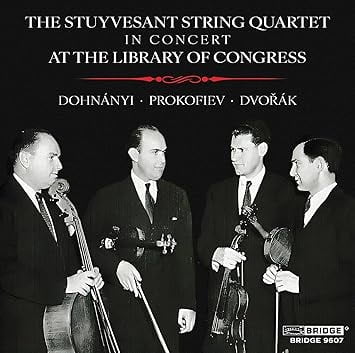
Stuyvesant String Quartet in Concert: Library of Congress = DOHNÁNYI: String Quartet No. 2; PROKOFIEV: String Quartet No. 1; DVORÁK: String Quartet No. 12, “American” – Stuyvesant String Quartet – Bridge Records 9607 (77:38) (6/28/24) ****:
Bridge Records restores a chamber music rarity: the sole – and previously unissued – appearance of the famed Stuyvesant String Quartet (1946-1954) at the Coolidge Auditorium of the Library of Congress for their program of 30 December 1946. Comprised of string instrumentalists from Arturo Toscanini’s NBC Symphony Orchestra, the ensemble underwent personnel changes until it settled upon its final identity: Sylvan Shulman and Bernard Robbins, violins; Ralph Hersh, viola; and Alan Shulman, cello. Despite having created their own record label, Philharmonia Records, that garnered enthusiastic reviews, the players relented to the practical consideration that performing for orchestral ensembles would be more lucrative and so disbanded after seven years.
The program opens with Dohnanyi’s 1906 Second Quartet, a work thoroughly influenced by the Brahms tradition. The 15-measure introduction establishes a motto theme, Andante, before the series of alternations between this tempo and Allegro. The sonata form rather collapses into a fantasia format, wherein Dohnanyi sets the tempos in conflict with each other. The dramatic elements, mostly in the violin and viola, become highly expressive, surging with moments of anguished passion. Quite unusual is the marking for movement two: Presto acciacato, whose driving rhythm centers around the cello part. The harmonic syntax, eerie and menacing, suggests some dire event lies at hand. Hints of whole tone scales come forward and retreat, until the middle section, in F major and duple meter, sets the tone of a solacing chorale. The phrase lengths, however, suspended over pizzicatos, do not provide sufficient relief against the onslaught from the opening motif. The Stuyvesant ensemble rather relishes the biting, slashing harmonies they project with a mean ferocity.
The last movement – as long as the first two movements combined – starts (C# minor) Molto Adagio in a somber tone, similar to the trio of the scherzo. The Animato section arrives abruptly, an angry display of passion (in F minor) that upsets whatever quiet the opening measures established. The latter part of the Animato segues into the entire exposition of the initial Adagio, with the viola’s taking precedence against other-worldly, high string violins. The tempo reverts to Andante, in which the opening motto is restated, the two violins proceeding upward, echo fashion in step-wise motion. Dramatically, the whole has engaged in a pseudo-Wagnerian interchange replete with leitmotifs, that ends with allusions to the “crushed” idea (acciacato) now made tame, even transcendent and ethereal. Despite some sonic deterioration of the acetates, the clarity of the playing remains, as does the audience’s enthusiastic response.
Prokofiev’s First Quartet derives from a commission in Los Angeles directly from Elizabeth Sprague Coolidge to the composer of $1000 for a new quartet, that would be supplied by the very last day of 1930. In three movements, and set in the unusual key of B minor, the First Quartet reveals the strong influence of Prokofiev’s having studied the works of Beethoven, especially for their contrapuntal techniques. The opening movement, Allegro – Allegro moderato, enjoys a propulsive rhythmic character while exploiting the lowest pitch on the viola and cello. Short melodic kernels comprise the music’s development, many of which adumbrate the ballet Romeo and Juliet. The verve and confidence in the writing conveys the composer’s easy assimilation of Classical form, even as his (dark) harmonic syntax remains idiosyncratically his own. The rhythmic impetus keeps the music moving, although the secondary motif conveys a sentimental sadness that often marks Prokofiev’s style.
While a melancholy Andante molto prologue opens the second movement, the feint proves deceptive, soon ceding to a robust scherzo, a Vivace identified by the composer’s patented sense of caustic irony, encased in polyphonic riffs. The color panoply easily rivals what Ravel achieves in his own F Major Quartet. We hear the Stuyvesant Quartet turn their pages for the second half of the movement, busy and pungently lyrical, at once. Of the Finale, Prokofiev wrote: “I ended the quartet with a slow movement because the material happened to be the most significant in the whole piece.” The lyrical subject seems to hint at the later Seventh Symphony opening movement in its swaying melancholy. The emotional tenor of the work, ending sadly, Andante, leaves us feeling unresolved, the musical trajectory incomplete. The Stuyvesant Quartet, however, has captured the tender pathos of the occasion.
Dvorak’s 1893 “American” Quartet in F Major stands as his most immediately accessible chamber work, invested as it is with Native American and folk idioms. The use of pentatonic scales no less proves intriguing and mildly exotic. The fugato sections of the first movement invest an “academic” element less intrusive than it might be in other composers who cannot claim Dvorak’s lyric gifts. The prominence of the theme in the viola part stands out, given Ralph Hersh’s chosen instrument, a Matthias Albani. The amazing beauty of the second movement, Lento, derives from Kickapoo Indian sources cross-fertilized by Bohemia, a pentatonic scale set in D minor. The texture proves intensely rich, varying ostinato figures with arco and pizzicato passagework. Sylvan Shulman’s own instrument, a Carlo Bergonzi violin, has proven effectively ardent throughout our time at Coolidge Auditorium.
The sprightly third movement Molto vivace combines scherzo temperament and rondo form, rife with cross rhythms and an allusion to a bird call. The Trio casts the tune in the minor mode at half tempo, but no less syncopated and heartfelt. The pentatonic theme for the rondo Finale: Vivace ma non troppo plods along at first, only to break out into exuberant song, led by Bernard Robbins’ earthy second violin, a Nicholas Gagliano instrument. Vivacious and contrapuntal at once, the music dances its way to the kind of chorale, or “and so my children” epilogue that tends to round out the composer’s vivid symphonic poems. The last two chords from the ensemble initiate unbridled enthusiasm.
—Gary Lemco
Stuyvesant String Quartet in Concert: Library of Congress
DOHNÁNYI: String Quartet No. 2 in D-flat Major, Op. 15;
PROKOFIEV: String Quartet No. 1 in B Minor, Op. 50;
DVORÁK: String Quartet No. 12 in F Major, Op. 96 “American”