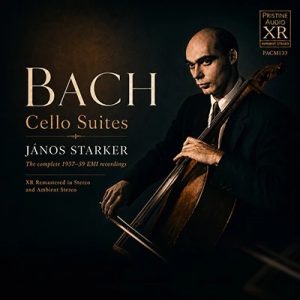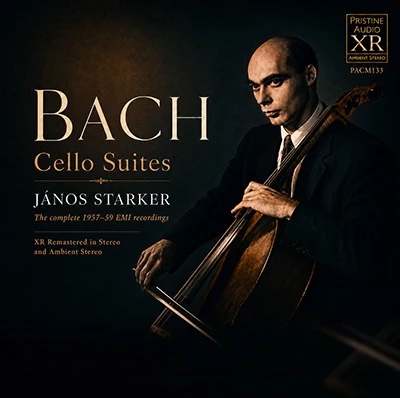
BACH: Cello Suites – Janos Starker, cello – Pristine Audio PACM 133 (2 CDS= 1:55:41) [www.pristineclassical.com] ****:
Hungarian cello virtuoso Janos Starker (1924-2013) recorded the Bach cello suites 1957-1959 for the Columbia label, received unbridled accolades, including the comment that Starker had reached “a level of technical polish and interpretative ease hitherto unattained.” I had met Janos starker in Atlanta, Georgia, as a result of my journalism coverage of the Atlanta Symphony, for which Starker’s step-daughter, Gwen Starker, served in the violin section. I had also cause to interview Starker for The Podium, the magazine of the Fritz Reiner Society. When I introduced myself to Starker, at the Fairmont Hotel, I announced that my subject was to be conductor Ferenc Fricsay (1914-1963), whom Starker had admired and with whom he had performed in concert and in recordings. “After WW II,” opened Starker, “we met in Budapest with a wealthy dowager who, in exalted terms, spoke of her sponsorship of the phoenix-like resurrection of Hungarian music from the ashes of war.” The actual results proved more modest.
It soon became obvious in conversation that Starker, despite his monumental reputation, would disagree with the attribution of a technical prowess “hitherto unattained.” His own model fo excellence had been and continued to be cellist Emanuel Feuermann (1902 –1942), who had died young because of medical malpractice. “Feuermann,” offered Starker, “represented the great departure from the Romantic tradition of Pablo Casals. True, Casals had imbued a new respect for the instrument, but his approach lacked the kind of directness and literacy Feuermann possessed. Though Feuermann did not, like Casals, record the six unaccompanied suite, he left instances from the set that reveal an ease and fluency of execution that still demand our marvel.”
From the outset of the G Major Suite, BWV 1007, the “Prelude,” the sureness of musical direction already enthralls us, the singular ambition of what Rachmaninoff terms “the point.” The “Allemande” establishes Starker’s meditative lyricism, a trait that becomes consistently spectacular in all of Bach’s sarabandes. If music is “the sound between the notes,” then Starker utters some deep truths as we progress through the series. The “Courante” reveals how dance movements retain their jaunty exhilaration, acerbic wit, and flexible spontaneity, even while maintaining a solid pulse. This first “Sarabande” moves from the depths in a song of tragic wisdom, but its floating affect defies gravity. Expressivity and finesse combine for the two “Menuets” and the final “Gigue,” clean, clear, chiseled in soft marble. Thus, we have the template for the succeeding five suites, from which each auditor may select his personal icon, well aware that the next traversal may give rise to new elegantly chromatic. paragons.
Cello Suite No. 3 in C Major, BWV 1009 offers a sweeping, richly intoned “Prelude,” elegantly chromatic and double-stopped. “Allemande” proceeds as a stodgy dance, carefully heavy but a mite mischievous. The resonance of the execution, aided by Pristine’s XR process, basks in a richly luxurious sound world. Starker whistles through the “Courante” with breathless energy, a single, nuanced gesture. “Sarabande” presents a refined pause, a sacred space. We lack only incense. That this suite has two Bourrées argues for a French taste, totally imbibed by Starker. Gusto and flamboyant energy mark the Gigue, bustling with earthy pleasure.
An unearthly vibrancy marks the lengthy “Prelude” of Suite No. 4 in E-flat Major, BWV 1010, rife with concentrated passion. Starker’s deep tones seem to protest against all weltschmerz. The “Allemande” feels more relaxed, even whimsical, in contrast. Starker’s 1725 Stradivari instrument has rarely sung in such glorious resonance. “Courante” seems a busy, thickly harmonized affair, acerbic in its punctuations and throaty slides. The “Sarabande” offers a sincere, meditative plaint whose intervals vibrate with longing. Once more, the Auvergne influence appears in two Bourrées of resolute, rhythmic vitality. The concluding “Gigue” offers a moto perpetuo requiring technique and stamina. Starker’s wrist action demands our awe.
Connoisseurs of the Bach cello suites cherish numbers 2 and 5 as the plums of the set. The “Prelude” of the Suite No. 5 in C Minor, BWV 1011 stands as its own monument to Bach’s “craft and sullen art.” Much like an extended sarabande, it proffers a dialogue for the solo instrument, laden with the pain and mystery of the world. A polyphonic dance emerges from the welter of dark emotions, perhaps equally somber but somehow liberated and free to “sing in its chains like the sea.” Starker’s “Allemande” groans in its augmented, scordatura tuning then soars in dire lamentation, an orison of Paradise Lost. “The “Courante” appears no less a “hard-won resolution,” urging itself forward as if sullenly resisting having been anchored to a lonely place. “Sarabande” concentrates its sorrow into a small space, its stealthy parlando seeming to waft upon a lonely isle. The “antiquity” of the occasion emerges in two “Gavottes,” the first of militant temper, stridently urgent. The second mutters more intimately, restrained and self-absorbed. The resolute sensibility returns as the da capo, even more fierce in its advocacy of resistance. “Gigue” does little to alleviate the existential gloom, but the cello sings to spite the world.
The last of the immortal set, No. 6 in D Minor, BWV 1012, opens with a punishing, aggressive “Prelude” that wants to defy the limits of the instrument itself. Its ostinati convey an intensity that Atlas himself could hardly bear. Conceived for a 5-string instrument, the demand to enclose the panorama of emotions in four strings sets a Herculean task before Starker which he assumes with fervor. Extremely intimate, the “Allemande” sends its voice into the wilderness, and I doubt not that much of the music of Ernest Bloch responds to this call. The “Courante” revives our spirits, hustling its way in lofty, virtuosic, dance gestures. With the “Sarabande,” we find a degree of resignation to Fate, though sung, duet-like, in spiritual purity of motion. Two “Gavottes” follow, the first assertive in the grand manner, acerbically slick at every turn. The second proves more “courtly,” more refined. When the first returns, the opposition could be said to adumbrate Robert Schumann’s dual personalities, Florestan and Eusebius. “Gigue” has something heroically final in its bearing, a nobility and confidence that laughs and scorns to be diminished by Time.
—Gary Lemco