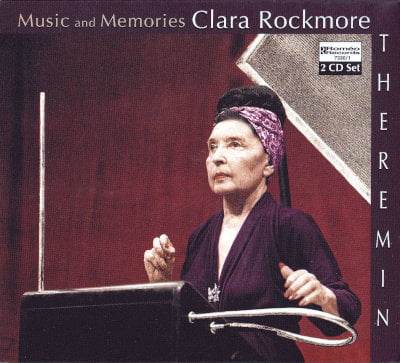
Music and Memories: Clara Rockmore = Lalo: Symphonie espagnole, Op. 21: Andante; BACH: Concerto for 2 Violins in D minor, BWV 1043: Largo, ma non tanto; FRANCK: Sonata in A Major for Violin and Piano; PONCE: Estrellita; RAVEL: Kaddish; RACHMANINOFF: “O Cease Thy Singing, Maiden Fair,” Op. 4, No. 4; Song of Grusia; GLINKA: “Doubt”; Elegy, “Do Not Tempt Me Needlessly”; SAINT-SAENS: The Swan – Clara Rockmore, theremin/ Morey Ritt, piano/ Nadia Reisenberg, piano/ Erick Friedman, violin/Robert Sherman, moderator/ John Corigliano, Jr., host/ David Garland, host/ Alexander Schneider, interviewer and commentator/ Leon Theremin, commentator – Romeo Records 7230/1 (2 CDs) 71:25; 71:25 [Distr. by Albany] *****:
Clara Rockmore (1911-1998) had been a violin prodigy who become the greatest-ever virtuoso of the theremin, which had been invented in the 1920s in Russia by Leon Theremin, and popularized in the U.S. in the 1930s by RCA Victor, who made a tubed model. Rockmore had retired from the concert stage but had impromptu gatherings at her 57th street apartment. In 1975 Robert Moog repaired her ailing theremin and then supervised the recording session that created the theremin albums on Delos and Bridge. Four years later came several broadcasts on WQXR, particularly “The Listening Room,” hosted by Rockmore’s nephew Robert Sherman. Several of the offerings of this collection had appeared prior in September 2013, and John Sunier reviewed the Romeo Recording.
Among the many charms of this set, besides several wondrous, historical photographs included in the 15-page booklet, we have a WQXR-FM broadcast of 14 February 1984, “Valentine to Vilna,” the Lithuanian birthplace of Rockmore and Alexander Schneider (1908-1993), legendary violinist of the Budapest String Quartet and more than occasional conductor. The ensuing verbal, picture post-card of Old World Lithuania as it presented both opportunities and obstacles for aspiring Jewish musicians proves fascinating listening. Both Rockmore and Schneider celebrate their fellow Vilja native, Jascha Heifetz, without reservation. Rockmore recalls even the young Heifetz in a performance of the Carmen Fantasy, with its grueling thirds. Like Heifetz, Rockmore had trained with Leopold Auer, who could be a harsh taskmaster, but especially for gifted students. Schneider compares Auer to Casals, who could praise mediocrity with “Beautiful!” and then tear into the truly promising with fury.
The Clara Rockmore WBAI interview with John Corigliano, Jr. (1962) discusses her discovery of the theremin, after having performed as a violinist, then after she abandoned the violin career. The theremin might meet the definition of a violin with only one string. The performer of the theremin enters the electronic field of the “pulpit,” and the person’s body affects the sound, and the artist’s hands have access to five octaves, all controlled by the height of the hand in relation to the antenna. Thus, any audience must keep away from the instrument and its electronic field, which Rockmore calls “inhospitable.” The right hand controls the “fingering,” while the left hand controls the volume. Rockmore had the ability to overcome the glissando and swooping propensity of the instrument to add hesitations and nuances, like staccatos. At the time of the interview, no theremins were being produced, so any prospective student of the instrument had no outlet, except to approach Clara Rockmore. Josef Hofmann, the great pianist, lent his mechanical expertise to amplify the sound and allow the performer’s hands visibility to the audience. Rockmore and Corigliano confirm that the theremin serves as a melodic, lyrical instrument, and it occupies a place in history among the first of the “electronic instruments.”
The interview with David Garland on WNYC’s “Spinning on Air” (12 September 1995) derives from a telephone conversation. Rockmore had never conceived the theremin as a creator of “effects,” but as melodic instrument for what its inventor, Leon Theremin, calls “real music.” Rockmore extended the instrument’s range and possibilities, using her expertise on the violin as a means of “bowing” of musical volume, and the resultant “vocal” sonorities come as a constant revelation. Delicacy, Rockmore insists, remains the key, that “less is more” when playing with air.
The tour de force occurs at the WQXR studio in New York, 4 January 1992, with the appearance of Professor Leon Theremin (1896-1993) and Clara Rockmore with host Robert Sherman. Later in the program Nadia Reisenberg and Erick Freidman join Rockmore for a soaring Rachmaninoff song from a 26 January 1979 taping. Historically, the big piece for the instrument, that created by RCA, came in the form of Rockmore’s playing Bloch’s Schelomo with the Philadelphia Orchestra, under Stokowski. That no recording of this collaboration exists remains a great pity. Concluding the program, we hear a marvelously affecting “The Swan” by Saint-Saens from that 1979 broadcast. How easy does it become to hear the theremin and think not of an imposing, bulky piece of mechanical equipment but of a soprano in the mold of Licia Albanese or Bidu Sayao, born to sing the aria from Bachianas Brasilieras No. 5.
From 1960 home tapes, the two gifted sisters, Nadia and Clara, perform, first, the slow movement of the Lalo Symphonie espagnole and the Bach Double Concerto, the latter enhanced through over-dubbing to produce the “second” theremin. Who of the older generation will not recall, while listening, the Heifetz recording for RCA in which he accompanied himself! The cantabile quality endures even into the highest octave, as does the sheer virtuosity of the extended, sliding scales.
That we have Nadia Reisenberg in a complete Franck Violin Sonata in A Major (rec. 1960; 1977) – here with Clara Rockmore’s theremin in the violin part – provides warrant enough to acquire this uncanny set. At times, the throaty sound of the theremin resembles that of a viola or cello transcription of the piece, quite common today. Neither player stints on the velocity and passionate expression in the piece, particularly in the second movement Allegro. In the Sonata’s most lyrical moments, we hear what Robert Moog called Rockmore’s “riding the silken edge of feedback.” The music often assumes the power of an unbroken vocalise with richly evocative piano accompaniment.
The last half hour of Side One gives us “Nadia Reisenberg – A Joyful Remembrance” from 28 September 1989 from Merkin Concert Hall, New York City. Robert Sherman moderates and introduces Clara Rockmore “back in action” as Nadia Reisenberg’s first musical collaborator, serving in her capacity as violinist. Here, pianist Morey Ritt – a Nadia Reisenberg student – joins Clara for the piece that proved the final work in her duo work with Nadia, the Ponce Estrellita. The Kaddish of Maurice Ravel – again with Morey Ritt – represents a piece Nadia and Clara performed in private, and its overt appeal to a Hebrew sensibility loses nothing in its theremin vocalism. The Rachmaninoff “Song of Grusia” serves as an encore. The song had been Nadia’s favorite.
Alexander Schneider provides the piece de resistance, recounting his playing in a movie theater in 1920 Vilna with Nadia Reisenberg and Clara Rockmore. Movie music demanded immediate improvisation, according to the emotions on the screen. “Playing from the heart demanded we all be as quiet as possible.” Nadia also played with the Budapest String Quartet, “the most important ingredient’s being the phrasing.” Otherwise, admonishes Schneider, “it’s just notes, music without music.”
—Gary Lemco