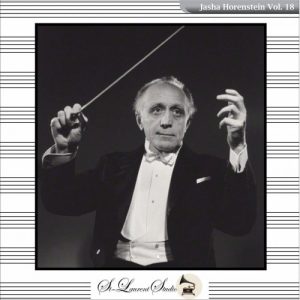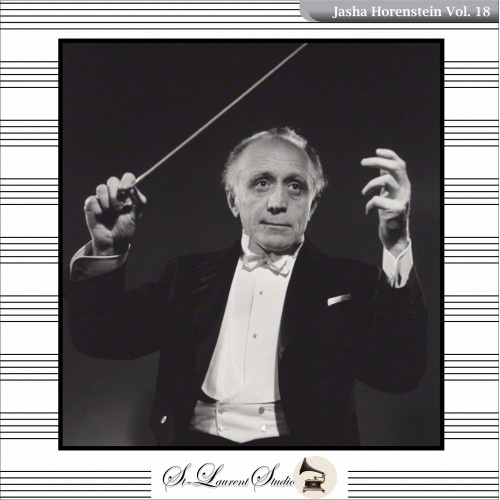
Jascha Horenstein Vol. 18 = SPITZMÜLLER: 3 Hymns to Peace; BEETHOVEN: Egmont Overture; MOZART: Violin Concerto No. 3 ; HINDEMITH: Mathis der Maler “Symphony”; STRAVINSKY: Firebird Suite – André Gertler, violin/ Orchestre Radio Symphonique/ Jascha Horenstein – Yves St-Laurent YSL T-1808 (2 CDs = 47:00; 51:00) [www.78experience.com] ****:
The rich and varied legacy of conductor Jascha Horenstein (1898-1973) receives more additions from two concerts arranged by Yves St-Laurent, those of 13 November 1950 (Spitzmüller) and 27 May 1954, both recorded in Paris. Born in 1894, composer Alexander Spitzmüeller began writing in a neo-Classical style, but he soon found the serial innovators Schoenberg, Berg, and Webern more to his taste. Horenstein’s selection, Trois Hymnes à la Paix, Op. 27 (1947), is listed by St-Laurent with the premiere cited as 1943. Created amidst the throes of WW II, the composer proffers a humanitarian message for global reconciliation.
The first of Spitzmüller’sTrois Hymnes is labelled “Magnificat,” and it resonates lyrically as a large serenade for string orchestra, until the percussion enters and invites the brass. The texture becomes thick and somewhat cacophonous, busy with interior canons and passing dissonances, fanfares, and acerbic clashes of the cymbals. The piece culminates in a pungent fortissimo on an open cadence. The second movement, “Prayer,” feels darkly contempletive, early allowing passing, canonic dissonances that resemble Bartok. The texture softens with the presence of flute, strings, cymbals, and harp, the whole’s having become romantic in spirit.
A new, meandering melodic line appears, gathering dynamic force and stringent harmonies. The brass enter, again asserting a loose fanfare in staccato figures and then sustained chords supported by trilled strings and percussion. The fanfare has turned ominous and disturbed, but it dissolves abruptly, to make room for the third Hymn, entitled Frénésie (frenzy). The opening measures prove militant in dotted rhythm, a preparation for battle, with striking pizzicatos in the strings and a busy batter section and brass. The ferocity continues until the string line offers some relief, but to no avail, the crashes victorious.
From 1809-1810 Beethoven occupied himself with Goethe’s theatrical narrative of the Belgian nobleman Count Egmont, who involved himself in the Dutch defense against Spanish rule in the Netherlands, only to suffer execution in Brussels in 1568. His death incited a popular uprising that eventually liberated his country. For Beethoven, the political and spiritual parallels fed his imaginative hostility to Napoleon’s ambitions of dictatorship. The Overture, set in a fateful F minor, opens with dire, pungent chords that resolve into woodwind meditations answered by low strings that the brass soon augment.
A mounting turmoil sets forth, Allegro, punctuated by the tympani, and a kind of whirlwind ensues. Horenstein achieves a titanic momentum, interrupted by a five-note motto and its resonant answer tutti, in syncopations. Egmont dies, but there arises a chorale that inspires defiance in F major, a torrent of rebellion that dispels all tyrannies. Goethe exclaimed that Beethoven caught his intent “with remarkable genius,” as the trumpets and high piccolo carry us to the frenetic coda.
For the performance of Mozart’s youthful Violin Concerto No. 3 in G Major (1775), Horenstein has the gifted assistance of Hungarian violinist André Gertler (1907-1998), who had made his home in Belgium in 1928, where he taught at the Royal Academy and founded his Gertler String Quartet. The G Major Concerto by Mozart stands, along with the fourth and fifth concertos, as his most virtuosic and gratifying works in the medium, likely the first great violin concerto in the repertory, originally conceived for the virtuoso Brunetti but for which Mozart himself proved a capable interpreter himself.
The vibrant immediacy of all three movements, the second an Adagio accompanied by muted strings, enjoys a long, spacious melody, virtually an opera aria. Each of the movements possesses an impressive, ornate cadenza for Gertler. The opening movement Allegro bustles with bright energy, often in fanfare style, featuring bright colloquy between Gertler and the tutti. Oboe and violin, especially, enjoy a fluent rapport. Gertler’s cadenza contribution, daring and startling, extends well over several minutes of breathtaking eloquence.
The Adagio retains something of the galant style, but its nobility of expression well hints at Mozart’s latent Romanticism, particularly the use of upper strings in triplets. Horenstein’s wind players exert alert, precise intonation and warm response of the oboes in pairs. Gertler once more introduces passing dissonances that defy the Mozart style, but his execution and focus win the day.
The last movement yields to Mozart’s canny grasp of folk idioms, the music a Rondeau (Allegro) in 3/8. Horns and winds remain prominent, gaining more status as the music progresses. A sudden shift into 2/2 G minor adds a touch of operatic drama to the context, the strings galantly pizzicato. Then, the music bursts forth into G major, stating verbatim a Hungarian tune. Gertler adds color touches to the last statement of the ritornello theme, and the whole ends, sans cadenza, with the zest of unbuttoned whimsy.
In 2010, I reviewed this identical performance (on Doremi) of Hindemith’s 1934 symphony version of his opera Mathis der Maler, and here, in the St-Laurent product, the sound is exemplary. I quote myself:
“…almost like Stokowski – Horenstein exacts a wondrously homogeneous tone from his French ensemble, athletic as it is finely-honed and internally colorful. The Angelic Concert moves with a muscular elasticity we might mistake for a performance by Cantelli from around the same period, except the clear, layered sound hearkens to Stokowski. The audience cannot help but applaud at the last chord.
“Deep purple, burnt gold, and black browns for the Entombment scene, which Hindemith converted into a tableau by Rembrandt. Horenstein’s reading of The Temptation of St. Anthony remains the broadest I know, yet its inner conflict moves with sinewy velocity, insistent and ominous in spite of whatever optimism lies as the basis of its creed. The pungency of the wind and brass choirs – and later, the inverted pedal in the high strings – makes us wish Horenstein had recorded music by Charles Ives.”
Horenstein concludes with the 1919 suite adapted from the 1911 The Firebird, Stravinsky’s musical homage to Russian legend and to his teacher Rimsky-Korsakov and his octatonic, half-step scales. From the low rumblings of the strings, their subsequent slides, and the intonations of the brass, the Paris ensemble invokes the magic of the score, a tale of Prince Ivan’s pursuit of a fabulous bird which inhabits a tree of golden apples. The Danse de l’Oiseau de feu has all the vivid, alluring orchestral elements we desire, here in glorious Technicolor. Flute, oboe, viola, horn, harp and strings invoke the sultry Rondes des Princesses with their implied promise of love.
The succeeding Danse infernale de roi Kachchei provides the requisite moment of syncopated terror, laced with sulphur, marked by brilliant trombone slides and screeching szofzati in the strings. The enchanting, even erotic, Berceuse proffers the bassoon’s version of a lullaby over muted strings and harp. The lulling 3/2 meter of the Final (the wedding of Ivan and the Princess) evolves, from the famed (and here, a bit nervous) French horn motif among trembling strings — via an equally famous harp glissando — into a broad canvas whose meter becomes asymmetrical in 7/4 and assumes a glowing apotheosis worthy of Stravinsky’s other idol, Tchaikovsky.
-–Gary Lemco
Jascha Horenstein Vol. 18 =
SPITZMÜLLER: 3 Hymns to Peace;
BEETHOVEN: Egmont Overture, Op. 84;
MOZART: Violin Concerto No. 3 in G Major, K. 216;
HINDEMITH: Mathis der Maler “Symphony”;
STRAVINSKY: Firebird Suite –
André Gertler, violin/
Orchestre Radio Symphonique/