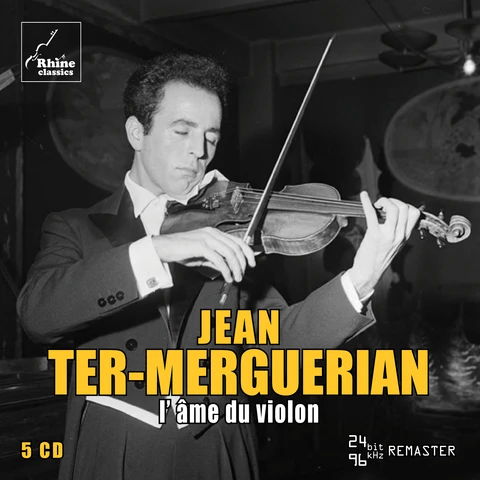
Jean Ter-Merguerian: The Soul of the Violin = Collected Recordings – Rhine Classics RH-016 (5 CDs) 74:14; 73:05; 67:27; 74:35; 79:12 (Complete contents and collaborative artists below) [RhineClassics.com] *****:
French-Armenian violin virtuoso Jean Ter-Merguerian (1935-2015) had been unknown to me prior to this Rhine Classics issue by the devoted producer Emilio Pessina, but those days are over! Testimony as to his innate musical mastery comes from such luminaries as Zino Francescatti, Henryk Szeryng – among the judges at 1961 Ninth Long-Thibaud Competition in 1961 – Christian Ferras, and Mstislav Rostropovich, who had asserted, “Merguerian possesses the most perfect bow technique in all the world, of all stringed instruments combined.” In these recordings, Merguerian plays instruments fashioned by Amati, Stradivarius, and Guarneri, the Stradivarius on loan from the Moscow Conservatory.
A student of Karp Dombayev and David Oistrakh, Mr. Ter-Merguerian was a former prize winner at the 1958 Tchaikovsky, 1963 Queen Elisabeth and 1961 Long-Thibaud International Violin Competitions. He served a long-term teaching position at the Yerevan Komitas State Conservatory. The Amati instrument Merguerian plays in these concertos projects a fiercely burnished tone, a rival to the “digging” quality we hear in the possessed interpretations we know from such explosive violinists as Bustabo, Rosand, Senofsky, and Spivakovsky. These remarks do not detract from the sheer beauty of tone Merguerian elicits in the second movements of the large works proffered here: the marvelous Brahms Concerto from Boston, 1975 and the Beethoven “Triple” Concerto from Marseille, 1983.
The Brahms appearance (13 June 1975) marks Merguerian’s debut in the United States, and to characterize the Boston audience response as “enthusiastic” hardly captures the mood of the occasion. The piano playing of Pierre Barbizet (1922-1990) – better known as the faithful accompanist of violinist Christian Ferras – gathers up a controlled storm in the blistering Rondo alla polacca finale of the Beethoven (30 July 1983), Philippe Bender conducting.
Certainly, the more intimate aspects of Merguerian’s artistry emerge in the various duo recitals; and among the foremost, that with Monique Oberdoerfer (20 February 1982) at the Imperial Theatre, Carcasonne, reveals a special sense of ensemble. Their Brahms “Rain” Sonata communicates both a plastic inwardness and intense passion commensurate with the Brahms who saw himself as his master, Schumann’s, disciple. Oberdoerfer’s slow parlando that opens the Adagio seems wrought from the same impulse that dominates many of the late piano works, Op. 116. The contoured, legato lines of the last movement warrant comparisons to the masters of this idiom: Oistrakh, Francescatti, Heifetz, and Szigeti.
For a compendium Ter-Merguerian’s sublime control of violin effects, few works suffice with such a grand scale as the Chaconne from Bach’s Partita in D Minor, which adds to the challenges an emphasis on articulation and stamina of contrapuntal line. (In miniature, the same effects – with French accents – appear in the vital, compressed solo 1923 Ballade of Eugene Ysaye, given to us in Marseille in 1998.) The attractions of galant charm do not evade Ter-Merguerian’s silken approach in the Mozart 1779 B-flat Sonata, K. 378, whose fanciful textures divide themselves equally to the two instrumentalists in movement one. Oberdoerfer’s keyboard reigns in the Andantino sostenuto e cantabile, while the last movement, Rondeau: Allegro projects a French affect that passes through G Minor on its way to a hint of opera buffa and our violinist’s concluding pizzicato chords. The cantabile accorded this entire reading makes it a divine moment in the Mozart style. The recital concludes with three bravura pieces: the enchanted Saint-Saens Havanaise in E and a Spanish dance and Caprice basque from the fiendishly clever Pablo de Sarasate, all of which Ter-Merguerian delivers with that easy, seamless panache that we have known from the likes of Heifetz and Ricci. Sarasate (played on a Guarneri violin) returns in Ter-Merguerian’s Armenian recordings from Yerevan, 1968-1971, with two more deliciously “throaty” Spanish dances, accompanied by Nelli Daniel-Beck.
The music of Beethoven figures significantly in Ter-Merguerian’s history, and these discs capture him in three, full sonatas recorded live from the Church of the Sacred Heart, Marseilles (28 June 1985) with Pierre Barbizet, whom we recall served as director at the Marseilles Conservatory. Their “colloquy of reciprocal enrichment,” to cite Louis Biancolli, maintains the tonal and textural parity of the instruments and a blended, graded sonority. In the D Major Sonata, the measured fluency of the Tema con variazioni second movement leads to a buoyant Rondo whose humor exerts itself in this spirited collaboration. The light air of Op. 12, No. 1 yield to a relentless, solemn and passionate drama in the C Minor Sonata, Op. 30, No. 2 of 1802. Besides the dark tone of the opening subject of the Allegro con brio, the secondary theme in E-flat exerts a martial impulse. After a wafted, ethereal Adagio cantabile, Ter-Merguerian and Barbizet inflect a coarse, biting wit into the Scherzo, followed by a Finale whose C Minor, driving depths foretell of a later, “fateful” symphony.
The triptych of full works concludes with the eternally potent “Kreutzer” Sonata, which retains its imposing girth while emanating a decided sense of intimate melancholy and passion, a rare mix. The technical demands made on Ter-Merguerian, having to execute triple and quadruple stops over three strings or four, mean little except as modes of demonic, even symphonic, expression. Not since the Nathan Milstein union with Artur Balsam have I heard such single-minded and pointed articulation to what Rachmaninoff called “the point.” The Andante con variazioni, the longest movement in the Beethoven violin canon, projects an elegant leisure and unbroken continuity of line. The last movement, Finale: Presto, we have long appreciated as a grueling tarantella whose figures gallop and hustle with electric abandon from these inspired players. As a bracing encore, the touching, rarified Adagio molto espressivo from the F Major “Spring” Sonata breathes a relaxing, fresh air into a church packed with worshippers.
The Beethoven readings “conclude” with the 27 June 1961 appearance (taken from a monaural video tape) by Ter-Merguerian at the 9th Long-Thibaud Competition in the last movement, Rondo: Allegro, of the Beethoven D Major Concerto under Louis Fourestier. The hunting motif appears after a brief Joachim cadenza transition, and the wonderful Stradivarius reveals its lowest string. The secondary theme in minor has a bassoon to accompany the sweet lyric from Ter-Merguerian. Even the appearance of the main tune in E-flat Major after a second cadenza seems a sweet surprise. The gentle sway of the return to a landed D Major casts both soloist and conductor Fourestier into a bath of audience appreciation, followed, in French, by a three-minute interview with Ter-Merguerian and jurist Henryk Szeryng, mostly on the distinction of the Long-Thibaud Competition as a standard of French performance art.
The remainder of this generous sampling of Maestro Ter-Merguerian’s art derives from people and music Armenian, composers or their interpreters: first, a bristling, heart-pounding rendition of the 1940 Khachaturian Violin Concerto in D Minor (1964) with the Armenian Philharmonic under Michael Maluntsian, a reading worthy of the music’s dedicatee, David Oistrakh, and here realized in full, dexterous awareness by his admirable pupil. Ter-Merguerian’s Guarnerius instrument seems alternately made of buzz-saw material, brushed denim, or spun silk. The high character of its energy, exotically colored lyricism, and pounding rhythms will convince anyone of its innate merits as both a showpiece and a thriving contribution to the repertory. Ter-Merguerian joins Yerevan-born, pianist-composer Gerard Gasparian (b. 1960) in two distinct performances, respectively, from Victoria Hall, Geneva (19 November 1998) and a studio in Paris (1999): in Mozart’s C Major Violin Sonata, K. 296, which often restrains the violin part; but, when Ter-Merguerian’s Amati cuts loose, as in the middle of the Andante sostenuto, the music soars infectiously, despite distant, boxy acoustics from a video tape. Gasparian the composer – often praised for a “romanticism, giving enthusiasm and passion. . .in pieces that indulge in dreams” – has his Sonate for Violon et Piano (1990), taken from a recording originally on the Timpani label, 2001. The opening Andantino has a wavy, modal motion in dark hues; an angular, brief Valse follows with some delicate moves in the keyboard; the Lento, the most extensive movement, owes (contrapuntal) debts to Enescu and Ravel, and maybe Lipatti; The Scherzo et Finale exerts a more virtuosic tenor not so far from sprightly Bartok, in which both principals indulge in bravura. Effective music worth a re-hearing.
The aforementioned items in collaboration in Yerevan with pianist Nelli Daniel-Beck (1968-1971) include a regional Dance in B-flat, Op. 1 by Khachaturian, and his ever-sweet Ayshe’s Dance as arranged by Mikhael Fikhtengolis. Ter-Merguerian makes one concession to Jascha Heifetz, in the pert Masks from the Suite from Romeo and Juliet. All of these miniatures stand comparison with the equally rich and incisive documents from Leonid Kogan. Finally, music – 3 Armenian Songs – from Komitas, nee Soghomon Soghomonian (1869-1935), a priest and composer generally regarded as the founder of the Armenian national musical style. “Ah, dear Maral” (arr. Aram Shamshyan) proves a lovely plaint shared by both violin and piano, in a most Mendelssohnian style. “Striding, beaming” (arr. Shamshyan), exotically modal, proceeds in small steps to a fine, lyric outpouring. “The Crane” features our splendid Ter-Merguerian solo, here in a rich meditation whose opening makes us wish to hear him in Ravel’s Tzigane.
That these song transcriptions are not better known mystifies me – but that has been no less true for Ter-Merguerian’s repute as well, a situation that the Rhine Classics label has remedied with a superior justice!
Jean Ter-Merguerian: The Soul of the Violin
BRAHMS: Violin Concerto in D Major, Op. 77;
BEETHOVEN: “Triple” Concerto in C Major, Op. 56
BRAHMS: Violin Sonata No. 1 in G Major, Op. 78
BACH: Chaconne from Partita No. 2 in D minor, BWV 1004
MOZART: Violin Sonata No. 26 in B-flat Major, K. 378
SAINT-SAENS: Havanaise in E Major, Op. 83
SARASATE: Playera, Op. 23, No. 1; Caprice basque, Op. 24
SARASATE: Habanera, Op. 21, No. 2; Romanza Andalusa, Op. 22, No. 1
YSAYE: Solo Sonata No. 3 in D Minor, Op. 27 “Ballade”
BEETHOVEN: Violin Sonatas 1, 2, 5, 7, 9
BEETHOVEN: Violin Concerto: Rondo: Allegro
MOZART: Violin Sonata No. 17 in C Major, K. 296
GASPARIAN: Sonata for Violin and Piano
KHACHATURIAN: Violin Concerto in D Minor; Dance in B-flat Major, Op. 1; Ayshe’s Dance from Gayane Ballet
PROKOFIEV (arr. Heifetz): Masks from Romeo and Juliet
KOMITAS: 3 Armenian Songs
Collaborative Artists:
Monique Oberdoerfer, piano/ Pierre Barbizet, piano/ Gerard Gasprian, piano/ Yvan Chiffolea, cello/ Nelli Daniel-Beck, piano/ Boston Pops Orchestra/ Arthur Fiedler/ Orchestre de Cannes-Provence-Cote d’Azur/ Philippe Bender/ Orchestre National de la RTF/ Louis Forestier/ Armenian Philharmonic Orchestra/ Michael Maluntsian/ Henryk Szeryng, interviewer (27 June 1961)
–Gary Lemco
For more information, please visit Rhine Classics website: